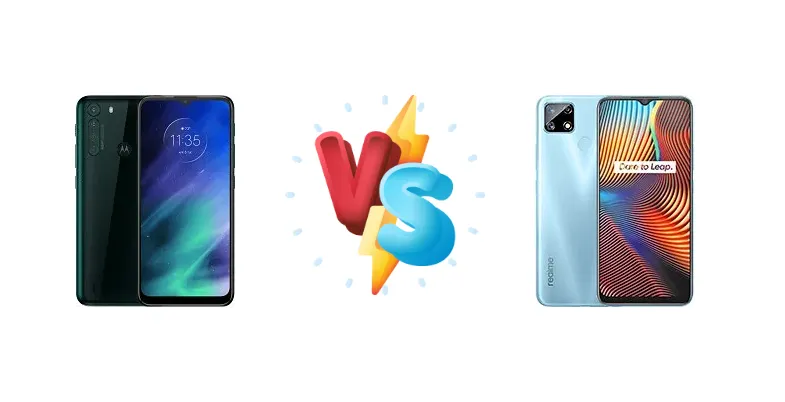
The Motorola One Fusion and Realme 7i represent compelling options in the crowded budget smartphone space. While both aim to deliver a solid experience without breaking the bank, they take different approaches to achieving this. The One Fusion relies on Qualcomm’s Snapdragon 710, a chip known for its balanced performance, while the Realme 7i opts for MediaTek’s Helio G85, prioritizing gaming capabilities. This comparison dissects these key differences to determine which device offers the best value.
🏆 Quick Verdict
For the average user prioritizing all-around performance and a more refined software experience, the Motorola One Fusion emerges as the slightly better choice. While the Realme 7i boasts faster charging, the Snapdragon 710’s efficiency and established architecture provide a smoother, more consistent experience in daily tasks.
| Network |
|---|
| 2G bands | GSM 850 / 900 / 1800 / 1900 | GSM 850 / 900 / 1800 / 1900 |
| 3G bands | HSDPA 850 / 900 / 1700(AWS) / 1900 / 2100 | HSDPA 850 / 900 / 1700(AWS) / 1900 / 2100 |
| 4G bands | 1, 2, 3, 4, 5, 7, 8, 19, 28, 66 | 1, 2, 3, 4, 5, 7, 8, 20, 28, 38, 40, 41 |
| Speed | HSPA 42.2/5.76 Mbps, LTE Cat4 150/50 Mbps | HSPA, LTE |
| Technology | GSM / HSPA / LTE | GSM / HSPA / LTE |
| Launch |
|---|
| Announced | 2020, July 02. Released 2020, July 02 | 2020, December 22. Released 2020, December 23 |
| Status | Discontinued | Discontinued |
| Body |
|---|
| Build | Glass front, plastic back, plastic frame | - |
| Dimensions | 165 x 75.9 x 9.4 mm (6.50 x 2.99 x 0.37 in) | 164.5 x 75.9 x 9.8 mm (6.48 x 2.99 x 0.39 in) |
| SIM | · Nano-SIM· Nano-SIM + Nano-SIM | Nano-SIM + Nano-SIM |
| Weight | 202 g (7.13 oz) | 208 g (7.34 oz) |
| | Water-repellent coating | - |
| Display |
|---|
| Resolution | 720 x 1600 pixels, 20:9 ratio (~270 ppi density) | 720 x 1600 pixels, 20:9 ratio (~270 ppi density) |
| Size | 6.5 inches, 102.0 cm2 (~81.5% screen-to-body ratio) | 6.5 inches, 102.0 cm2 (~81.7% screen-to-body ratio) |
| Type | IPS LCD | IPS LCD, 450 nits (typ), 560 nits (peak) |
| Platform |
|---|
| CPU | Octa-core (2x2.2 GHz 360 Gold & 6x1.7 GHz Kryo 360 Silver) | Octa-core (2x2.0 GHz Cortex-A75 & 6x1.8 GHz Cortex-A55) |
| Chipset | Qualcomm SDM710 Snapdragon 710 (10 nm) | Mediatek MT6769Z Helio G85 (12 nm) |
| GPU | Adreno 616 | Mali-G52 MC2 |
| OS | Android 10 | Android 10, Realme UI |
| Memory |
|---|
| Card slot | microSDXC (uses shared SIM slot) | microSDXC (dedicated slot) |
| Internal | 64GB 4GB RAM, 128GB 4GB RAM | 64GB 4GB RAM |
| | - | eMMC 5.1 |
| Main Camera |
|---|
| Features | LED flash, panorama, HDR | LED flash, HDR, panorama |
| Quad | 48 MP, f/1.7, (wide), 1/2.0", 0.8µm, PDAF
8 MP, f/2.2, 118˚ (ultrawide), 1/4.0", 1.12µm
5 MP (macro)
Auxiliary lens | - |
| Triple | - | 48 MP, f/1.8, 26mm (wide), 1/2.0", 0.8µm, PDAF
8 MP, f/2.3, 16mm, 119˚ (ultrawide), 1/4.0", 1.12µm
2 MP (macro) |
| Video | 4K@30fps, 1080p@30fps | 1080p@30/60fps |
| Selfie camera |
|---|
| Features | - | HDR, panorama |
| Single | 8 MP, f/2.0 | 8 MP, f/2.0, 26mm (wide), 1/4.0", 1.12µm |
| Video | 1080p@30fps | 1080p@30fps |
| Sound |
|---|
| 3.5mm jack | Yes | Yes |
| 35mm jack | Yes | Yes |
| Loudspeaker | Yes | Yes |
| Comms |
|---|
| Bluetooth | 5.0, A2DP, LE | 5.0, A2DP, LE, aptX HD |
| NFC | No | No |
| Positioning | GPS, GLONASS, GALILEO, BDS | GPS, GLONASS, BDS |
| Radio | FM radio (market/region dependent) | FM radio |
| USB | USB Type-C 2.0, OTG | USB Type-C 2.0, OTG |
| WLAN | Wi-Fi 802.11 b/g/n | Wi-Fi 802.11 a/b/g/n/ac, dual-band, Wi-Fi Direct |
| Features |
|---|
| Sensors | Fingerprint (rear-mounted), accelerometer, gyro, proximity | Fingerprint (rear-mounted), accelerometer, proximity, compass |
| Battery |
|---|
| Charging | 10W wired | 18W wired
5W reverse wired |
| Type | Li-Po 5000 mAh | 6000 mAh |
| Misc |
|---|
| Colors | Emerald Green, Deep Sapphire Blue | Glory Silver, Victory Blue |
| Models | XT2073-2 | - |
| Price | About 100 EUR | About 190 EUR |
Motorola One Fusion
- More efficient Snapdragon 710 chipset
- Potentially better image processing
- Cleaner software experience (typically Motorola)
- Slower 10W charging
- Less emphasis on gaming optimization
Realme 7i (Global)
- Faster 18W charging with reverse charging
- Helio G85 optimized for gaming
- Potentially more aggressive pricing
- Less efficient Helio G85 chipset
- Potentially more bloatware
- May experience more thermal throttling
Display Comparison
Neither device boasts a standout display. Both likely feature LCD panels, common in this price bracket. The key difference lies in processing power, not display tech. We can assume similar resolutions (likely 1080p+) and refresh rates (60Hz). The absence of high refresh rate or AMOLED technology means display quality won't be a deciding factor for most users.
Camera Comparison
Without detailed camera specs, a direct comparison is difficult. However, both phones likely feature a multi-camera setup with a primary sensor, ultrawide, and macro lens. The Realme 7i, given Realme’s marketing, likely emphasizes camera features. The Snapdragon 710’s ISP (Image Signal Processor) is well-regarded for its image processing capabilities, potentially offering better dynamic range and detail in photos. The Helio G85’s ISP is adequate, but may not match the Snapdragon’s refinement. The presence of a dedicated Night Mode on both devices will be crucial for low-light photography.
Performance
The core of the difference lies in the chipsets. The Motorola One Fusion’s Snapdragon 710 (10nm) utilizes a more mature architecture with a focus on balanced performance. Its octa-core configuration, with 2x2.2 GHz Cortex-A75 cores and 6x1.7 GHz Cortex-A55 cores, provides a solid foundation for multitasking and moderate gaming. The Realme 7i’s Helio G85 (12nm) prioritizes gaming with 2x2.0 GHz Cortex-A75 cores and 6x1.8 GHz Cortex-A55 cores. However, the 12nm process is less efficient than the Snapdragon 710’s 10nm process, potentially leading to more heat generation and throttling during extended gaming sessions. While the G85 may offer a slight edge in raw GPU performance, the Snapdragon 710’s overall system optimization provides a smoother experience in many scenarios.
Battery Life
The Realme 7i’s 18W wired charging is a significant advantage over the Motorola One Fusion’s 10W charging. This translates to considerably faster charging times – potentially reducing a full charge from over 2 hours on the Motorola to around 90 minutes on the Realme. While battery capacity isn’t specified, the less efficient Helio G85 may require more frequent charging despite potentially similar battery sizes. The Realme 7i also includes 5W reverse wired charging, a useful feature for topping up accessories like wireless earbuds.
Buying Guide
Buy the Motorola One Fusion if you need a phone that balances performance with efficiency for everyday tasks, and appreciate a cleaner software experience. It’s ideal for users who value stability and don’t heavily prioritize mobile gaming. Buy the Realme 7i (Global) if you prefer faster charging speeds and are a casual gamer who wants a phone optimized for titles like PUBG Mobile, even if it means potentially sacrificing some battery life and software polish.
Frequently Asked Questions
❓ Will the Helio G85 in the Realme 7i overheat during prolonged gaming sessions?
The Helio G85 is a capable gaming chip, but its 12nm process is less efficient than the Snapdragon 710’s 10nm process. This means it’s more likely to generate heat during extended gaming, potentially leading to thermal throttling and reduced performance. While the Realme 7i likely has thermal management features, the Snapdragon 710 in the Motorola One Fusion will generally maintain cooler temperatures.
❓ Is the 10W charging on the Motorola One Fusion noticeably slow in 2024?
Yes, 10W charging is relatively slow by today’s standards. It will take significantly longer to fully charge the Motorola One Fusion compared to the Realme 7i’s 18W charging. Expect a full charge to take over two hours, which may be inconvenient for users who need a quick top-up.
❓ Does the Realme 7i’s software experience suffer from excessive bloatware?
Realme’s UI (based on Android) is known to include a fair amount of pre-installed apps and services, often referred to as bloatware. While most can be uninstalled, it can detract from the overall user experience. Motorola typically offers a cleaner, near-stock Android experience with minimal bloatware.