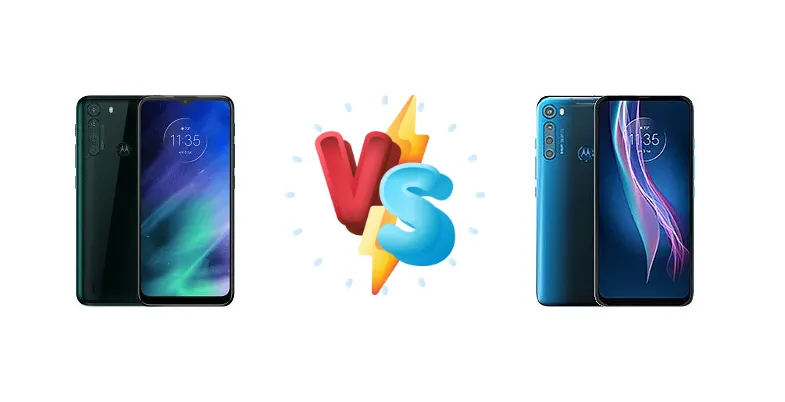
Motorola's One series offers compelling budget-friendly smartphones. The One Fusion and One Fusion+ both aim to deliver great value, but they have key differences. This comprehensive comparison will break down the specs, performance, and features to help you decide which phone is the best fit for your needs.
🏆 Quick Verdict
The Motorola One Fusion+ is the clear winner, offering a brighter display, faster chipset, improved camera, and quicker charging. While the Fusion is more affordable, the Fusion+'s upgrades make it a worthwhile investment for most users seeking a reliable and feature-rich Android experience.
| Network |
|---|
| 2G bands | GSM 850 / 900 / 1800 / 1900 | GSM 850 / 900 / 1800 / 1900 |
| 3G bands | HSDPA 850 / 900 / 1700(AWS) / 1900 / 2100 | HSDPA 800 / 850 / 900 / 1900 / 2100 International |
| 4G bands | 1, 2, 3, 4, 5, 7, 8, 19, 28, 66 | 1, 2, 3, 5, 7, 8, 19, 20, 38, 40, 41 - Europe, India |
| Speed | HSPA 42.2/5.76 Mbps, LTE Cat4 150/50 Mbps | HSPA 42.2/5.76 Mbps, LTE Cat4 150/50 Mbps |
| Technology | GSM / HSPA / LTE | GSM / HSPA / LTE |
| | - | 1, 2, 3, 5, 7, 8, 19, 20, 28, 38, 40, 41 - APEM |
| Launch |
|---|
| Announced | 2020, July 02. Released 2020, July 02 | 2020, June 08. Released 2020, June 08 |
| Status | Discontinued | Discontinued |
| Body |
|---|
| Build | Glass front, plastic back, plastic frame | Glass front, plastic back, plastic frame |
| Dimensions | 165 x 75.9 x 9.4 mm (6.50 x 2.99 x 0.37 in) | 162.9 x 76.4 x 9.6 mm (6.41 x 3.01 x 0.38 in) |
| SIM | · Nano-SIM· Nano-SIM + Nano-SIM | · Nano-SIM· Nano-SIM + Nano-SIM |
| Weight | 202 g (7.13 oz) | 210 g (7.41 oz) |
| | Water-repellent coating | Water-repellent coating |
| Display |
|---|
| Resolution | 720 x 1600 pixels, 20:9 ratio (~270 ppi density) | 1080 x 2340 pixels, 19.5:9 ratio (~396 ppi density) |
| Size | 6.5 inches, 102.0 cm2 (~81.5% screen-to-body ratio) | 6.5 inches, 103.7 cm2 (~83.3% screen-to-body ratio) |
| Type | IPS LCD | IPS LCD, HDR10 |
| Platform |
|---|
| CPU | Octa-core (2x2.2 GHz 360 Gold & 6x1.7 GHz Kryo 360 Silver) | Octa-core (2x2.2 GHz Kryo 470 Gold & 6x1.8 GHz Kryo 470 Silver) |
| Chipset | Qualcomm SDM710 Snapdragon 710 (10 nm) | Qualcomm SDM730 Snapdragon 730 (8 nm) - EuropeQualcomm SDM730 Snapdragon 730G (8 nm) - India |
| GPU | Adreno 616 | Adreno 618 |
| OS | Android 10 | Android 10 |
| Memory |
|---|
| Card slot | microSDXC (uses shared SIM slot) | microSDXC (uses shared SIM slot) |
| Internal | 64GB 4GB RAM, 128GB 4GB RAM | 128GB 4GB RAM, 128GB 6GB RAM |
| | - | UFS 2.1 |
| Main Camera |
|---|
| Features | LED flash, panorama, HDR | LED flash, panorama, HDR |
| Quad | 48 MP, f/1.7, (wide), 1/2.0", 0.8µm, PDAF
8 MP, f/2.2, 118˚ (ultrawide), 1/4.0", 1.12µm
5 MP (macro)
Auxiliary lens | 64 MP, f/1.8, (wide), 1/1.72", 0.8µm, PDAF
8 MP, f/2.2, 118˚ (ultrawide), 1/4.0", 1.12µm
5 MP (macro)
Auxiliary lens |
| Video | 4K@30fps, 1080p@30fps | 4K@30fps, 1080p@30/60fps |
| Selfie camera |
|---|
| Single | 8 MP, f/2.0 | Motorized pop-up 16 MP, f/2.0, (wide), 1/3.06", 1.0µm |
| Video | 1080p@30fps | 1080p@30fps |
| Sound |
|---|
| 3.5mm jack | Yes | Yes |
| 35mm jack | Yes | Yes |
| Loudspeaker | Yes | Yes |
| Comms |
|---|
| Bluetooth | 5.0, A2DP, LE | 5.0, A2DP, LE |
| NFC | No | No |
| Positioning | GPS, GLONASS, GALILEO, BDS | GPS, GLONASS, GALILEO, BDS |
| Radio | FM radio (market/region dependent) | FM radio (market/region dependent) |
| USB | USB Type-C 2.0, OTG | USB Type-C 2.0, OTG |
| WLAN | Wi-Fi 802.11 b/g/n | Wi-Fi 802.11 a/b/g/n/ac, dual-band, Wi-Fi Direct |
| Features |
|---|
| Sensors | Fingerprint (rear-mounted), accelerometer, gyro, proximity | Fingerprint (rear-mounted), accelerometer, gyro, proximity |
| Battery |
|---|
| Charging | 10W wired | 15W wired |
| Type | Li-Po 5000 mAh | Li-Po 5000 mAh |
| Misc |
|---|
| Colors | Emerald Green, Deep Sapphire Blue | Moonlight White, Twilight Blue |
| Models | XT2073-2 | PAKF0002IN |
| Price | About 100 EUR | About 300 EUR |
| SAR | - | 0.52 W/kg (head) 1.43 W/kg (body) |
| Tests |
|---|
| Battery life | - |
Endurance rating 136h
|
| Camera | - |
Photo / Video |
| Display | - |
Contrast ratio: 1423:1 (nominal) |
| Loudspeaker | - |
-27.9 LUFS (Good)
|
| Performance | - |
AnTuTu: 267980 (v8)
GeekBench: 1705 (v5.1)
GFXBench: 14fps (ES 3.1 onscreen) |
Motorola One Fusion
- Affordable
- Decent battery life
- Reliable Motorola software
- Slower performance
- Less bright display
- Slower charging
- Older chipset
Motorola One Fusion+
- Brighter, better display
- Faster performance
- Improved camera
- Faster charging
- More modern chipset
- Slightly more expensive
- No significant design changes from Fusion
Display Comparison
The One Fusion+ boasts a significantly brighter display (562 nits vs. likely around 400 nits for the Fusion) and a superior contrast ratio (1423:1 nominal). This translates to more vibrant colors and better visibility in sunlight. The Fusion's display is adequate, but the Fusion+ offers a noticeably better viewing experience.
Camera Comparison
While both phones offer decent camera capabilities, the One Fusion+ generally delivers better image quality, especially in low-light conditions. The 730/730G chipset allows for improved image processing and potentially more advanced camera features. Specific camera specs are not detailed, but the Fusion+ is expected to have a more capable setup.
Performance
The Snapdragon 730/730G in the One Fusion+ provides a substantial performance boost over the Snapdragon 710 in the One Fusion. Expect smoother multitasking, faster app loading times, and better gaming performance on the Fusion+. The Fusion is still capable for everyday tasks, but the Fusion+ handles more demanding workloads with ease.
Battery Life
Both phones share an impressive endurance rating of 136h, suggesting excellent battery life. However, the Fusion+'s faster 15W charging provides a quicker top-up compared to the Fusion's 10W charging.
Buying Guide
The Motorola One Fusion is ideal for budget-conscious users who prioritize affordability and basic functionality. The Motorola One Fusion+ is better suited for those who value a better display, faster performance, a more capable camera, and faster charging, even if it means spending a bit more.
Frequently Asked Questions
❓ Is the Motorola One Fusion+ worth the extra money?
Yes, the Fusion+ offers significant improvements in display quality, performance, and camera capabilities, making it a worthwhile upgrade for most users.
❓ What chipset does the Motorola One Fusion+ have in India?
The Motorola One Fusion+ in India is equipped with the Qualcomm Snapdragon 730G chipset, offering slightly better performance than the Snapdragon 730 found in the European model.