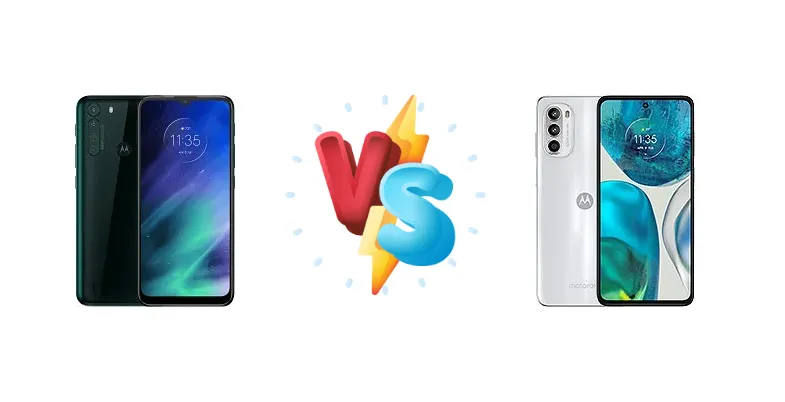
Choosing a new smartphone can be overwhelming, especially with so many options available. Today, we're pitting two popular Motorola devices against each other: the Motorola One Fusion and the Moto G52. Let's dive into a detailed comparison to help you decide which one is right for you.
🏆 Quick Verdict
The Moto G52 emerges as the winner thanks to its significantly faster charging, more efficient chipset, and likely improved display technology. While the One Fusion offers a decent experience, the G52's modern features and performance edge make it the better overall choice for most users.
| Network |
|---|
| 2G bands | GSM 850 / 900 / 1800 / 1900 | GSM 850 / 900 / 1800 / 1900 |
| 3G bands | HSDPA 850 / 900 / 1700(AWS) / 1900 / 2100 | HSDPA 850 / 900 / 1700(AWS) / 1900 / 2100 |
| 4G bands | 1, 2, 3, 4, 5, 7, 8, 19, 28, 66 | LTE |
| Speed | HSPA 42.2/5.76 Mbps, LTE Cat4 150/50 Mbps | HSPA, LTE |
| Technology | GSM / HSPA / LTE | GSM / HSPA / LTE |
| Launch |
|---|
| Announced | 2020, July 02. Released 2020, July 02 | 2022, April 12 |
| Status | Discontinued | Available. Released 2022, April 20 |
| Body |
|---|
| Build | Glass front, plastic back, plastic frame | - |
| Dimensions | 165 x 75.9 x 9.4 mm (6.50 x 2.99 x 0.37 in) | 160.1 x 74.5 x 8 mm (6.30 x 2.93 x 0.31 in) |
| SIM | · Nano-SIM· Nano-SIM + Nano-SIM | Nano-SIM + Nano-SIM |
| Weight | 202 g (7.13 oz) | 169 g (5.96 oz) |
| | Water-repellent coating | Water-repellent design |
| Display |
|---|
| Resolution | 720 x 1600 pixels, 20:9 ratio (~270 ppi density) | 1080 x 2400 pixels, 20:9 ratio (~402 ppi density) |
| Size | 6.5 inches, 102.0 cm2 (~81.5% screen-to-body ratio) | 6.6 inches, 103.6 cm2 (~86.9% screen-to-body ratio) |
| Type | IPS LCD | AMOLED, 90Hz |
| Platform |
|---|
| CPU | Octa-core (2x2.2 GHz 360 Gold & 6x1.7 GHz Kryo 360 Silver) | Octa-core (4x2.4 GHz Kryo 265 Gold & 4x1.9 GHz Kryo 265 Silver) |
| Chipset | Qualcomm SDM710 Snapdragon 710 (10 nm) | Qualcomm SM6225 Snapdragon 680 4G (6 nm) |
| GPU | Adreno 616 | Adreno 610 |
| OS | Android 10 | Android 12, planned upgrade to Android 13 |
| Memory |
|---|
| Card slot | microSDXC (uses shared SIM slot) | microSDXC (uses shared SIM slot) |
| Internal | 64GB 4GB RAM, 128GB 4GB RAM | 64GB 4GB RAM, 128GB 4GB RAM, 128GB 6GB RAM, 256GB 6GB RAM |
| Main Camera |
|---|
| Features | LED flash, panorama, HDR | LED flash, HDR, panorama |
| Quad | 48 MP, f/1.7, (wide), 1/2.0", 0.8µm, PDAF
8 MP, f/2.2, 118˚ (ultrawide), 1/4.0", 1.12µm
5 MP (macro)
Auxiliary lens | - |
| Triple | - | 50 MP, f/1.8 (wide), 1/2.76", 0.64µm, PDAF
8 MP, f/2.2, 118˚ (ultrawide), 1/4.0", 1.12µm
2 MP (macro) |
| Video | 4K@30fps, 1080p@30fps | 1080p@30fps |
| Selfie camera |
|---|
| Single | 8 MP, f/2.0 | 16 MP, f/2.5, (wide), 1.0µm |
| Video | 1080p@30fps | 1080p@30fps |
| Sound |
|---|
| 3.5mm jack | Yes | Yes |
| 35mm jack | Yes | Yes |
| Loudspeaker | Yes | Yes, with stereo speakers |
| Comms |
|---|
| Bluetooth | 5.0, A2DP, LE | 5.0, A2DP, LE |
| NFC | No | Yes (market/region dependent) |
| Positioning | GPS, GLONASS, GALILEO, BDS | GPS, GLONASS, GALILEO |
| Radio | FM radio (market/region dependent) | Unspecified |
| USB | USB Type-C 2.0, OTG | USB Type-C 2.0 |
| WLAN | Wi-Fi 802.11 b/g/n | Wi-Fi 802.11 a/b/g/n/ac, dual-band, Wi-Fi Direct |
| Features |
|---|
| Sensors | Fingerprint (rear-mounted), accelerometer, gyro, proximity | Fingerprint (side-mounted), accelerometer, gyro, proximity, compass |
| Battery |
|---|
| Charging | 10W wired | 30W wired |
| Type | Li-Po 5000 mAh | Li-Po 5000 mAh |
| Misc |
|---|
| Colors | Emerald Green, Deep Sapphire Blue | Charcoal Gray, Porcelain White |
| Models | XT2073-2 | XT2221-1, XT2221-2 |
| Price | About 100 EUR | About 470 EUR |
Motorola One Fusion
- Larger Screen
- Decent Performance for the Price
- Good Battery Life (despite slow charging)
- Slow Charging (10W)
- Older Chipset
- Likely IPS LCD Display
- Less Efficient
Motorola Moto G52
- Faster Charging (30W)
- More Efficient Chipset (Snapdragon 680)
- Likely AMOLED Display
- Improved Performance
- Smaller Screen
- Potentially Higher Price
Display Comparison
The Moto G52 likely boasts a superior display, potentially with an AMOLED panel offering vibrant colors and deeper blacks, compared to the One Fusion's likely IPS LCD. Resolution and refresh rate are also likely to be better on the G52, resulting in a more immersive viewing experience. The One Fusion has a larger screen size, which some users may prefer.
Camera Comparison
While both phones offer decent camera setups, the Moto G52 likely has an advantage due to its newer image processing capabilities and potentially improved sensors. Expect better low-light performance and more detailed photos from the G52. Both likely feature a main sensor around 48MP, but the G52's software and processing will be key.
Performance
The Snapdragon 680 in the Moto G52 is a more modern and efficient chipset built on a 6nm process, offering better performance and power efficiency than the One Fusion's Snapdragon 710 (10nm). Expect smoother multitasking, faster app loading times, and improved gaming performance on the G52.
Battery Life
The Moto G52's 30W fast charging is a significant advantage over the One Fusion's 10W charging. This means significantly faster charging times for the G52. Battery capacity is likely similar between the two, but the G52's efficiency will contribute to better overall battery life.
Buying Guide
The Motorola One Fusion is a good option for users on a tight budget who prioritize a larger screen and don't need the latest features. The Moto G52 is ideal for those seeking a smoother performance, faster charging, and a more modern design, even if it means a slightly smaller screen.
Frequently Asked Questions
❓ Is the Motorola One Fusion still worth buying?
It can be a decent option if you find it at a significantly discounted price and prioritize a larger screen. However, the Moto G52 offers a more modern and improved experience.
❓ Which phone has better battery life?
While both have similar battery capacities, the Moto G52's more efficient chipset and faster charging likely result in better overall battery life and quicker top-ups.