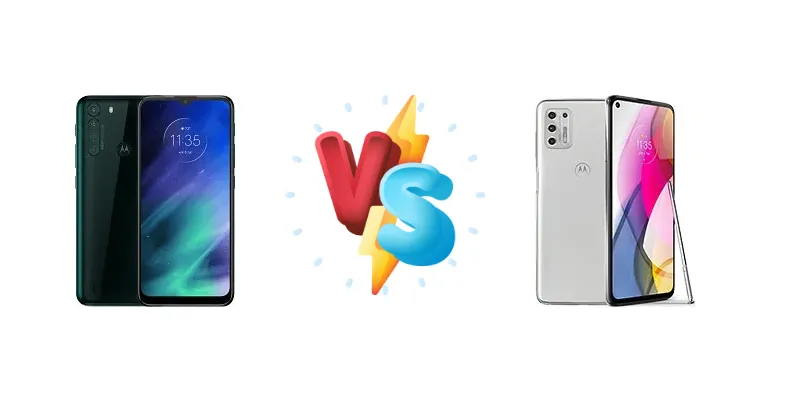
Both the Motorola One Fusion and the Moto G Stylus (2021) target the budget-conscious smartphone user, but they approach the segment with slightly different strategies. The One Fusion, released earlier, leverages the Snapdragon 710 for a performance edge, while the G Stylus (2021) opts for the newer, more efficient Snapdragon 678. This comparison dissects the key differences to help you determine which device best suits your needs.
🏆 Quick Verdict
For most users, the Motorola Moto G Stylus (2021) represents the better value. While the One Fusion’s Snapdragon 710 offers a theoretical performance advantage, the Snapdragon 678 in the G Stylus provides a solid experience with improved efficiency, and the inclusion of the stylus adds unique functionality that justifies the slight performance trade-off.
| Network |
|---|
| 2G bands | GSM 850 / 900 / 1800 / 1900 | GSM 850 / 900 / 1800 / 1900 |
| 3G bands | HSDPA 850 / 900 / 1700(AWS) / 1900 / 2100 | HSDPA 850 / 900 / 1700(AWS) / 1900 / 2100 |
| 4G bands | 1, 2, 3, 4, 5, 7, 8, 19, 28, 66 | 1, 2, 3, 4, 5, 7, 8, 12, 13, 14, 17, 20, 25, 26, 29, 38, 40, 41, 66, 71 |
| Speed | HSPA 42.2/5.76 Mbps, LTE Cat4 150/50 Mbps | HSPA, LTE |
| Technology | GSM / HSPA / LTE | GSM / CDMA / HSPA / LTE |
| | - | CDMA 800 / 1900 |
| Launch |
|---|
| Announced | 2020, July 02. Released 2020, July 02 | 2021, January 08 |
| Status | Discontinued | Available. Released 2021, January 14 |
| Body |
|---|
| Build | Glass front, plastic back, plastic frame | Glass front, plastic frame, plastic back |
| Dimensions | 165 x 75.9 x 9.4 mm (6.50 x 2.99 x 0.37 in) | 169.8 x 77.9 x 9 mm (6.69 x 3.07 x 0.35 in) |
| SIM | · Nano-SIM· Nano-SIM + Nano-SIM | Nano-SIM |
| Weight | 202 g (7.13 oz) | 213 g (7.51 oz) |
| | Water-repellent coating | Stylus
Water-repellent coating |
| Display |
|---|
| Resolution | 720 x 1600 pixels, 20:9 ratio (~270 ppi density) | 1080 x 2400 pixels, 20:9 ratio (~386 ppi density) |
| Size | 6.5 inches, 102.0 cm2 (~81.5% screen-to-body ratio) | 6.8 inches, 112.2 cm2 (~84.8% screen-to-body ratio) |
| Type | IPS LCD | IPS LCD |
| Platform |
|---|
| CPU | Octa-core (2x2.2 GHz 360 Gold & 6x1.7 GHz Kryo 360 Silver) | Octa-core (2x2.2 GHz Kryo 460 Gold & 6x1.7 GHz Kryo 460 Silver) |
| Chipset | Qualcomm SDM710 Snapdragon 710 (10 nm) | Qualcomm SDM678 Snapdragon 678 (11 nm) |
| GPU | Adreno 616 | Adreno 612 |
| OS | Android 10 | Android 10 |
| Memory |
|---|
| Card slot | microSDXC (uses shared SIM slot) | microSDXC (dedicated slot) |
| Internal | 64GB 4GB RAM, 128GB 4GB RAM | 128GB 4GB RAM |
| Main Camera |
|---|
| Features | LED flash, panorama, HDR | LED flash, HDR, panorama |
| Quad | 48 MP, f/1.7, (wide), 1/2.0", 0.8µm, PDAF
8 MP, f/2.2, 118˚ (ultrawide), 1/4.0", 1.12µm
5 MP (macro)
Auxiliary lens | 48 MP, f/1.7, 26mm (wide), 1/2.0", 0.8µm, PDAF
8 MP, f/2.2, 118˚ (ultrawide), 1/4.0, 1.12µm
2 MP (macro)
Auxiliary lens |
| Video | 4K@30fps, 1080p@30fps | 4K@30fps, 1080p@30/60fps; gyro-EIS |
| Selfie camera |
|---|
| Features | - | HDR |
| Single | 8 MP, f/2.0 | 16 MP, f/2.0, (wide), 1/3.06", 1.0µm |
| Video | 1080p@30fps | 1080p@30fps, gyro-EIS |
| Sound |
|---|
| 3.5mm jack | Yes | Yes |
| 35mm jack | Yes | Yes |
| Loudspeaker | Yes | Yes |
| Comms |
|---|
| Bluetooth | 5.0, A2DP, LE | 5.0, A2DP, LE |
| NFC | No | No |
| Positioning | GPS, GLONASS, GALILEO, BDS | GPS, GLONASS, BDS, GALILEO |
| Radio | FM radio (market/region dependent) | Unspecified |
| USB | USB Type-C 2.0, OTG | USB Type-C 2.0 |
| WLAN | Wi-Fi 802.11 b/g/n | Wi-Fi 802.11 a/b/g/n/ac, dual-band, Wi-Fi Direct |
| Features |
|---|
| Sensors | Fingerprint (rear-mounted), accelerometer, gyro, proximity | Fingerprint (side-mounted), accelerometer, gyro, proximity |
| Battery |
|---|
| Charging | 10W wired | 10W wired |
| Type | Li-Po 5000 mAh | Li-Po 4000 mAh |
| Misc |
|---|
| Colors | Emerald Green, Deep Sapphire Blue | Aurora Black, Aurora White |
| Models | XT2073-2 | XT2115, XT2115-1 |
| Price | About 100 EUR | About 90 EUR |
Motorola One Fusion
- Potentially faster CPU performance with Snapdragon 710
- May be available at a lower price point now due to its age
- Clean Android experience (typical of Motorola)
- Less power-efficient Snapdragon 710
- Lacks the stylus functionality of the G Stylus
- Older chipset architecture
Motorola Moto G Stylus (2021)
- More efficient Snapdragon 678 for longer battery life
- Integrated stylus for note-taking and creative tasks
- More modern chipset architecture
- Slightly lower CPU performance compared to the One Fusion
- 10W charging is slow
- May be slightly more expensive than the One Fusion
Display Comparison
Neither device boasts a standout display. Both likely feature LCD panels, typical for this price bracket. The focus here isn't on visual fidelity, but on practicality. Without specific display specs, it's reasonable to assume similar resolutions and brightness levels. The absence of high refresh rates on both devices suggests a focus on power conservation rather than a fluid visual experience.
Camera Comparison
Without detailed camera specifications, a direct comparison is difficult. However, Motorola typically focuses on software processing rather than cutting-edge hardware in this price range. The image quality will likely be similar, with both phones producing acceptable results in good lighting conditions. The absence of Optical Image Stabilization (OIS) on either device suggests that low-light performance will be a weakness. The inclusion of a stylus on the G Stylus could be leveraged for creative photo editing, offering a slight advantage in post-processing workflows.
Performance
The core difference lies in the chipsets. The Motorola One Fusion’s Snapdragon 710 (10nm) features a dual-cluster configuration with 2x 2.2 GHz Cortex-A75 cores and 6x 1.7 GHz Cortex-A55 cores. The Moto G Stylus (2021) utilizes the Snapdragon 678 (11nm), also an octa-core processor, but with 2x 2.2 GHz Kryo 460 Gold and 6x 1.7 GHz Kryo 460 Silver cores. The 11nm process of the SD678 offers improved power efficiency compared to the 10nm SD710, potentially leading to longer battery life. While the SD710 theoretically has a slight edge in CPU-intensive tasks due to the A75 cores, the real-world difference will be minimal for everyday use. Both phones will likely struggle with graphically demanding games at high settings.
Battery Life
Both devices are equipped with 10W wired charging, indicating a similar charging experience – slow by modern standards. The Snapdragon 678’s improved efficiency in the Moto G Stylus (2021) will likely translate to longer battery life despite potentially having a similar battery capacity to the One Fusion. Expect both phones to last a full day with moderate use, but heavy users may need to top up before the end of the day. The slower charging speeds mean that a full charge will take a significant amount of time.
Buying Guide
Buy the Motorola One Fusion if you prioritize raw processing power for demanding applications and occasional gaming, and don't need the stylus functionality. Buy the Motorola Moto G Stylus (2021) if you value all-day battery life, appreciate the convenience of a built-in stylus for note-taking and quick tasks, and prefer a more modern chipset architecture despite a slight performance decrease.
Frequently Asked Questions
❓ Will the Snapdragon 678 in the Moto G Stylus (2021) handle popular games like PUBG Mobile?
The Snapdragon 678 can run PUBG Mobile, but you'll likely need to lower the graphics settings to medium or low to achieve a smooth frame rate. It's not a gaming powerhouse, but it's capable of casual gaming.
❓ How useful is the stylus on the Moto G Stylus (2021) for everyday tasks?
The stylus is surprisingly versatile. It's excellent for quick note-taking, sketching, navigating the interface, and precise selection in apps. It adds a layer of convenience that many users will appreciate, especially those who frequently jot down ideas or annotate documents.
❓ Is the 10W charging speed on either phone a significant drawback?
Yes, 10W charging is quite slow compared to modern standards. Expect a full charge to take over 3 hours. It's best to charge the phone overnight to ensure it's ready for the next day.
❓ Does the Motorola One Fusion support software updates for longer than the Moto G Stylus (2021)?
Generally, Motorola's software update support is limited, regardless of the model. However, the Moto G Stylus (2021) being a newer device may receive updates for a slightly longer period, but don't expect major Android version upgrades beyond the initial release.