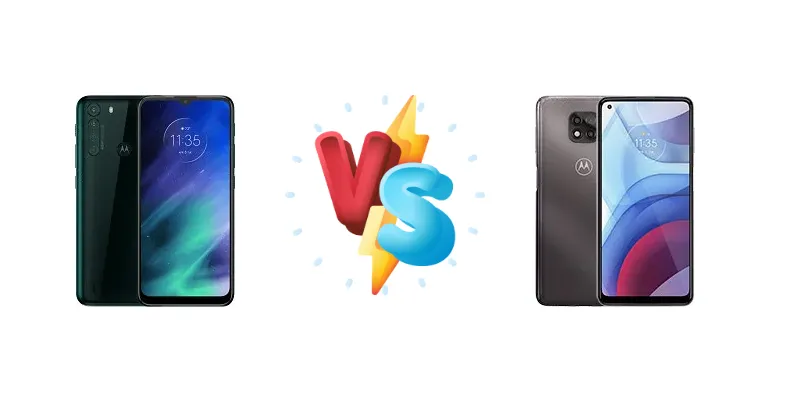
Motorola's budget and mid-range offerings consistently deliver strong value, but choosing between models like the One Fusion and the Moto G Power (2021) requires careful consideration. While both aim for affordability, they diverge in chipset choice and charging capabilities, impacting performance and user experience. This comparison dissects these differences to help you make the right decision.
🏆 Quick Verdict
For most users, the Motorola Moto G Power (2021) is the better choice. Its newer Snapdragon 662 chipset, built on an 11nm process, offers a more efficient architecture, and the 15W charging provides a noticeable improvement over the One Fusion’s slower 10W charging, crucial for its target audience prioritizing longevity.
| Network |
|---|
| 2G bands | GSM 850 / 900 / 1800 / 1900 | GSM 850 / 900 / 1800 / 1900 |
| 3G bands | HSDPA 850 / 900 / 1700(AWS) / 1900 / 2100 | HSDPA 850 / 900 / 1700(AWS) / 1900 / 2100 |
| 4G bands | 1, 2, 3, 4, 5, 7, 8, 19, 28, 66 | 1, 2, 3, 4, 5, 7, 8, 12, 13, 14, 17, 25, 26, 29, 30, 38, 41, 66, 71 |
| Speed | HSPA 42.2/5.76 Mbps, LTE Cat4 150/50 Mbps | HSPA, LTE |
| Technology | GSM / HSPA / LTE | GSM / CDMA / HSPA / EVDO / LTE |
| | - | CDMA2000 1xEV-DO |
| Launch |
|---|
| Announced | 2020, July 02. Released 2020, July 02 | 2021, January 08 |
| Status | Discontinued | Available. Released 2021, January 14 |
| Body |
|---|
| Build | Glass front, plastic back, plastic frame | Glass front, plastic back, plastic frame |
| Dimensions | 165 x 75.9 x 9.4 mm (6.50 x 2.99 x 0.37 in) | 165.3 x 75.9 x 9.5 mm (6.51 x 2.99 x 0.37 in) |
| SIM | · Nano-SIM· Nano-SIM + Nano-SIM | Nano-SIM |
| Weight | 202 g (7.13 oz) | 206.5 g (7.30 oz) |
| | Water-repellent coating | Water-repellent coating |
| Display |
|---|
| Resolution | 720 x 1600 pixels, 20:9 ratio (~270 ppi density) | 720 x 1600 pixels, 20:9 ratio (~266 ppi density) |
| Size | 6.5 inches, 102.0 cm2 (~81.5% screen-to-body ratio) | 6.6 inches, 105.2 cm2 (~83.8% screen-to-body ratio) |
| Type | IPS LCD | IPS LCD |
| Platform |
|---|
| CPU | Octa-core (2x2.2 GHz 360 Gold & 6x1.7 GHz Kryo 360 Silver) | Octa-core (4x2.0 GHz Kryo 260 Gold & 4x1.8 GHz Kryo 260 Silver) |
| Chipset | Qualcomm SDM710 Snapdragon 710 (10 nm) | Qualcomm SM6115 Snapdragon 662 (11 nm) |
| GPU | Adreno 616 | Adreno 610 |
| OS | Android 10 | Android 10 |
| Memory |
|---|
| Card slot | microSDXC (uses shared SIM slot) | microSDXC (dedicated slot) |
| Internal | 64GB 4GB RAM, 128GB 4GB RAM | 32GB 3GB RAM, 64GB 4GB RAM |
| | - | eMMC 5.1 |
| Main Camera |
|---|
| Features | LED flash, panorama, HDR | LED flash, HDR, panorama |
| Quad | 48 MP, f/1.7, (wide), 1/2.0", 0.8µm, PDAF
8 MP, f/2.2, 118˚ (ultrawide), 1/4.0", 1.12µm
5 MP (macro)
Auxiliary lens | - |
| Triple | - | 48 MP, f/1.7, (wide), 1/2.0", 0.8µm, PDAF
2 MP (macro)
Auxiliary lens |
| Video | 4K@30fps, 1080p@30fps | 1080p@30/60fps, gyro-EIS |
| Selfie camera |
|---|
| Features | - | HDR |
| Single | 8 MP, f/2.0 | 8 MP, f/2.0, 1.12µm |
| Video | 1080p@30fps | 1080p@30fps, gyro-EIS |
| Sound |
|---|
| 3.5mm jack | Yes | Yes |
| 35mm jack | Yes | Yes |
| Loudspeaker | Yes | Yes |
| Comms |
|---|
| Bluetooth | 5.0, A2DP, LE | 5.0, A2DP, LE |
| NFC | No | No |
| Positioning | GPS, GLONASS, GALILEO, BDS | GPS, GLONASS, GALILEO |
| Radio | FM radio (market/region dependent) | FM radio |
| USB | USB Type-C 2.0, OTG | USB Type-C 2.0 |
| WLAN | Wi-Fi 802.11 b/g/n | Wi-Fi 802.11 a/b/g/n/ac, dual-band, Wi-Fi Direct |
| Features |
|---|
| Sensors | Fingerprint (rear-mounted), accelerometer, gyro, proximity | Fingerprint (side-mounted), accelerometer, gyro, proximity, compass, barometer |
| Battery |
|---|
| Charging | 10W wired | 15W wired |
| Type | Li-Po 5000 mAh | Li-Po 5000 mAh |
| Misc |
|---|
| Colors | Emerald Green, Deep Sapphire Blue | Flash Gray, Polar Silver |
| Models | XT2073-2 | - |
| Price | About 100 EUR | About 60 EUR |
Motorola One Fusion
- Slightly higher peak CPU clock speeds (potentially faster single-core tasks)
- May be available at a lower price point if older stock remains
- Established Snapdragon 710 performance for general use
- Slower 10W charging
- Less efficient 10nm Snapdragon 710 chipset
- Older ISP potentially impacting image quality
Motorola Moto G Power (2021)
- More efficient 11nm Snapdragon 662 chipset
- Faster 15W charging
- Modern ISP for improved image processing
- Better sustained performance due to thermal efficiency
- Lower peak CPU clock speeds compared to the 710
- May be slightly more expensive than the One Fusion
Display Comparison
Neither device boasts a standout display. Both likely feature LCD panels, typical for this price bracket. The key difference lies under the hood. While specific display specs are unavailable, the One Fusion’s older chipset may translate to less efficient display power draw. The Moto G Power (2021) benefits from the 11nm Snapdragon 662, potentially allowing for slightly better sustained brightness and color reproduction without significant battery impact.
Camera Comparison
Without detailed camera specs beyond the presence of sensors, a direct comparison is difficult. However, Motorola typically focuses on software processing rather than cutting-edge hardware in this segment. The Snapdragon 662 in the Moto G Power (2021) includes a more modern image signal processor (ISP) which likely translates to better image processing capabilities, especially in low-light conditions. The One Fusion’s older ISP may struggle to deliver the same level of detail and dynamic range. The presence of a dedicated Night Mode on the G Power is also probable, further enhancing low-light photography.
Performance
The core of the difference lies in the chipsets. The Motorola One Fusion utilizes the Qualcomm Snapdragon 710 (10nm), featuring a dual-core 2.2 GHz Kryo 360 Gold and a hexa-core 1.7 GHz Kryo 360 Silver configuration. The Moto G Power (2021) employs the Snapdragon 662 (11nm) with a quad-core 2.0 GHz Kryo 260 Gold and a quad-core 1.8 GHz Kryo 260 Silver setup. The 11nm process of the 662 offers improved power efficiency compared to the 10nm 710. While the 710 has a higher peak clock speed on its prime cores, the 662’s architecture is more modern, resulting in better sustained performance and thermal management, particularly beneficial for users engaging in prolonged app usage or light gaming. The 662’s Adreno 610 GPU is also more efficient than the 710’s Adreno 615.
Battery Life
The Moto G Power (2021) shines in this category. While specific battery capacities aren't provided, the combination of the more efficient Snapdragon 662 and the 15W wired charging gives it a significant advantage. The One Fusion’s 10W charging is noticeably slower, requiring more time to reach a full charge. Users prioritizing all-day battery life and quick top-ups will greatly benefit from the G Power’s charging capabilities. The 11nm process of the 662 contributes to lower power consumption during typical usage, extending battery life further.
Buying Guide
Buy the Motorola One Fusion if you prioritize a slightly older, but still capable, processor for tasks beyond basic usage and don't mind slower charging. It's a reasonable option if found at a significantly lower price. Buy the Motorola Moto G Power (2021) if you prioritize battery life, efficient performance for everyday tasks, and faster charging speeds – making it ideal for users who heavily rely on their phone throughout the day and want to minimize downtime.
Frequently Asked Questions
❓ Will the Snapdragon 662 in the Moto G Power (2021) struggle with demanding games like PUBG Mobile?
While not a flagship gaming chip, the Snapdragon 662 paired with sufficient RAM (likely 4GB or 6GB) can handle PUBG Mobile at medium settings with reasonable frame rates. The 11nm process also helps prevent excessive throttling during extended gaming sessions, offering a more consistent experience than the One Fusion’s Snapdragon 710.
❓ How much faster is the 15W charging on the Moto G Power (2021) compared to the One Fusion’s 10W charging?
The difference is substantial. Expect the Moto G Power (2021) to charge approximately 30-40% faster than the One Fusion. This translates to significantly less time tethered to an outlet, a crucial benefit for users who rely heavily on their phones throughout the day.
❓ Does the Motorola One Fusion support fast charging at all, or is 10W its maximum?
The Motorola One Fusion is limited to 10W wired charging. It does not support any faster charging protocols, meaning you won't see any benefit from using a higher-wattage charger.
❓ Is the Snapdragon 710 still a capable processor in 2024?
The Snapdragon 710 remains functional for basic tasks like browsing, social media, and light app usage. However, it's showing its age compared to newer chipsets like the Snapdragon 662, particularly in terms of efficiency and sustained performance.