
Motorola One Fusion vs. Google Pixel 4a 5G: A Detailed Comparison
| Phones Images | |||||
|---|---|---|---|---|---|
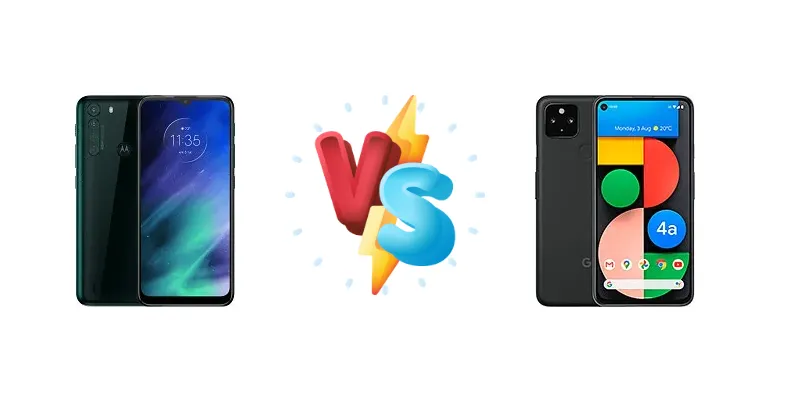
|
🏆 Quick Verdict
For most users, the Google Pixel 4a 5G is the superior choice. Its Snapdragon 765G chipset, built on a more efficient 7nm process, provides a noticeable performance uplift over the Motorola One Fusion’s Snapdragon 710. While the One Fusion offers a reasonable experience, the Pixel 4a 5G’s faster charging and 5G connectivity justify the price difference.
| PHONES | ||
|---|---|---|
| Phone Names | Motorola One Fusion | Google Pixel 4a 5G |
| Network | ||
|---|---|---|
| 2G bands | GSM 850 / 900 / 1800 / 1900 | GSM 850 / 900 / 1800 / 1900 |
| 3G bands | HSDPA 850 / 900 / 1700(AWS) / 1900 / 2100 | HSDPA 850 / 900 / 1700(AWS) / 1900 / 2100 |
| 4G bands | 1, 2, 3, 4, 5, 7, 8, 19, 28, 66 | 1, 2, 3, 4, 5, 7, 8, 12, 13, 14, 17, 18, 19, 20, 25, 26, 28, 29, 30, 32, 38, 39, 40, 41, 42, 46, 48, 66, 71 |
| 5G bands | - | 1, 2, 3, 5, 7, 8, 12, 28, 41, 66, 71, 77, 78 Sub6, mmWave (market dependant) |
| Speed | HSPA 42.2/5.76 Mbps, LTE Cat4 150/50 Mbps | HSPA, LTE, 5G |
| Technology | GSM / HSPA / LTE | GSM / HSPA / LTE / 5G |
| Launch | ||
|---|---|---|
| Announced | 2020, July 02. Released 2020, July 02 | 2020, September 30 |
| Status | Discontinued | Available. Released 2020, November 05 |
| Body | ||
|---|---|---|
| Build | Glass front, plastic back, plastic frame | Glass front (Gorilla Glass 3), plastic back, plastic frame |
| Dimensions | 165 x 75.9 x 9.4 mm (6.50 x 2.99 x 0.37 in) | 153.9 x 74 x 8.2 mm (Sub-6) or 8.5 mm (Sub-6 and mmWave) |
| SIM | · Nano-SIM· Nano-SIM + Nano-SIM | Nano-SIM + eSIM |
| Weight | 202 g (7.13 oz) | 168 g (5G Sub-6); 171 g ( 5G Sub-6 and mmWave) (5.93 oz) |
| Water-repellent coating | - | |
| Display | ||
|---|---|---|
| Protection | - | Corning Gorilla Glass 3 |
| Resolution | 720 x 1600 pixels, 20:9 ratio (~270 ppi density) | 1080 x 2340 pixels, 19.5:9 ratio (~413 ppi density) |
| Size | 6.5 inches, 102.0 cm2 (~81.5% screen-to-body ratio) | 6.2 inches, 95.7 cm2 (~84.1% screen-to-body ratio) |
| Type | IPS LCD | OLED, HDR |
| - | Always-on display | |
| Platform | ||
|---|---|---|
| CPU | Octa-core (2x2.2 GHz 360 Gold & 6x1.7 GHz Kryo 360 Silver) | Octa-core (1x2.4 GHz Kryo 475 Prime & 1x2.2 GHz Kryo 475 Gold & 6x1.8 GHz Kryo 475 Silver) |
| Chipset | Qualcomm SDM710 Snapdragon 710 (10 nm) | Qualcomm SM7250 Snapdragon 765G 5G (7 nm) |
| GPU | Adreno 616 | Adreno 620 |
| OS | Android 10 | Android 11, upgradable to Android 14 |
| Memory | ||
|---|---|---|
| Card slot | microSDXC (uses shared SIM slot) | No |
| Internal | 64GB 4GB RAM, 128GB 4GB RAM | 128GB 6GB RAM |
| - | UFS 2.1 | |
| Main Camera | ||
|---|---|---|
| Dual | - | 12.2 MP, f/1.7, 27mm (wide), 1/2.55", 1.4µm, dual pixel PDAF, OIS 16 MP, f/2.2, 107˚ (ultrawide), 1.0µm |
| Features | LED flash, panorama, HDR | LED flash, Pixel Shift, Auto-HDR, panorama |
| Quad | 48 MP, f/1.7, (wide), 1/2.0", 0.8µm, PDAF 8 MP, f/2.2, 118˚ (ultrawide), 1/4.0", 1.12µm 5 MP (macro) Auxiliary lens | - |
| Video | 4K@30fps, 1080p@30fps | 4K@30/60fps, 1080p@30/60/120/240fps; gyro-EIS |
| Selfie camera | ||
|---|---|---|
| Features | - | HDR |
| Single | 8 MP, f/2.0 | 8 MP, f/2.0, 24mm (wide), 1/4.0", 1.12µm |
| Video | 1080p@30fps | 1080p@30fps |
| Sound | ||
|---|---|---|
| 3.5mm jack | Yes | Yes |
| 35mm jack | Yes | Yes |
| Loudspeaker | Yes | Yes, with stereo speakers |
| Comms | ||
|---|---|---|
| Bluetooth | 5.0, A2DP, LE | 5.0, A2DP, LE, aptX HD |
| NFC | No | Yes |
| Positioning | GPS, GLONASS, GALILEO, BDS | GPS, GLONASS, GALILEO, QZSS, BDS |
| Radio | FM radio (market/region dependent) | No |
| USB | USB Type-C 2.0, OTG | USB Type-C 3.1 |
| WLAN | Wi-Fi 802.11 b/g/n | Wi-Fi 802.11 a/b/g/n/ac, dual-band, Wi-Fi Direct |
| Features | ||
|---|---|---|
| Sensors | Fingerprint (rear-mounted), accelerometer, gyro, proximity | Fingerprint (rear-mounted), accelerometer, gyro, proximity, compass, barometer |
| Battery | ||
|---|---|---|
| Charging | 10W wired | 18W wired, PD2.0 |
| Type | Li-Po 5000 mAh | Li-Po 3885 mAh |
| Misc | ||
|---|---|---|
| Colors | Emerald Green, Deep Sapphire Blue | Just Black, Clearly White |
| Models | XT2073-2 | GD1YQ, G025I, G025E, G025H, G6QU3 |
| Price | About 100 EUR | About 140 EUR |
Motorola One Fusion
- More affordable price point
- Potentially longer battery life due to less powerful chipset (depending on battery capacity)
- Simple, uncluttered Android experience
- Significantly slower charging speed (10W)
- Less powerful Snapdragon 710 chipset
- Lacks 5G connectivity
Google Pixel 4a 5G
- Faster Snapdragon 765G processor
- 18W fast charging with PD2.0
- 5G connectivity for faster data speeds
- Superior camera software and image processing
- Higher price tag
- Potentially shorter battery life compared to One Fusion (depending on usage)
- Google's software updates, while frequent, can sometimes introduce bugs
Display Comparison
Neither device boasts a standout display. While specific panel details (like peak brightness or color gamut coverage) are unavailable for the One Fusion, the Pixel 4a 5G features a 6.2-inch FHD+ OLED display. The Pixel’s OLED panel inherently offers superior contrast and color accuracy compared to the likely LCD panel in the One Fusion. The difference in display technology will be immediately noticeable in content consumption.
Camera Comparison
Without detailed sensor information for the One Fusion, a direct comparison is challenging. However, the Pixel 4a 5G benefits immensely from Google’s computational photography prowess. While sensor size and aperture are crucial, Google’s image processing algorithms elevate the Pixel’s camera performance, particularly in low-light conditions. The 765G’s image signal processor (ISP) also contributes to faster image processing and better dynamic range. The One Fusion likely relies more heavily on hardware, potentially resulting in less refined images.
Performance
The core difference lies in the chipsets. The Google Pixel 4a 5G’s Snapdragon 765G (7nm) is a significant upgrade over the Motorola One Fusion’s Snapdragon 710 (10nm). The 7nm process allows for greater transistor density and improved power efficiency, translating to better sustained performance and less thermal throttling. The 765G’s CPU configuration – a 1x2.4 GHz Kryo 475 Prime core, 1x2.2 GHz Kryo 475 Gold, and 6x1.8 GHz Kryo 475 Silver – is architecturally more advanced than the One Fusion’s 2x2.2 GHz 360 Gold & 6x1.7 GHz Kryo 360 Silver. This means the Pixel 4a 5G will handle demanding apps and multitasking with greater ease.
Battery Life
The Motorola One Fusion’s 10W charging is a significant drawback compared to the Pixel 4a 5G’s 18W charging with PD2.0 support. While battery capacity isn’t specified for the One Fusion, the Pixel 4a 5G’s battery, combined with the more efficient Snapdragon 765G, provides a more practical charging experience. The Pixel 4a 5G can achieve a substantial charge in a short amount of time, while the One Fusion will require considerably longer to reach full capacity.
Buying Guide
Buy the Motorola One Fusion if you prioritize extreme budget-friendliness and are willing to compromise on performance and 5G connectivity. It’s a solid option for basic smartphone tasks. Buy the Google Pixel 4a 5G if you value a smoother user experience, faster charging, 5G capabilities, and Google’s excellent camera software – even if it means spending a bit more.