
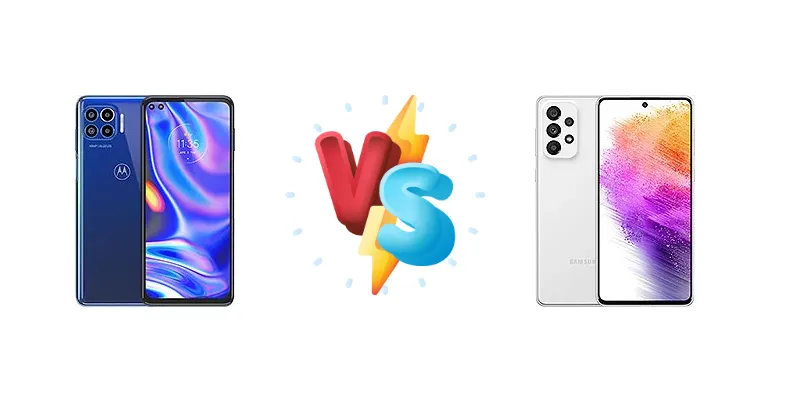
Motorola One 5G vs Samsung Galaxy A73 5G: Which Mid-Range 5G Phone Reigns Supreme?
| Phones Images | |||||
|---|---|---|---|---|---|
|
🏆 Quick Verdict
For most users, the Samsung Galaxy A73 5G is the superior choice. Its Snapdragon 778G 5G chipset, built on a more efficient 6nm process, delivers noticeably better performance and thermal management compared to the Motorola One 5G’s Snapdragon 765. While the Motorola offers a simpler experience, the A73’s advantages justify the potential price premium.
| PHONES | ||
|---|---|---|
| Phone Names | Motorola One 5G | Samsung Galaxy A73 5G |
| Network | ||
|---|---|---|
| 2G bands | GSM 850 / 900 / 1800 / 1900 | GSM 850 / 900 / 1800 / 1900 |
| 3G bands | HSDPA 850 / 900 / 1700(AWS) / 1900 / 2100 | HSDPA 850 / 900 / 1700(AWS) / 1900 / 2100 |
| 4G bands | 1, 2, 3, 4, 5, 7, 8, 12, 13, 14, 17, 18, 19, 20, 25, 26, 29, 30, 38, 39, 40, 41, 66, 71 | 1, 2, 3, 4, 5, 7, 8, 12, 13, 17, 20, 26, 28, 32, 38, 40, 41, 66 |
| 5G bands | 2, 5, 25, 41, 66, 71 SA/NSA | 1, 3, 5, 7, 28, 40, 41, 66, 78 SA/NSA/Sub6 |
| Speed | HSPA, LTE, 5G | HSPA, LTE, 5G |
| Technology | GSM / HSPA / LTE / 5G | GSM / HSPA / LTE / 5G |
| Launch | ||
|---|---|---|
| Announced | 2020, September 01. Released 2020, September 14 | 2022, March 17 |
| Status | Discontinued | Available. Released 2022, April 22 |
| Body | ||
|---|---|---|
| Build | Glass front, plastic back, plastic frame | - |
| Dimensions | 168 x 74 x 9 mm (6.61 x 2.91 x 0.35 in) | 163.7 x 76.1 x 7.6 mm (6.44 x 3.00 x 0.30 in) |
| SIM | Nano-SIM | · Nano-SIM· Nano-SIM + Nano-SIM |
| Weight | 207 g (7.30 oz) | 181 g (6.38 oz) |
| Water-repellent coating | IP67 dust/water resistant (up to 1m for 30 min) | |
| Display | ||
|---|---|---|
| Protection | - | Corning Gorilla Glass 5 |
| Resolution | 1080 x 2520 pixels, 21:9 ratio (~409 ppi density) | 1080 x 2400 pixels, 20:9 ratio (~393 ppi density) |
| Size | 6.7 inches, 104.9 cm2 (~84.3% screen-to-body ratio) | 6.7 inches, 108.4 cm2 (~87.0% screen-to-body ratio) |
| Type | IPS LCD, 90Hz, HDR10 | Super AMOLED Plus, 120Hz, 800 nits (HBM) |
| Platform | ||
|---|---|---|
| CPU | Octa-core (1x2.3 GHz Kryo 475 Prime & 1x2.2 GHz Kryo 475 Gold & 6x1.8 GHz Kryo 475 Silver) | Octa-core (1x2.4 GHz Cortex-A78 & 3x2.2 GHz Cortex-A78 & 4x1.9 GHz Cortex-A55) |
| Chipset | Qualcomm SM7250 Snapdragon 765 5G (7 nm) | Qualcomm SM7325 Snapdragon 778G 5G (6 nm) |
| GPU | Adreno 620 | Adreno 642L |
| OS | Android 10 | Android 12, up to 4 major Android upgrades, One UI 6.1 |
| Memory | ||
|---|---|---|
| Card slot | microSDXC (dedicated slot) | microSDXC (uses shared SIM slot) |
| Internal | 128GB 4GB RAM | 128GB 6GB RAM, 128GB 8GB RAM, 256GB 8GB RAM |
| UFS 2.1 | - | |
| Main Camera | ||
|---|---|---|
| Features | Dual-LED flash, ring flash (macro camera), panorama, HDR | LED flash, panorama, HDR |
| Quad | 48 MP, f/1.8, 26mm (wide), 1/2.0", 0.8µm, PDAF 8 MP, f/2.2, 118˚ (ultrawide), 1.12µm 5 MP (macro), AF Auxiliary lens | 108 MP, f/1.8, (wide), PDAF, OIS 12 MP, f/2.2, (ultrawide) 5 MP (macro) Auxiliary lens |
| Single | - | 32 MP, f/2.2, 26mm (wide), 1/2.8", 0.8µm |
| Video | 4K@30fps, 1080p@30/60fps, gyro-EIS | 4K@30fps, 1080p@30/60fps; gyro-EIS |
| Selfie camera | ||
|---|---|---|
| Dual | 16 MP, f/2.0, (wide), 1.0µm 8 MP, f/2.2, (ultrawide), 1.12µm | - |
| Features | HDR | HDR |
| Single | - | 32 MP, f/2.2, 26mm (wide), 1/2.8", 0.8µm |
| Video | 1080p@30fps | 4K@30fps, 1080p@30fps |
| Sound | ||
|---|---|---|
| 3.5mm jack | Yes | No |
| 35mm jack | Yes | No |
| Loudspeaker | Yes | Yes, with stereo speakers |
| Comms | ||
|---|---|---|
| Bluetooth | 5.1, A2DP, LE | 5.0, A2DP, LE |
| NFC | Yes | Yes (market/region dependent) |
| Positioning | GPS (L1+L5), GLONASS, GALILEO | GPS, GLONASS, GALILEO, BDS, QZSS |
| Radio | FM radio | Unspecified |
| USB | USB Type-C 2.0 | USB Type-C 2.0, OTG |
| WLAN | Wi-Fi 802.11 a/b/g/n/ac, dual-band, Wi-Fi Direct | Wi-Fi 802.11 a/b/g/n/ac/6, dual-band, Wi-Fi Direct |
| Features | ||
|---|---|---|
| Sensors | Fingerprint (side-mounted), accelerometer, gyro, proximity, compass | Fingerprint (under display, optical), accelerometer, gyro, proximity, compass |
| Battery | ||
|---|---|---|
| Charging | 15W wired | 25W wired |
| Type | Li-Po 5000 mAh | Li-Po 5000 mAh |
| Misc | ||
|---|---|---|
| Colors | Oxford Blue | Gray, Mint, White |
| Models | - | SM-A736B, SM-A736B/DS |
| Price | About 420 EUR | About 600 EUR |
| SAR | - | 1.14 W/kg (head) |
| SAR EU | - | 1.28 W/kg (head) 1.42 W/kg (body) |
Motorola One 5G
- Clean Android experience
- Potentially lower price
- 5G connectivity
- Slower charging (15W)
- Less powerful chipset
- Potential for thermal throttling
Samsung Galaxy A73 5G
- Faster Snapdragon 778G 5G chipset
- Faster 25W charging
- More efficient 6nm process
- Samsung’s One UI software (preference-based)
- Potentially higher price
- May include bloatware
Display Comparison
Neither device boasts a particularly standout display. While specific panel details (like peak brightness in nits) are unavailable, the focus here is on the processing power driving the visuals. Both likely utilize AMOLED panels, common in this segment. The A73’s more powerful GPU will translate to smoother animations and potentially better HDR rendering, even if the raw resolution is similar. Bezels are likely comparable, with Samsung generally offering slightly more polished designs.
Camera Comparison
Without detailed sensor specifications, a direct comparison is challenging. However, Samsung generally excels in image processing. The A73 likely benefits from more sophisticated algorithms and potentially larger sensor sizes, leading to better low-light performance and dynamic range. While both phones likely include standard wide, ultrawide, and macro lenses, the A73’s image signal processor (ISP), tied to the more powerful chipset, will likely deliver superior results. The Motorola’s camera is likely adequate for casual use, but the A73 aims for a more refined photographic experience.
Performance
The core difference lies in the chipsets. The Samsung Galaxy A73 5G’s Snapdragon 778G 5G (6nm) is a significant upgrade over the Motorola One 5G’s Snapdragon 765 (7nm). The 778G features a more modern CPU architecture – Cortex-A78 cores versus the Kryo 475 – offering superior single-core and multi-core performance. The 6nm process also contributes to better power efficiency, meaning less throttling during sustained loads like gaming. The A73’s CPU configuration (1x2.4 GHz Cortex-A78, 3x2.2 GHz Cortex-A78, 4x1.9 GHz Cortex-A55) is demonstrably more capable than the Motorola’s (1x2.3 GHz Kryo 475 Prime, 1x2.2 GHz Kryo 475 Gold, 6x1.8 GHz Kryo 475 Silver).
Battery Life
The Motorola One 5G’s 15W charging is a clear disadvantage compared to the Samsung Galaxy A73 5G’s 25W charging. This translates to significantly faster top-up times for the A73. While battery capacity isn’t specified, the faster charging speed mitigates any potential capacity difference. The Snapdragon 778G’s 6nm efficiency also contributes to better battery life under load, meaning the A73 will likely last longer during demanding tasks like gaming or video streaming.
Buying Guide
Buy the Motorola One 5G if you prioritize a clean Android experience and are on a very tight budget, accepting compromises in processing power. Buy the Samsung Galaxy A73 5G if you value smoother multitasking, better gaming performance, and faster charging, and are willing to spend a bit more for a more refined overall experience.