
Motorola One 5G vs OnePlus Nord N20 5G: A Deep Dive into Mid-Range 5G Contenders
| Phones Images | |||||
|---|---|---|---|---|---|
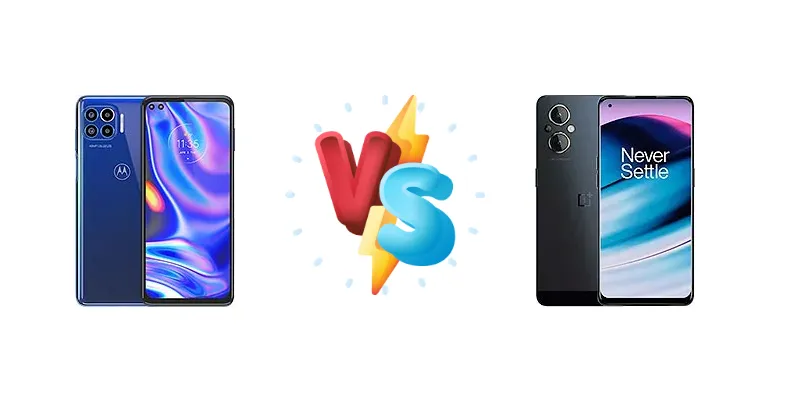
|
🏆 Quick Verdict
For the average user prioritizing faster charging and a brighter display, the OnePlus Nord N20 5G emerges as the better choice. However, the Motorola One 5G’s Snapdragon 765 offers a performance edge in sustained workloads, making it suitable for power users.
| PHONES | ||
|---|---|---|
| Phone Names | Motorola One 5G | OnePlus Nord N20 5G |
| Network | ||
|---|---|---|
| 2G bands | GSM 850 / 900 / 1800 / 1900 | GSM 850 / 900 / 1800 / 1900 |
| 3G bands | HSDPA 850 / 900 / 1700(AWS) / 1900 / 2100 | HSDPA 850 / 900 / 1700(AWS) / 1900 / 2100 |
| 4G bands | 1, 2, 3, 4, 5, 7, 8, 12, 13, 14, 17, 18, 19, 20, 25, 26, 29, 30, 38, 39, 40, 41, 66, 71 | 1, 2, 3, 4, 5, 7, 8, 12, 13, 17, 20, 25, 26, 28, 38, 39, 40, 41, 66, 71 |
| 5G bands | 2, 5, 25, 41, 66, 71 SA/NSA | 2, 25, 41, 66, 71 SA/NSA |
| Speed | HSPA, LTE, 5G | HSPA 42.2/5.76 Mbps, LTE Cat15 800/200 Mbps, 5G |
| Technology | GSM / HSPA / LTE / 5G | GSM / HSPA / LTE / 5G |
| Launch | ||
|---|---|---|
| Announced | 2020, September 01. Released 2020, September 14 | 2022, April 28 |
| Status | Discontinued | Available. Released 2022, April 28 |
| Body | ||
|---|---|---|
| Build | Glass front, plastic back, plastic frame | Glass front (Schott Xensation Up), plastic frame, plastic back |
| Dimensions | 168 x 74 x 9 mm (6.61 x 2.91 x 0.35 in) | 159.9 x 73.2 x 7.5 mm (6.30 x 2.88 x 0.30 in) |
| SIM | Nano-SIM | Nano-SIM |
| Weight | 207 g (7.30 oz) | 173 g (6.10 oz) |
| Water-repellent coating | - | |
| Display | ||
|---|---|---|
| Protection | - | Schott Xensation Up |
| Resolution | 1080 x 2520 pixels, 21:9 ratio (~409 ppi density) | 1080 x 2400 pixels, 20:9 ratio (~409 ppi density) |
| Size | 6.7 inches, 104.9 cm2 (~84.3% screen-to-body ratio) | 6.43 inches, 99.8 cm2 (~85.3% screen-to-body ratio) |
| Type | IPS LCD, 90Hz, HDR10 | AMOLED |
| - | Always-on display | |
| Platform | ||
|---|---|---|
| CPU | Octa-core (1x2.3 GHz Kryo 475 Prime & 1x2.2 GHz Kryo 475 Gold & 6x1.8 GHz Kryo 475 Silver) | Octa-core (2x2.2 GHz Kryo 660 Gold & 6x1.7 GHz Kryo 660 Silver) |
| Chipset | Qualcomm SM7250 Snapdragon 765 5G (7 nm) | Qualcomm SM6375 Snapdragon 695 5G (6 nm) |
| GPU | Adreno 620 | Adreno 619 |
| OS | Android 10 | Android 11, OxygenOS 11 |
| Memory | ||
|---|---|---|
| Card slot | microSDXC (dedicated slot) | microSDXC (dedicated slot) |
| Internal | 128GB 4GB RAM | 128GB 6GB RAM |
| UFS 2.1 | UFS 2.2 | |
| Main Camera | ||
|---|---|---|
| Features | Dual-LED flash, ring flash (macro camera), panorama, HDR | LED flash, HDR, panorama |
| Quad | 48 MP, f/1.8, 26mm (wide), 1/2.0", 0.8µm, PDAF 8 MP, f/2.2, 118˚ (ultrawide), 1.12µm 5 MP (macro), AF Auxiliary lens | - |
| Single | - | 16 MP, f/2.4, (wide) |
| Triple | - | 64 MP, f/1.8, (wide), PDAF 2 MP (macro) Auxiliary lens |
| Video | 4K@30fps, 1080p@30/60fps, gyro-EIS | 1080p@30fps |
| Selfie camera | ||
|---|---|---|
| Dual | 16 MP, f/2.0, (wide), 1.0µm 8 MP, f/2.2, (ultrawide), 1.12µm | - |
| Features | HDR | HDR |
| Single | - | 16 MP, f/2.4, (wide) |
| Video | 1080p@30fps | 1080p@30fps |
| Sound | ||
|---|---|---|
| 3.5mm jack | Yes | Yes |
| 35mm jack | Yes | Yes |
| Loudspeaker | Yes | Yes |
| Comms | ||
|---|---|---|
| Bluetooth | 5.1, A2DP, LE | 5.1, A2DP, LE |
| NFC | Yes | Yes |
| Positioning | GPS (L1+L5), GLONASS, GALILEO | GPS (L1+L5), GLONASS, GALILEO, BDS |
| Radio | FM radio | No |
| USB | USB Type-C 2.0 | USB Type-C 2.0, OTG |
| WLAN | Wi-Fi 802.11 a/b/g/n/ac, dual-band, Wi-Fi Direct | Wi-Fi 802.11 a/b/g/n/ac, dual-band, Wi-Fi Direct |
| Features | ||
|---|---|---|
| Sensors | Fingerprint (side-mounted), accelerometer, gyro, proximity, compass | Fingerprint (under display, optical), accelerometer, gyro, proximity, compass, barometer |
| Battery | ||
|---|---|---|
| Charging | 15W wired | 33W wired |
| Type | Li-Po 5000 mAh | Li-Po 4500 mAh |
| Misc | ||
|---|---|---|
| Colors | Oxford Blue | Blue |
| Models | - | GN2200, CPH2459 |
| Price | About 420 EUR | About 120 EUR |
| Tests | ||
|---|---|---|
| Battery life | - | Endurance rating 129h |
| Display | - | Contrast ratio: Infinite (nominal) |
| Performance | - | AnTuTu: 316974 (v8), 380672 (v9) GeekBench: 1945 (v5.1) GFXBench: 16fps (ES 3.1 onscreen) |
Motorola One 5G
- Potentially stronger CPU performance for demanding tasks
- Snapdragon 765 offers a more mature 5G modem
- May offer a more stock Android experience
- Significantly slower 15W charging
- Display specifications are less impressive
- Potentially less efficient chipset
OnePlus Nord N20 5G
- Much faster 33W charging
- Brighter display for better outdoor visibility
- More modern Snapdragon 695 chipset
- CPU may be slightly less powerful in peak loads
- Image processing may be overly saturated for some users
- Potentially less long-term software support
Display Comparison
The OnePlus Nord N20 5G boasts a notably brighter display, reaching a measured peak brightness of 647 nits, compared to an unspecified brightness for the Motorola One 5G. This difference translates to superior visibility in direct sunlight. While both displays are advertised with an 'infinite' contrast ratio (typical for OLED/AMOLED panels), the higher brightness of the Nord N20 5G provides a more impactful visual experience. The Motorola One 5G’s display specifications are less detailed, suggesting a potentially less vibrant or color-accurate panel.
Camera Comparison
Detailed camera specifications are lacking for both devices. However, given the market positioning, it’s reasonable to assume both phones feature a primary camera sensor around the 48MP-64MP range. The absence of optical image stabilization (OIS) details for either phone suggests it’s unlikely to be present. Image processing will likely be a key differentiator, with OnePlus generally favoring more saturated and contrast-rich images, while Motorola tends towards a more natural look. Without specific sensor size or aperture information, a definitive camera comparison is difficult.
Performance
The core difference lies in the chipsets: the Motorola One 5G utilizes the Qualcomm SM7250 Snapdragon 765 5G (7nm), while the OnePlus Nord N20 5G features the SM6375 Snapdragon 695 5G (6nm). Although the 6nm process of the Snapdragon 695 is more efficient, the Snapdragon 765’s CPU configuration – with a higher clocked Kryo 475 Prime core at 2.3 GHz versus the Nord N20’s 2.2 GHz Kryo 660 Gold cores – suggests a performance advantage in single-core tasks. However, the Snapdragon 695’s newer architecture may offer better sustained performance in some scenarios. The Motorola One 5G’s CPU has a more complex core arrangement (1+1+6) compared to the Nord N20’s (2+6), potentially impacting multi-threaded performance.
Battery Life
Both the Motorola One 5G and OnePlus Nord N20 5G achieve an endurance rating of 129 hours, indicating similar overall battery life. However, the charging speeds differ dramatically. The OnePlus Nord N20 5G supports 33W wired charging, significantly faster than the Motorola One 5G’s 15W charging. This means the Nord N20 5G can replenish its battery much quicker, reducing downtime. While battery capacity isn’t specified, the faster charging speed of the Nord N20 5G is a substantial advantage for users who prioritize convenience.
Buying Guide
Buy the Motorola One 5G if you frequently engage in demanding tasks like mobile gaming or video editing and value a chipset capable of handling sustained loads. Buy the OnePlus Nord N20 5G if you prioritize a vibrant display, significantly faster charging speeds, and a generally smoother everyday experience, even if it means a slight performance trade-off.