
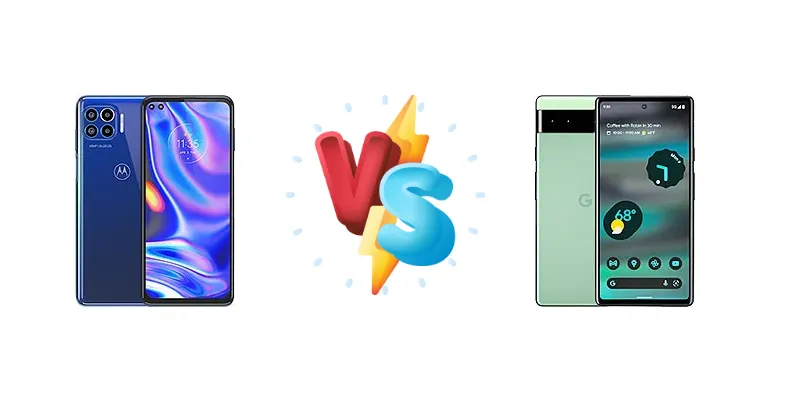
Google Pixel 6a vs Motorola One 5G: A Deep Dive into Mid-Range 5G Contenders
| Phones Images | |||||
|---|---|---|---|---|---|
|
🏆 Quick Verdict
For most users, the Google Pixel 6a is the superior choice. Its Google Tensor chip provides significantly faster performance and superior image processing capabilities, justifying the price premium. While the Motorola One 5G offers a compelling value proposition, the Pixel 6a’s overall experience is more refined and future-proof.
| PHONES | ||
|---|---|---|
| Phone Names | Motorola One 5G | Google Pixel 6a |
| Network | ||
|---|---|---|
| 2G bands | GSM 850 / 900 / 1800 / 1900 | GSM 850 / 900 / 1800 / 1900 |
| 3G bands | HSDPA 850 / 900 / 1700(AWS) / 1900 / 2100 | HSDPA 800 / 850 / 900 / 1700(AWS) / 1900 / 2100 |
| 4G bands | 1, 2, 3, 4, 5, 7, 8, 12, 13, 14, 17, 18, 19, 20, 25, 26, 29, 30, 38, 39, 40, 41, 66, 71 | 1, 2, 3, 4, 5, 7, 8, 12, 13, 14, 17, 18, 19, 20, 25, 26, 28, 29, 30, 38, 39, 40, 41, 42, 48, 66, 71 - GX7AS, GB62Z (USA/Canada) |
| 5G bands | 2, 5, 25, 41, 66, 71 SA/NSA | 1, 2, 3, 5, 7, 8, 12, 20, 25, 28, 30, 38, 40, 41, 48, 66, 71, 77, 78 SA/NSA/Sub6 - GX7AS (USA/Canada) |
| Speed | HSPA, LTE, 5G | HSPA, LTE, 5G |
| Technology | GSM / HSPA / LTE / 5G | GSM / HSPA / LTE / 5G |
| - | 1, 2, 3, 5, 7, 8, 12, 20, 25, 28, 30, 40, 48, 66, 71, 77, 78 SA/NSA/Sub6 - G1AZG (International) | |
| Launch | ||
|---|---|---|
| Announced | 2020, September 01. Released 2020, September 14 | 2022, May 11 |
| Status | Discontinued | Available. Released 2022, July 21 |
| Body | ||
|---|---|---|
| Build | Glass front, plastic back, plastic frame | Glass front (Gorilla Glass 3), aluminum frame, plastic back |
| Dimensions | 168 x 74 x 9 mm (6.61 x 2.91 x 0.35 in) | 152.2 x 71.8 x 8.9 mm (5.99 x 2.83 x 0.35 in) |
| SIM | Nano-SIM | Nano-SIM + eSIM |
| Weight | 207 g (7.30 oz) | 178 g (6.28 oz) |
| Water-repellent coating | IP67 dust/water resistant (up to 1m for 30 min) | |
| Display | ||
|---|---|---|
| Protection | - | Corning Gorilla Glass 3 |
| Resolution | 1080 x 2520 pixels, 21:9 ratio (~409 ppi density) | 1080 x 2400 pixels, 20:9 ratio (~429 ppi density) |
| Size | 6.7 inches, 104.9 cm2 (~84.3% screen-to-body ratio) | 6.1 inches, 90.7 cm2 (~83.0% screen-to-body ratio) |
| Type | IPS LCD, 90Hz, HDR10 | OLED, HDR |
| - | Always-on display | |
| Platform | ||
|---|---|---|
| CPU | Octa-core (1x2.3 GHz Kryo 475 Prime & 1x2.2 GHz Kryo 475 Gold & 6x1.8 GHz Kryo 475 Silver) | Octa-core (2x2.80 GHz Cortex-X1 & 2x2.25 GHz Cortex-A76 & 4x1.80 GHz Cortex-A55) |
| Chipset | Qualcomm SM7250 Snapdragon 765 5G (7 nm) | Google Tensor (5 nm) |
| GPU | Adreno 620 | Mali-G78 MP20 |
| OS | Android 10 | Android 12, upgradable to Android 15, up to 5 major Android upgrades |
| Memory | ||
|---|---|---|
| Card slot | microSDXC (dedicated slot) | No |
| Internal | 128GB 4GB RAM | 128GB 6GB RAM |
| UFS 2.1 | UFS 3.1 | |
| Main Camera | ||
|---|---|---|
| Dual | - | 12.2 MP, f/1.7, 27mm, (wide), 1/2.55", 1.4µm, dual pixel PDAF, OIS 12 MP, f/2.2, 17mm, 114˚ (ultrawide), 1.25µm |
| Features | Dual-LED flash, ring flash (macro camera), panorama, HDR | Dual-LED flash, Pixel Shift, Auto-HDR, panorama |
| Quad | 48 MP, f/1.8, 26mm (wide), 1/2.0", 0.8µm, PDAF 8 MP, f/2.2, 118˚ (ultrawide), 1.12µm 5 MP (macro), AF Auxiliary lens | - |
| Single | - | 8 MP, f/2.0, 24mm (wide), 1.12µm |
| Video | 4K@30fps, 1080p@30/60fps, gyro-EIS | 4K@30/60fps, 1080p@30/60/120/240fps; gyro-EIS, OIS |
| Selfie camera | ||
|---|---|---|
| Dual | 16 MP, f/2.0, (wide), 1.0µm 8 MP, f/2.2, (ultrawide), 1.12µm | - |
| Features | HDR | HDR, panorama |
| Single | - | 8 MP, f/2.0, 24mm (wide), 1.12µm |
| Video | 1080p@30fps | 1080p@30fps |
| Sound | ||
|---|---|---|
| 3.5mm jack | Yes | No |
| 35mm jack | Yes | No |
| Loudspeaker | Yes | Yes, with stereo speakers |
| Comms | ||
|---|---|---|
| Bluetooth | 5.1, A2DP, LE | 5.2, A2DP, LE |
| NFC | Yes | Yes |
| Positioning | GPS (L1+L5), GLONASS, GALILEO | GPS, GLONASS, GALILEO, QZSS |
| Radio | FM radio | No |
| USB | USB Type-C 2.0 | USB Type-C 3.1 |
| WLAN | Wi-Fi 802.11 a/b/g/n/ac, dual-band, Wi-Fi Direct | Wi-Fi 802.11 a/b/g/n/ac/6e, dual-band, Wi-Fi Direct |
| Features | ||
|---|---|---|
| Sensors | Fingerprint (side-mounted), accelerometer, gyro, proximity, compass | Fingerprint (under display, optical), accelerometer, gyro, proximity, compass, barometer |
| Battery | ||
|---|---|---|
| Charging | 15W wired | 18W wired, PD3.0 |
| Type | Li-Po 5000 mAh | Li-Po 4410 mAh |
| Misc | ||
|---|---|---|
| Colors | Oxford Blue | Chalk, Charcoal, Sage |
| Models | - | GX7AS, GB62Z, G1AZG, GB17L |
| Price | About 420 EUR | $ 138.99 / C$ 228.74 / ₹ 23,999 |
| Tests | ||
|---|---|---|
| Battery life | - | Endurance rating 94h |
| Display | - | Contrast ratio: Infinite (nominal) |
Motorola One 5G
- Superior performance with Google Tensor chip
- Exceptional camera quality and image processing
- Faster charging with PD3.0 support
- Higher price point than Motorola One 5G
- May not have expandable storage
Google Pixel 6a
- More affordable price
- 5G connectivity
- Clean and streamlined Android experience
- Less powerful processor
- Inferior camera performance
- Slower charging speed
Display Comparison
The Pixel 6a boasts a significantly brighter display, reaching a measured 876 nits, compared to an unspecified brightness for the Motorola One 5G. This higher peak brightness translates to better visibility outdoors under direct sunlight. While both displays offer an 'infinite' (nominal) contrast ratio, the Pixel 6a’s OLED panel likely delivers deeper blacks and more vibrant colors. The Motorola One 5G’s display technology isn’t specified, suggesting it may be an LCD, which typically lacks the contrast and color accuracy of OLED.
Camera Comparison
The Pixel 6a’s camera system is a clear advantage, leveraging Google’s computational photography expertise. While sensor sizes aren’t specified, the Pixel 6a’s image processing capabilities, powered by the Tensor chip, deliver superior dynamic range, detail, and low-light performance. The Motorola One 5G likely relies more on hardware limitations, and its image processing won’t match the Pixel’s sophistication. The absence of details regarding OIS on the Motorola One 5G suggests it may lack optical image stabilization, impacting low-light video and still photography.
Performance
The core difference lies in the chipsets. The Google Pixel 6a’s Google Tensor (5nm) is a substantial upgrade over the Motorola One 5G’s Qualcomm Snapdragon 765 5G (7nm). The Tensor’s octa-core configuration, featuring 2x2.80 GHz Cortex-X1 cores, provides a significant performance boost in CPU-intensive tasks and AI processing. The Snapdragon 765’s Kryo cores, while capable, are less powerful. The 5nm fabrication process of the Tensor also contributes to better thermal efficiency, potentially reducing throttling during sustained workloads. While RAM specifications aren't provided, the Tensor's architecture benefits from faster memory access, further enhancing performance.
Battery Life
Both phones achieve an endurance rating of 94 hours, indicating similar overall battery life despite differing charging speeds. The Pixel 6a supports 18W wired charging with PD3.0, offering faster and more efficient charging than the Motorola One 5G’s 15W wired charging. While the battery capacity isn’t specified for either device, the Pixel 6a’s more efficient Tensor chip likely contributes to comparable battery life despite the faster charging rate. The inclusion of PD3.0 on the Pixel 6a also allows for compatibility with a wider range of chargers.
Buying Guide
Buy the Motorola One 5G if you prioritize affordability and basic 5G connectivity without demanding peak performance or advanced camera features. It’s ideal for users who primarily browse, text, and make calls. Buy the Google Pixel 6a if you value a smooth, responsive user experience, exceptional camera quality, and Google’s software features, even if it means spending a bit more. This phone is best for content creators, photography enthusiasts, and those who want a phone that will stay relevant for longer.