
Google Pixel 5a 5G vs Motorola One 5G: A Detailed Comparison
| Phones Images | |||||
|---|---|---|---|---|---|
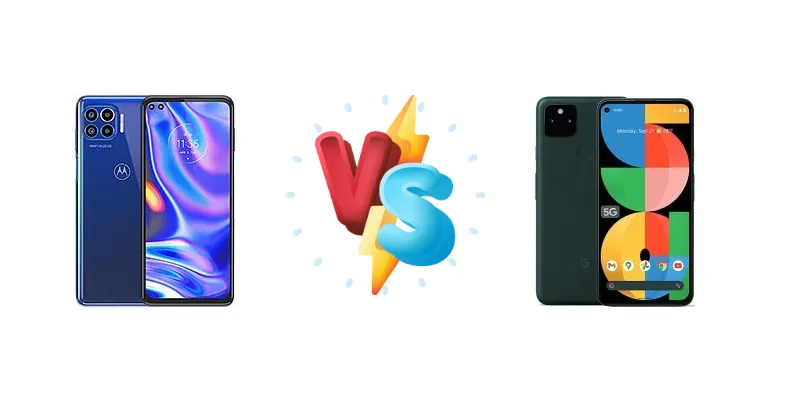
|
🏆 Quick Verdict
For the average user, the Google Pixel 5a 5G is the better choice. While both phones share the same Snapdragon 765 5G chipset family, the Pixel 5a 5G’s brighter display, faster 18W PD2.0 charging, and Google’s superior image processing provide a more polished and enjoyable user experience.
| PHONES | ||
|---|---|---|
| Phone Names | Motorola One 5G | Google Pixel 5a 5G |
| Network | ||
|---|---|---|
| 2G bands | GSM 850 / 900 / 1800 / 1900 | GSM 850 / 900 / 1800 / 1900 |
| 3G bands | HSDPA 850 / 900 / 1700(AWS) / 1900 / 2100 | HSDPA 850 / 900 / 1700(AWS) / 1900 / 2100 |
| 4G bands | 1, 2, 3, 4, 5, 7, 8, 12, 13, 14, 17, 18, 19, 20, 25, 26, 29, 30, 38, 39, 40, 41, 66, 71 | 1, 2, 3, 4, 5, 7, 8, 12, 13, 14, 17, 18, 19, 20, 25, 26, 28, 29, 30, 32, 38, 39, 40, 41, 42, 46, 48, 66, 71 |
| 5G bands | 2, 5, 25, 41, 66, 71 SA/NSA | 1, 2, 5, 12, 25, 28, 41, 66, 71, 77, 78 SA/NSA/Sub6 |
| Speed | HSPA, LTE, 5G | HSPA, LTE, 5G |
| Technology | GSM / HSPA / LTE / 5G | GSM / HSPA / EVDO / LTE / 5G |
| - | CDMA2000 1xEV-DO | |
| Launch | ||
|---|---|---|
| Announced | 2020, September 01. Released 2020, September 14 | 2021, August 17 |
| Status | Discontinued | Available. Released 2021, August 26 |
| Body | ||
|---|---|---|
| Build | Glass front, plastic back, plastic frame | Glass front (Gorilla Glass 3), aluminum frame, aluminum back |
| Dimensions | 168 x 74 x 9 mm (6.61 x 2.91 x 0.35 in) | 156.2 x 73.2 x 8.8 mm (6.15 x 2.88 x 0.35 in) |
| SIM | Nano-SIM | Nano-SIM + eSIM |
| Weight | 207 g (7.30 oz) | 183 g (6.46 oz) |
| Water-repellent coating | IP67 dust/water resistant (up to 1m for 30 min) | |
| Display | ||
|---|---|---|
| Protection | - | Corning Gorilla Glass 3 |
| Resolution | 1080 x 2520 pixels, 21:9 ratio (~409 ppi density) | 1080 x 2400 pixels, 20:9 ratio (~415 ppi density) |
| Size | 6.7 inches, 104.9 cm2 (~84.3% screen-to-body ratio) | 6.34 inches, 97.0 cm2 (~84.9% screen-to-body ratio) |
| Type | IPS LCD, 90Hz, HDR10 | OLED, HDR |
| - | Always-on display | |
| Platform | ||
|---|---|---|
| CPU | Octa-core (1x2.3 GHz Kryo 475 Prime & 1x2.2 GHz Kryo 475 Gold & 6x1.8 GHz Kryo 475 Silver) | Octa-core (1x2.4 GHz Kryo 475 Prime & 1x2.2 GHz Kryo 475 Gold & 6x1.8 GHz Kryo 475 Silver) |
| Chipset | Qualcomm SM7250 Snapdragon 765 5G (7 nm) | Qualcomm SM7250 Snapdragon 765G 5G (7 nm) |
| GPU | Adreno 620 | Adreno 620 |
| OS | Android 10 | Android 11, upgradable to Android 14 |
| Memory | ||
|---|---|---|
| Card slot | microSDXC (dedicated slot) | No |
| Internal | 128GB 4GB RAM | 128GB 6GB RAM |
| UFS 2.1 | - | |
| Main Camera | ||
|---|---|---|
| Dual | - | 12.2 MP, f/1.7, 27mm, (wide), 1/2.55", 1.4µm, dual pixel PDAF, OIS 16 MP, f/2.2, 119˚ (ultrawide), 1.0µm |
| Features | Dual-LED flash, ring flash (macro camera), panorama, HDR | LED flash, Pixel Shift, Auto-HDR, panorama |
| Quad | 48 MP, f/1.8, 26mm (wide), 1/2.0", 0.8µm, PDAF 8 MP, f/2.2, 118˚ (ultrawide), 1.12µm 5 MP (macro), AF Auxiliary lens | - |
| Single | - | 8 MP, f/2.0, 24mm (wide), 1.12µm |
| Video | 4K@30fps, 1080p@30/60fps, gyro-EIS | 4K@30/60fps, 1080p@30/60/120/240fps; gyro-EIS |
| Selfie camera | ||
|---|---|---|
| Dual | 16 MP, f/2.0, (wide), 1.0µm 8 MP, f/2.2, (ultrawide), 1.12µm | - |
| Features | HDR | HDR |
| Single | - | 8 MP, f/2.0, 24mm (wide), 1.12µm |
| Video | 1080p@30fps | 1080p@30fps |
| Sound | ||
|---|---|---|
| 3.5mm jack | Yes | Yes |
| 35mm jack | Yes | Yes |
| Loudspeaker | Yes | Yes, with stereo speakers |
| Comms | ||
|---|---|---|
| Bluetooth | 5.1, A2DP, LE | 5.0, A2DP, LE, aptX HD |
| NFC | Yes | Yes |
| Positioning | GPS (L1+L5), GLONASS, GALILEO | GPS, GLONASS, GALILEO, QZSS, BDS |
| Radio | FM radio | No |
| USB | USB Type-C 2.0 | USB Type-C 3.1 |
| WLAN | Wi-Fi 802.11 a/b/g/n/ac, dual-band, Wi-Fi Direct | Wi-Fi 802.11 a/b/g/n/ac, dual-band, Wi-Fi Direct |
| Features | ||
|---|---|---|
| Sensors | Fingerprint (side-mounted), accelerometer, gyro, proximity, compass | Fingerprint (rear-mounted), accelerometer, gyro, proximity, compass, barometer |
| Battery | ||
|---|---|---|
| Charging | 15W wired | 18W wired, PD2.0 |
| Type | Li-Po 5000 mAh | Li-Po 4680 mAh |
| Misc | ||
|---|---|---|
| Colors | Oxford Blue | Mostly Black |
| Models | - | G1F8F, G4S1M |
| Price | About 420 EUR | $ 189.00 / C$ 249.99 |
| Tests | ||
|---|---|---|
| Battery life | - | Endurance rating 122h |
| Display | - | Contrast ratio: Infinite (nominal) |
| Performance | - | AnTuTu: 291303 (v8) GeekBench: 1337 (v5.1) GFXBench: 19fps (ES 3.1 onscreen) |
Motorola One 5G
- More affordable price point
- Functional 5G connectivity
- Decent battery life
- Dimmer display compared to Pixel 5a 5G
- Slower 15W charging
- Less refined camera software
Google Pixel 5a 5G
- Brighter and more vibrant display
- Faster 18W PD2.0 charging
- Superior camera image processing
- Higher price than Motorola One 5G
- Similar chipset performance to Motorola One 5G
- May be harder to find new
Display Comparison
The Google Pixel 5a 5G boasts a significantly brighter display, reaching a measured 861 nits, compared to an unspecified brightness for the Motorola One 5G. This higher peak brightness translates to better visibility outdoors under direct sunlight. Both displays feature an infinite (nominal) contrast ratio, suggesting excellent black levels. While both likely utilize OLED panels, the Pixel 5a 5G’s superior brightness is a clear advantage for media consumption and everyday use.
Camera Comparison
While both phones likely feature similar camera hardware configurations beyond the main sensor, the Pixel 5a 5G’s strength lies in Google’s computational photography. The Pixel’s image processing excels in dynamic range, detail preservation, and low-light performance. The Motorola One 5G’s camera system, while capable, lacks the software refinement of the Pixel. Details regarding sensor sizes and apertures are missing, but the Pixel’s software advantage is a significant differentiator.
Performance
Both devices are powered by the Qualcomm Snapdragon 765 5G (7nm) chipset, but the Pixel 5a 5G features a slightly higher clocked Kryo 475 Prime core at 2.4 GHz versus the Motorola One 5G’s 2.3 GHz. This minor clock speed difference likely results in a negligible performance gain in most real-world scenarios. Both phones share the same CPU core configuration (1x2.2 GHz Kryo 475 Gold & 6x1.8 GHz Kryo 475 Silver). The impact of RAM speed isn't specified, but both likely utilize LPDDR4X. Thermal management will likely be similar, given the identical chipset architecture, though Google’s software optimization could provide a slight edge.
Battery Life
Both the Motorola One 5G and Google Pixel 5a 5G achieve an endurance rating of 122 hours, indicating comparable battery life under similar usage patterns. However, the Pixel 5a 5G supports 18W wired charging with PD2.0, offering faster charging speeds than the Motorola One 5G’s 15W charging. This means the Pixel 5a 5G can replenish its battery more quickly, reducing downtime.
Buying Guide
Buy the Motorola One 5G if you need a functional 5G phone on a very tight budget and prioritize affordability above all else. Buy the Google Pixel 5a 5G if you value a brighter, more vibrant display, faster charging speeds, and Google’s exceptional camera software, even if it means spending a bit more.