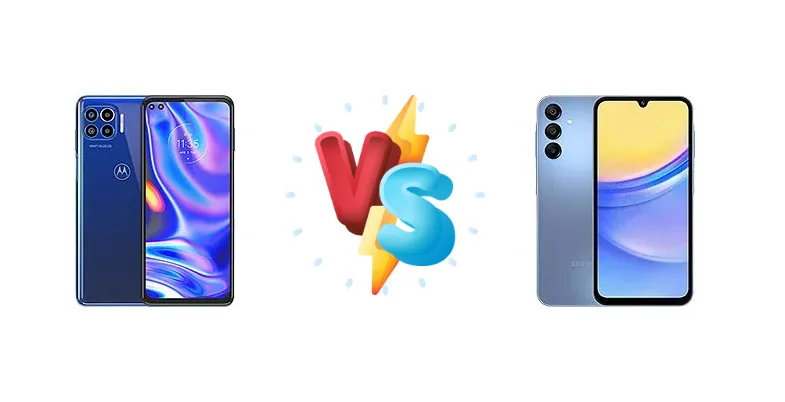
The Motorola One 5G UW and Samsung Galaxy A15 5G represent compelling options in the increasingly competitive sub-$300 5G smartphone market. The Motorola, leveraging Qualcomm's Snapdragon 765G, aims for a balance of performance and connectivity, while the Samsung focuses on delivering a long-lasting experience with its Mediatek Dimensity 6100+ and optimized battery. This comparison dissects their strengths and weaknesses to determine which device best suits your needs.
🏆 Quick Verdict
For the average user prioritizing battery life and a brighter display, the Samsung Galaxy A15 5G emerges as the better choice. While the Motorola One 5G UW offers a slightly older but still capable chipset, the A15’s superior battery performance and screen visibility give it a decisive edge in everyday use.
| Network |
|---|
| 2G bands | GSM 850 / 900 / 1800 / 1900 | GSM 850 / 900 / 1800 / 1900 |
| 3G bands | HSDPA 850 / 900 / 1900 / 2100 | HSDPA 850 / 900 / 1700(AWS) / 1900 / 2100 |
| 4G bands | 2, 4, 5, 12, 13, 66 | 1, 2, 3, 4, 5, 7, 8, 12, 17, 20, 26, 28, 38, 40, 41, 66 |
| 5G bands | 2, 5, 66, 260, 261 mmWave | 1, 3, 5, 7, 8, 26, 28, 40, 41, 66, 77, 78 SA/NSA/Sub6 |
| Speed | HSPA, LTE, 5G | HSPA, LTE, 5G |
| Technology | GSM / HSPA / LTE / 5G | GSM / HSPA / LTE / 5G |
| Launch |
|---|
| Announced | 2020, October 16. Released 2020, October 16 | 2023, December 11 |
| Status | Discontinued | Available. Released 2023, December 16 |
| Body |
|---|
| Build | Glass front, plastic back, plastic frame | Glass front, plastic back, plastic frame |
| Dimensions | 167.9 x 73.9 x 8.9 mm (6.61 x 2.91 x 0.35 in) | 160.1 x 76.8 x 8.4 mm (6.30 x 3.02 x 0.33 in) |
| SIM | Nano-SIM (pre-installed) | · Nano-SIM· Nano-SIM + Nano-SIM |
| Weight | 209.8 g (7.41 oz) | 200 g (7.05 oz) |
| | Water-repellent coating | - |
| Display |
|---|
| Resolution | 1080 x 2520 pixels, 21:9 ratio (~409 ppi density) | 1080 x 2340 pixels, 19.5:9 ratio (~396 ppi density) |
| Size | 6.7 inches, 104.9 cm2 (~84.5% screen-to-body ratio) | 6.5 inches, 103.7 cm2 (~84.3% screen-to-body ratio) |
| Type | IPS LCD, 90Hz, HDR10 | Super AMOLED, 90Hz, 800 nits (HBM) |
| Platform |
|---|
| CPU | Octa-core (1x2.3 GHz Kryo 475 Prime & 1x2.2 GHz Kryo 475 Gold & 6x1.8 GHz Kryo 475 Silver) | Octa-core (2x2.2 GHz Cortex-A76 & 6x2.0 GHz Cortex-A55) |
| Chipset | Qualcomm SM7250 Snapdragon 765 5G (7 nm) | Mediatek Dimensity 6100+ (6 nm) |
| GPU | Adreno 620 | Mali-G57 MC2 |
| OS | Android 10, upgradable to Android 11 | Android 14, upgradable to Android 16, One UI 8, up to 4 major Android upgrades |
| Memory |
|---|
| Card slot | microSDXC (dedicated slot) | microSDXC (uses shared SIM slot) |
| Internal | 128GB 4GB RAM | 64GB 4GB RAM, 128GB 4GB RAM, 128GB 6GB RAM, 128GB 8GB RAM, 256GB 8GB RAM |
| | UFS 2.1 | - |
| Main Camera |
|---|
| Features | Dual-LED flash, ring flash (macro camera), panorama, HDR | LED flash, panorama, HDR |
| Quad | 48 MP, f/1.8, 26mm (wide), 1/2.0", 0.8µm, PDAF
8 MP, f/2.2, 118˚ (ultrawide), 1.12µm
5 MP (macro), AF
Auxiliary lens | - |
| Triple | - | 50 MP, f/1.8, (wide), AF
5 MP, f/2.2, (ultrawide)
2 MP (macro) |
| Video | 4K@30fps, 1080p@30/60fps, gyro-EIS | 1080p@30fps, gyro-EIS |
| Selfie camera |
|---|
| Dual | 16 MP, f/2.0, (wide), 1.0µm
8 MP, f/2.2, (ultrawide), 1.12µm | - |
| Features | HDR | - |
| Single | - | 13 MP, f/2.0, (wide) |
| Video | 1080p@30fps | 1080p@30fps |
| Sound |
|---|
| 3.5mm jack | Yes | - |
| 35mm jack | Yes | Yes |
| Loudspeaker | Yes | Yes |
| Comms |
|---|
| Bluetooth | 5.1, A2DP, LE | 5.3, A2DP, LE |
| NFC | Yes | Yes (market/region dependent) |
| Positioning | GPS (L1+L5), GLONASS, GALILEO | GPS, GALILEO, GLONASS, BDS, QZSS |
| Radio | FM radio | No |
| USB | USB Type-C 2.0 | USB Type-C 2.0 |
| WLAN | Wi-Fi 802.11 a/b/g/n/ac, dual-band, Wi-Fi Direct | Wi-Fi 802.11 a/b/g/n/ac, dual-band, Wi-Fi Direct |
| Features |
|---|
| Sensors | Fingerprint (side-mounted), accelerometer, gyro, proximity, compass | Fingerprint (side-mounted), accelerometer, gyro, compass |
| Battery |
|---|
| Charging | 15W wired | 25W wired |
| Type | Li-Po 5000 mAh | 5000 mAh |
| Misc |
|---|
| Colors | Oxford Blue | Brave Black, Personality Yellow, Magical Blue, Optimistic Blue |
| Models | - | SM-A156B, SM-A156B/DS, SM-A156P, SM-A156P/DS, SM-A156U, SM-A156U1, SM-A156U1/DS, SM-A156W, SM-A156P/N, SM-A156P/DSN, SM-S156VL, SM-A156M, SM-A156E, SM-A156E/DSN |
| Price | About 470 EUR | € 167.00 / $ 79.97 / ₹ 17,490 |
| SAR | 0.98 W/kg (head) | - |
| SAR EU | - | 0.80 W/kg (head) 1.46 W/kg (body) |
Motorola One 5G UW
- Established Snapdragon 765G chipset
- Potential for near-stock Android experience
- 5G connectivity
- Slower 15W charging
- Unknown display brightness
- Battery life likely inferior to A15
Samsung Galaxy A15 5G
- Excellent 14:31 hour battery life
- Bright 786 nit display
- Faster 25W charging
- Mediatek Dimensity 6100+ may not match Snapdragon in all tasks
- Samsung’s One UI can be resource intensive
- Camera performance likely average
Display Comparison
The Samsung Galaxy A15 5G boasts a significantly brighter display, reaching a measured 786 nits, compared to an assumed lower brightness on the Motorola One 5G UW (data unavailable). This brightness advantage translates to superior visibility in direct sunlight. While panel technology details are missing for both, the A15’s higher peak brightness is a clear win for outdoor users. The Motorola’s display specs are unknown, making a detailed comparison of color accuracy and viewing angles impossible, but the A15’s brightness alone is a substantial advantage.
Camera Comparison
Camera details beyond sensor counts are unavailable for both devices. However, given the market positioning, it’s unlikely either phone features a flagship-level camera system. The focus should be on everyday photography. Without specific aperture or sensor size data, it’s difficult to definitively declare a winner. The Motorola One 5G UW likely relies on Qualcomm’s image signal processor (ISP) for processing, while the Samsung utilizes Mediatek’s. Image processing preferences are subjective, but Samsung’s generally produces more vibrant, saturated images, while Motorola aims for more natural tones. The presence of a 2MP macro lens on either device is largely inconsequential due to its limited resolution and image quality.
Performance
The Motorola One 5G UW utilizes the Qualcomm Snapdragon 765 5G (7nm), while the Samsung Galaxy A15 5G features the Mediatek Dimensity 6100+ (6nm). The Dimensity 6100+ benefits from a more modern 6nm process, potentially offering improved power efficiency. The Snapdragon 765G’s CPU configuration (1x2.3 GHz Kryo 475 Prime, 1x2.2 GHz Kryo 475 Gold, 6x1.8 GHz Kryo 475 Silver) is pitted against the A15’s (2x2.2 GHz Cortex-A76 & 6x2.0 GHz Cortex-A55). While clock speeds are comparable, the Cortex-A76 cores in the Dimensity 6100+ generally offer better single-core performance than the Kryo 475 Gold. The A15’s 6nm process should also result in better thermal management during sustained loads.
Battery Life
The Samsung Galaxy A15 5G shines in battery life, achieving an active use score of 14:31 hours. The Motorola One 5G UW’s battery capacity is unknown, but its 15W wired charging is significantly slower than the A15’s 25W charging. This means the A15 will reach a full charge much faster. The Dimensity 6100+'s 6nm process likely contributes to the A15’s superior battery endurance. While a larger battery capacity on the Motorola could potentially offset the charging speed difference, the A15’s measured runtime demonstrates a clear advantage.
Buying Guide
Buy the Motorola One 5G UW if you prioritize a more established chipset architecture and potentially better software support from Motorola. This phone is ideal for users who occasionally engage in more demanding tasks and value a brand known for near-stock Android. Buy the Samsung Galaxy A15 5G if you prefer a longer-lasting battery, a brighter screen for outdoor visibility, and Samsung’s One UI software experience. This is the better option for media consumption and users who need all-day battery life without compromise.
Frequently Asked Questions
❓ Does the Mediatek Dimensity 6100+ in the Galaxy A15 5G overheat during prolonged gaming sessions?
The Dimensity 6100+’s 6nm process and efficient core design generally result in good thermal management. While it may get warm during extended gaming, it’s unlikely to experience significant throttling like some older or more powerful chipsets. The A15’s thermal design is adequate for its performance class.
❓ Is the 15W charging on the Motorola One 5G UW noticeably slow compared to the A15’s 25W charging?
Yes, the difference is significant. 15W charging will take considerably longer to fully charge the Motorola One 5G UW. The Samsung Galaxy A15 5G’s 25W charging will provide a much faster top-up, especially useful for users who need to quickly replenish their battery.
❓ How does the software experience differ between Motorola’s near-stock Android and Samsung’s One UI?
Motorola offers a cleaner, near-stock Android experience with minimal bloatware, appealing to users who prefer a simple and uncluttered interface. Samsung’s One UI is more feature-rich and customizable, but it can also be more resource-intensive and include pre-installed apps. The choice depends on personal preference.