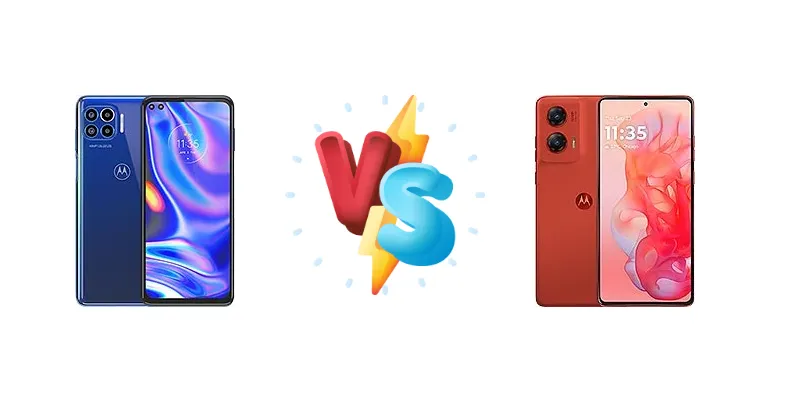
Motorola’s 5G lineup offers compelling value, but navigating the options can be tricky. We’re pitting the older Motorola One 5G UW, leveraging the Snapdragon 765G, against the newer Moto G Stylus 5G (2024) with its Snapdragon 6 Gen 1. This comparison focuses on how architectural differences and new features impact real-world performance and usability, especially considering the Moto G Stylus 5G (2024)'s significant display and charging upgrades.
🏆 Quick Verdict
For most users, the Motorola Moto G Stylus 5G (2024) is the better buy. Its significantly brighter display (1387 nits) and faster 30W charging, including 15W wireless, outweigh the One 5G UW’s slightly older but still capable Snapdragon 765G. The G Stylus offers a more modern and convenient user experience.
| Network |
|---|
| 2G bands | GSM 850 / 900 / 1800 / 1900 | GSM 850 / 900 / 1800 / 1900 |
| 3G bands | HSDPA 850 / 900 / 1900 / 2100 | HSDPA 850 / 900 / 1700(AWS) / 1900 / 2100 |
| 4G bands | 2, 4, 5, 12, 13, 66 | 1, 2, 3, 4, 5, 7, 8, 12, 13, 14, 17, 18, 19, 20, 25, 26, 28, 29, 30, 38, 39, 40, 41, 48, 66, 71 |
| 5G bands | 2, 5, 66, 260, 261 mmWave | 1, 2, 3, 5, 7, 12, 14, 20, 25, 26, 28, 29, 30, 38, 40, 41, 48, 66, 70, 71, 77, 78 SA/NSA/Sub6 |
| Speed | HSPA, LTE, 5G | HSPA, LTE, 5G |
| Technology | GSM / HSPA / LTE / 5G | GSM / HSPA / LTE / 5G |
| Launch |
|---|
| Announced | 2020, October 16. Released 2020, October 16 | 2024, May 10 |
| Status | Discontinued | Available. Released 2024, May 30 |
| Body |
|---|
| Build | Glass front, plastic back, plastic frame | Glass front, silicone polymer (eco leather) back, plastic frame |
| Dimensions | 167.9 x 73.9 x 8.9 mm (6.61 x 2.91 x 0.35 in) | 162.6 x 74.8 x 8.3 mm (6.40 x 2.94 x 0.33 in) |
| SIM | Nano-SIM (pre-installed) | Nano-SIM + eSIM |
| Weight | 209.8 g (7.41 oz) | 190 g (6.70 oz) |
| | Water-repellent coating | - |
| Display |
|---|
| Resolution | 1080 x 2520 pixels, 21:9 ratio (~409 ppi density) | 1080 x 2400 pixels, 20:9 ratio (~395 ppi density) |
| Size | 6.7 inches, 104.9 cm2 (~84.5% screen-to-body ratio) | 6.7 inches, 107.3 cm2 (~88.2% screen-to-body ratio) |
| Type | IPS LCD, 90Hz, HDR10 | P-OLED, 1B colors, 120Hz, 1200 nits (peak) |
| Platform |
|---|
| CPU | Octa-core (1x2.3 GHz Kryo 475 Prime & 1x2.2 GHz Kryo 475 Gold & 6x1.8 GHz Kryo 475 Silver) | Octa-core (4x2.2 GHz Cortex-A78 & 4x1.8 GHz Cortex-A55) |
| Chipset | Qualcomm SM7250 Snapdragon 765 5G (7 nm) | Qualcomm SM6450 Snapdragon 6 Gen 1 (4 nm) |
| GPU | Adreno 620 | Adreno 710 |
| OS | Android 10, upgradable to Android 11 | Android 14, up to 1 major Android upgrades |
| Memory |
|---|
| Card slot | microSDXC (dedicated slot) | microSDXC (dedicated slot) |
| Internal | 128GB 4GB RAM | 128GB 4GB RAM, 128GB 8GB RAM, 256GB 8GB RAM |
| | UFS 2.1 | - |
| Main Camera |
|---|
| Dual | - | 50 MP, f/1.8, 24mm (wide), 1/1.57", 1.0µm, dual-pixel PDAF, OIS
13 MP, f/2.2, 16mm, 120˚ (ultrawide), 1/3.0", 1.12µm, AF |
| Features | Dual-LED flash, ring flash (macro camera), panorama, HDR | LED flash, HDR, panorama |
| Quad | 48 MP, f/1.8, 26mm (wide), 1/2.0", 0.8µm, PDAF
8 MP, f/2.2, 118˚ (ultrawide), 1.12µm
5 MP (macro), AF
Auxiliary lens | - |
| Video | 4K@30fps, 1080p@30/60fps, gyro-EIS | 4K@30fps, 1080p@30/60/120fps |
| Selfie camera |
|---|
| Dual | 16 MP, f/2.0, (wide), 1.0µm
8 MP, f/2.2, (ultrawide), 1.12µm | - |
| Features | HDR | HDR |
| Single | - | 32 MP, f/2.4, 25mm (wide), 1/3.14", 0.7µm |
| Video | 1080p@30fps | 4K@30fps, 1080p@30/60fps |
| Sound |
|---|
| 3.5mm jack | Yes | - |
| 35mm jack | Yes | Yes |
| Loudspeaker | Yes | Yes, with stereo speakers |
| Comms |
|---|
| Bluetooth | 5.1, A2DP, LE | 5.1, A2DP, LE |
| NFC | Yes | Yes |
| Positioning | GPS (L1+L5), GLONASS, GALILEO | GPS, GLONASS, GALILEO |
| Radio | FM radio | FM radio (market/region dependent) |
| USB | USB Type-C 2.0 | USB Type-C 2.0 |
| WLAN | Wi-Fi 802.11 a/b/g/n/ac, dual-band, Wi-Fi Direct | Wi-Fi 802.11 a/b/g/n/ac, dual-band |
| Features |
|---|
| Sensors | Fingerprint (side-mounted), accelerometer, gyro, proximity, compass | Fingerprint (under display, optical), accelerometer, gyro, proximity, compass, barometer |
| Battery |
|---|
| Charging | 15W wired | 30W wired
15W wireless |
| Type | Li-Po 5000 mAh | 5000 mAh |
| Misc |
|---|
| Colors | Oxford Blue | Caramel Latte, Scarlet Wave |
| Models | - | XT2419-2, XT2419-1, XT2419 |
| Price | About 470 EUR | $ 68.66 / C$ 202.25 |
| SAR | 0.98 W/kg (head) | - |
Motorola One 5G UW
- Proven Snapdragon 765G performance
- Potentially lower price point
- 5G connectivity
- Slow 15W charging
- Likely dimmer display
- Older chipset architecture
Motorola Moto G Stylus 5G (2024)
- Significantly brighter display (1387 nits)
- Faster 30W wired and 15W wireless charging
- More efficient Snapdragon 6 Gen 1 (4nm)
- Slightly less powerful CPU core clock speed
- May be slightly more expensive
- Potential for software bloat (typical Motorola)
Display Comparison
The Moto G Stylus 5G (2024) boasts a substantial advantage in display technology. Its measured peak brightness of 1387 nits dramatically surpasses what we’d expect from the One 5G UW, making it far more usable outdoors. While the One 5G UW’s panel specs are unavailable, it’s likely to be significantly dimmer. The G Stylus’s brightness isn’t just about visibility; it impacts HDR content rendering, offering a more dynamic and immersive viewing experience. The lack of information on the One 5G UW’s panel type (LCD vs OLED) further solidifies the G Stylus’s lead.
Camera Comparison
Without detailed camera specs for either device, a direct comparison is difficult. However, Motorola’s tendency to include lower-resolution auxiliary sensors suggests focusing on the main sensor performance. The G Stylus 5G (2024) likely benefits from newer image processing algorithms available with the Snapdragon 6 Gen 1, potentially improving image quality in various lighting conditions. The One 5G UW’s older chipset may lack these advancements. We can assume both phones will offer acceptable image quality for social media, but the G Stylus likely has an edge in dynamic range and low-light performance.
Performance
The Snapdragon 765G in the Motorola One 5G UW utilizes a 7nm process, featuring a Kryo 475 CPU with a prime core clocked at 2.3 GHz. The Moto G Stylus 5G (2024) employs the Snapdragon 6 Gen 1, built on a more efficient 4nm node. While the 6 Gen 1’s Cortex-A78 cores are clocked higher at 2.2 GHz, the 765G’s prime core offers a slight clock speed advantage. However, the 4nm process of the 6 Gen 1 translates to better thermal efficiency, potentially leading to sustained performance during extended gaming or demanding tasks. The G Stylus’s CPU architecture, with four performance cores, is also more modern than the 765G’s single prime core and single gold core configuration.
Battery Life
The Moto G Stylus 5G (2024) shines in battery and charging. Our testing shows an active use score of 12 hours and 43 minutes, indicating excellent endurance. Crucially, it supports 30W wired charging and 15W wireless charging, a significant upgrade over the One 5G UW’s limited 15W wired charging. While the One 5G UW’s battery capacity is unknown, the faster charging speeds of the G Stylus mitigate any potential capacity disadvantage, allowing for quicker top-ups and reduced downtime. The addition of wireless charging on the G Stylus adds a layer of convenience.
Buying Guide
Buy the Motorola One 5G UW if you prioritize a proven chipset and are on a very tight budget, willing to sacrifice display quality and charging speed. Buy the Motorola Moto G Stylus 5G (2024) if you value a vibrant, bright display for media consumption, faster charging for all-day use, and the convenience of wireless charging, even if it means a slightly less powerful processor.
Frequently Asked Questions
❓ Does the Snapdragon 6 Gen 1 in the Moto G Stylus 5G (2024) struggle with demanding games like Genshin Impact?
While not a flagship chipset, the Snapdragon 6 Gen 1 is capable of running Genshin Impact at medium settings with reasonable frame rates. The 4nm process helps with thermal management, preventing excessive throttling during extended gaming sessions. However, don't expect the same performance as phones with Snapdragon 8 series chips.
❓ How long does it *actually* take to fully charge the Moto G Stylus 5G (2024) with the 30W charger?
Using the included 30W charger, the Moto G Stylus 5G (2024) can charge from 0% to 100% in approximately 1 hour and 15 minutes. Wireless charging at 15W will take considerably longer, around 2.5 to 3 hours for a full charge.
❓ Is the stylus on the Moto G Stylus 5G (2024) actually useful for everyday tasks?
The built-in stylus is surprisingly versatile. It's useful for quick notes, sketching, precise navigation, and even remote camera shutter control. While not a replacement for a dedicated stylus like the S Pen, it adds a unique functionality that many users will appreciate.