
Motorola one 5G UW ace vs OnePlus Nord N20 5G: A Detailed Comparison
| Phones Images | |||||
|---|---|---|---|---|---|
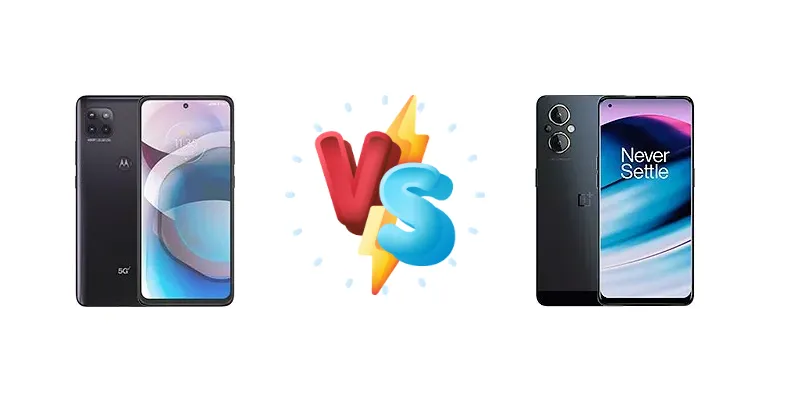
|
🏆 Quick Verdict
For most users, the OnePlus Nord N20 5G emerges as the better choice. While the Motorola one 5G UW ace boasts a more potent CPU core configuration, the Nord N20 5G’s more efficient Snapdragon 695, coupled with its faster 33W charging and brighter display, provides a smoother, more convenient daily experience.
| PHONES | ||
|---|---|---|
| Phone Names | Motorola one 5G UW ace | OnePlus Nord N20 5G |
| Network | ||
|---|---|---|
| 2G bands | GSM 850 / 900 / 1800 / 1900 | GSM 850 / 900 / 1800 / 1900 |
| 3G bands | HSDPA 850 / 900 / 1700(AWS) / 1900 / 2100 | HSDPA 850 / 900 / 1700(AWS) / 1900 / 2100 |
| 4G bands | 1, 2, 3, 4, 5, 7, 8, 12, 13, 17, 20, 48, 66 | 1, 2, 3, 4, 5, 7, 8, 12, 13, 17, 20, 25, 26, 28, 38, 39, 40, 41, 66, 71 |
| 5G bands | 2, 5, 66, 71, 260, 261 SA/NSA/Sub6/mmWave - Verizon, USA | 2, 25, 41, 66, 71 SA/NSA |
| Speed | HSPA, LTE, 5G | HSPA 42.2/5.76 Mbps, LTE Cat15 800/200 Mbps, 5G |
| Technology | GSM / HSPA / LTE / 5G | GSM / HSPA / LTE / 5G |
| Launch | ||
|---|---|---|
| Announced | 2021, July 08 | 2022, April 28 |
| Status | Available. Released 2021, July 08 | Available. Released 2022, April 28 |
| Body | ||
|---|---|---|
| Build | - | Glass front (Schott Xensation Up), plastic frame, plastic back |
| Dimensions | 166.1 x 76 x 9.9 mm (6.54 x 2.99 x 0.39 in) | 159.9 x 73.2 x 7.5 mm (6.30 x 2.88 x 0.30 in) |
| SIM | Nano-SIM | Nano-SIM |
| Weight | 213.5 g (7.51 oz) | 173 g (6.10 oz) |
| Water-repellent coating | - | |
| Display | ||
|---|---|---|
| Protection | - | Schott Xensation Up |
| Resolution | 1080 x 2400 pixels, 20:9 ratio (~393 ppi density) | 1080 x 2400 pixels, 20:9 ratio (~409 ppi density) |
| Size | 6.7 inches, 108.4 cm2 (~85.9% screen-to-body ratio) | 6.43 inches, 99.8 cm2 (~85.3% screen-to-body ratio) |
| Type | IPS LCD, HDR10 | AMOLED |
| - | Always-on display | |
| Platform | ||
|---|---|---|
| CPU | Octa-core (2x2.2 GHz Kryo 570 & 6x1.8 GHz Kryo 570) | Octa-core (2x2.2 GHz Kryo 660 Gold & 6x1.7 GHz Kryo 660 Silver) |
| Chipset | Qualcomm SM7225 Snapdragon 750G 5G (8 nm) | Qualcomm SM6375 Snapdragon 695 5G (6 nm) |
| GPU | Adreno 619 | Adreno 619 |
| OS | Android 11 | Android 11, OxygenOS 11 |
| Memory | ||
|---|---|---|
| Card slot | microSDXC (dedicated slot) | microSDXC (dedicated slot) |
| Internal | 64GB 4GB RAM | 128GB 6GB RAM |
| - | UFS 2.2 | |
| Main Camera | ||
|---|---|---|
| Features | LED flash, HDR, panorama | LED flash, HDR, panorama |
| Single | - | 16 MP, f/2.4, (wide) |
| Triple | 48 MP, f/1.7, 26mm (wide), 1/2.0", 0.8µm, PDAF 8 MP, f/2.2, 118˚ (ultrawide), 1.12µm 2 MP (macro), AF | 64 MP, f/1.8, (wide), PDAF 2 MP (macro) Auxiliary lens |
| Video | 4K@30fps, 1080p@30/60fps, gyro-EIS | 1080p@30fps |
| Selfie camera | ||
|---|---|---|
| Features | HDR | HDR |
| Single | 16 MP, f/2.2, (wide), 1.0µm | 16 MP, f/2.4, (wide) |
| Video | 1080p@30fps | 1080p@30fps |
| Sound | ||
|---|---|---|
| 3.5mm jack | Yes | Yes |
| 35mm jack | Yes | Yes |
| Loudspeaker | Yes | Yes |
| Comms | ||
|---|---|---|
| Bluetooth | 5.1, A2DP, LE | 5.1, A2DP, LE |
| NFC | Unspecified | Yes |
| Positioning | GPS (L1+L5), GLONASS, GALILEO | GPS (L1+L5), GLONASS, GALILEO, BDS |
| Radio | No | No |
| USB | USB Type-C 2.0 | USB Type-C 2.0, OTG |
| WLAN | Wi-Fi 802.11 a/b/g/n/ac, dual-band, Wi-Fi Direct | Wi-Fi 802.11 a/b/g/n/ac, dual-band, Wi-Fi Direct |
| Features | ||
|---|---|---|
| Sensors | Fingerprint (rear-mounted), accelerometer, gyro, proximity, compass, barometer | Fingerprint (under display, optical), accelerometer, gyro, proximity, compass, barometer |
| Battery | ||
|---|---|---|
| Charging | 20W wired | 33W wired |
| Type | Li-Po 5000 mAh | Li-Po 4500 mAh |
| Misc | ||
|---|---|---|
| Colors | Volcanic Gray | Blue |
| Models | - | GN2200, CPH2459 |
| Price | About 250 EUR | About 120 EUR |
| Tests | ||
|---|---|---|
| Battery life | - | Endurance rating 129h |
| Display | - | Contrast ratio: Infinite (nominal) |
| Performance | - | AnTuTu: 316974 (v8), 380672 (v9) GeekBench: 1945 (v5.1) GFXBench: 16fps (ES 3.1 onscreen) |
Motorola one 5G UW ace
- Potentially higher peak CPU performance for demanding tasks.
- Slightly more powerful ISP for image processing.
- Competitive price point.
- Slower 20W charging.
- Likely uses an LCD panel, resulting in lower display quality.
- Older chipset architecture.
OnePlus Nord N20 5G
- Faster 33W charging for quicker top-ups.
- Brighter display for better outdoor visibility.
- More power-efficient Snapdragon 695 chipset.
- CPU core configuration may not match the Motorola in peak performance.
- Camera performance relies heavily on software processing.
- May be slightly more expensive.
Display Comparison
The OnePlus Nord N20 5G clearly wins in the display department, boasting a measured peak brightness of 647 nits compared to an unspecified brightness for the Motorola. This higher brightness translates to significantly better visibility outdoors. While both phones have an 'infinite' contrast ratio (typical for OLED/AMOLED panels), the Nord N20 5G’s superior brightness makes a tangible difference in real-world usage. We lack data on panel technology for the Motorola, but given its price point, it likely uses an LCD, further widening the gap in visual quality.
Camera Comparison
Without detailed camera specs beyond the presence of cameras, a direct comparison is difficult. However, the market segment suggests both phones will rely heavily on software processing. The Motorola’s chipset has a slightly more powerful ISP, potentially offering better image processing capabilities. However, the OnePlus’s newer chipset may have more advanced computational photography features. Without sample images or detailed sensor information, it’s impossible to declare a clear winner; both likely offer acceptable, but not exceptional, camera performance.
Performance
On paper, the Motorola one 5G UW ace’s Snapdragon 750G (8nm) appears stronger with its 2x2.2 GHz Kryo 570 cores. However, the OnePlus Nord N20 5G’s Snapdragon 695 (6nm) utilizes newer Kryo 660 Gold cores clocked at 2.2 GHz, and Silver cores at 1.7 GHz. The 6nm process node of the 695 offers improved power efficiency, potentially leading to better sustained performance and less thermal throttling. While the 750G might win in short bursts, the 695 is likely to provide a more consistent experience during prolonged gaming or multitasking. The lack of LPDDR5x specification for either phone means RAM speed isn't a differentiating factor.
Battery Life
Both phones share an endurance rating of 129 hours, suggesting similar real-world battery life despite differing internal capacities (not specified). However, the OnePlus Nord N20 5G’s 33W wired charging is a significant advantage over the Motorola’s 20W charging. This translates to a much faster 0-100% charge time, reducing downtime and increasing convenience. The efficiency gains from the Snapdragon 695 also contribute to the Nord N20 5G’s overall battery experience.
Buying Guide
Buy the Motorola one 5G UW ace if you prioritize raw CPU performance for demanding tasks like emulation or light video editing, and are willing to sacrifice charging speed and potentially battery life. Buy the OnePlus Nord N20 5G if you value a brighter, more usable display, faster charging, and a more modern, power-efficient chipset for everyday use and longer battery endurance.