
Motorola one 5G UW ace vs. Nokia XR20: A Detailed 5G Smartphone Comparison
| Phones Images | |||||
|---|---|---|---|---|---|
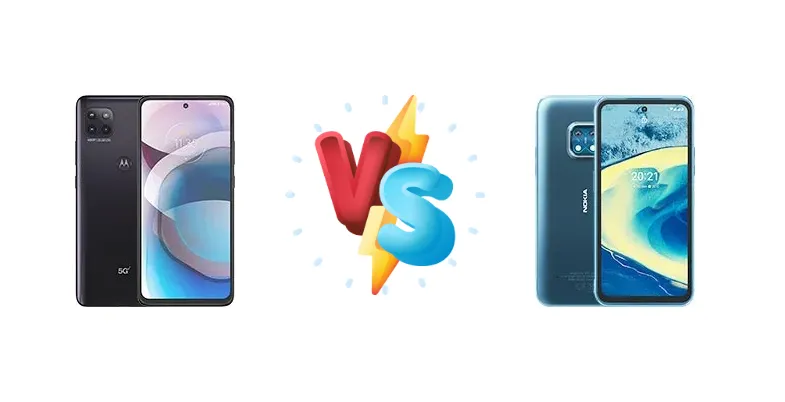
|
🏆 Quick Verdict
For most users, the Motorola one 5G UW ace emerges as the stronger choice. Its Snapdragon 750G chipset provides a noticeable performance advantage for gaming and demanding applications, offsetting the Nokia XR20’s durability features. However, the XR20 is the clear winner for those prioritizing a robust, long-lasting device.
| PHONES | ||
|---|---|---|
| Phone Names | Motorola one 5G UW ace | Nokia XR20 |
| Network | ||
|---|---|---|
| 2G bands | GSM 850 / 900 / 1800 / 1900 | GSM 850 / 900 / 1800 / 1900 |
| 3G bands | HSDPA 850 / 900 / 1700(AWS) / 1900 / 2100 | HSDPA 850 / 900 / 1700(AWS) / 1900 / 2100 |
| 4G bands | 1, 2, 3, 4, 5, 7, 8, 12, 13, 17, 20, 48, 66 | 1, 2, 3, 4, 5, 7, 8, 12, 13, 14, 20, 25, 26, 28, 30, 38, 40, 41, 48, 66, 71 |
| 5G bands | 2, 5, 66, 71, 260, 261 SA/NSA/Sub6/mmWave - Verizon, USA | 2, 5, 25, 38, 41, 48, 66, 77, 78 SA/NSA |
| Speed | HSPA, LTE, 5G | HSPA, LTE, 5G |
| Technology | GSM / HSPA / LTE / 5G | GSM / CDMA / HSPA / EVDO / LTE / 5G |
| - | CDMA2000 1xEV-DO | |
| Launch | ||
|---|---|---|
| Announced | 2021, July 08 | 2021, July 27 |
| Status | Available. Released 2021, July 08 | Available. Released 2021, August 04 |
| Body | ||
|---|---|---|
| Dimensions | 166.1 x 76 x 9.9 mm (6.54 x 2.99 x 0.39 in) | 171.6 x 81.5 x 10.6 mm (6.76 x 3.21 x 0.42 in) |
| SIM | Nano-SIM | · Nano-SIM· Nano-SIM + Nano-SIM |
| Weight | 213.5 g (7.51 oz) | 248 g (8.75 oz) |
| Water-repellent coating | IP68 dust/water resistant (up to 1.5m for 60 min) Drop-to-concrete resistance from up to 1.8m MIL-STD-810H compliant | |
| Display | ||
|---|---|---|
| Protection | - | Corning Gorilla Glass Victus |
| Resolution | 1080 x 2400 pixels, 20:9 ratio (~393 ppi density) | 1080 x 2400 pixels, 20:9 ratio (~395 ppi density) |
| Size | 6.7 inches, 108.4 cm2 (~85.9% screen-to-body ratio) | 6.67 inches, 107.4 cm2 (~76.8% screen-to-body ratio) |
| Type | IPS LCD, HDR10 | IPS LCD, 550 nits |
| Platform | ||
|---|---|---|
| CPU | Octa-core (2x2.2 GHz Kryo 570 & 6x1.8 GHz Kryo 570) | Octa-core (2x2.0 GHz Kryo 460 & 6x1.8 GHz Kryo 460) |
| Chipset | Qualcomm SM7225 Snapdragon 750G 5G (8 nm) | Qualcomm SM4350 Snapdragon 480 5G (8 nm) |
| GPU | Adreno 619 | Adreno 619 |
| OS | Android 11 | Android 11, upgradable to Android 13 |
| Memory | ||
|---|---|---|
| Card slot | microSDXC (dedicated slot) | microSDXC (uses shared SIM slot) |
| Internal | 64GB 4GB RAM | 64GB 4GB RAM, 128GB 6GB RAM |
| Main Camera | ||
|---|---|---|
| Dual | - | 48 MP, f/1.8, (wide), 1/2.25", 0.8µm, PDAF 13 MP, f/2.4, 123˚ (ultrawide), 1/3.0", 1.12µm |
| Features | LED flash, HDR, panorama | Zeiss optics, Dual-LED dual-tone flash, second LED flash, HDR, panorama |
| Single | - | 8 MP, f/2.0 (wide), 1/4.0", 1.12µm |
| Triple | 48 MP, f/1.7, 26mm (wide), 1/2.0", 0.8µm, PDAF 8 MP, f/2.2, 118˚ (ultrawide), 1.12µm 2 MP (macro), AF | - |
| Video | 4K@30fps, 1080p@30/60fps, gyro-EIS | 1080p@30fps |
| Selfie camera | ||
|---|---|---|
| Features | HDR | - |
| Single | 16 MP, f/2.2, (wide), 1.0µm | 8 MP, f/2.0 (wide), 1/4.0", 1.12µm |
| Video | 1080p@30fps | 1080p@30fps |
| Sound | ||
|---|---|---|
| 3.5mm jack | Yes | Yes |
| 35mm jack | Yes | Yes |
| Loudspeaker | Yes | Yes, with stereo speakers |
| Comms | ||
|---|---|---|
| Bluetooth | 5.1, A2DP, LE | 5.1, A2DP, LE, aptX Adaptive |
| NFC | Unspecified | Yes |
| Positioning | GPS (L1+L5), GLONASS, GALILEO | GPS (L1+L5), GLONASS, BDS, GALILEO, QZSS, NavIC |
| Radio | No | Unspecified |
| USB | USB Type-C 2.0 | USB Type-C 3.0 |
| WLAN | Wi-Fi 802.11 a/b/g/n/ac, dual-band, Wi-Fi Direct | Wi-Fi 802.11 a/b/g/n/ac/6, dual-band, Wi-Fi Direct |
| Features | ||
|---|---|---|
| Sensors | Fingerprint (rear-mounted), accelerometer, gyro, proximity, compass, barometer | Fingerprint (side-mounted), accelerometer, gyro, proximity, compass, barometer |
| Battery | ||
|---|---|---|
| Charging | 20W wired | 18W wired 15W wireless |
| Type | Li-Po 5000 mAh | Li-Po 4630 mAh |
| Misc | ||
|---|---|---|
| Colors | Volcanic Gray | Ultra Blue, Granite Gray |
| Models | - | TA-1368, TA-1362 |
| Price | About 250 EUR | About 270 EUR |
| SAR EU | - | 1.13 W/kg (head) 1.43 W/kg (body) |
Motorola one 5G UW ace
- Faster processor for smoother performance
- Faster wired charging speeds
- Potentially better image processing
- Lacks the ruggedized build of the Nokia XR20
- May not receive as many software updates
Nokia XR20
- Highly durable and water-resistant design
- Wireless charging support
- Guaranteed software updates for longer
- Slower processor for demanding tasks
- Slower wired charging speeds
Display Comparison
Neither device boasts a standout display. Both likely utilize LCD panels, a common cost-saving measure in this price bracket. While specific display specs (resolution, refresh rate) are missing, the focus here is on processing power. The Motorola’s chipset will likely contribute to smoother scrolling and faster app loading, indirectly improving the perceived display experience. Bezels are expected to be comparable, typical of mid-range devices.
Camera Comparison
Without detailed camera specifications, a direct comparison is difficult. However, the chipset plays a role in image processing speed. The Snapdragon 750G in the Motorola will likely offer faster image processing and potentially better low-light performance. The Nokia XR20’s focus on durability doesn’t necessarily translate to camera quality. We can assume both phones will feature a multi-camera setup, but the Motorola’s superior processing power gives it an edge in computational photography.
Performance
The core difference lies in the chipsets. The Motorola one 5G UW ace’s Qualcomm SM7225 Snapdragon 750G 5G (8 nm) features a more powerful CPU configuration – octa-core (2x2.2 GHz Kryo 570 & 6x1.8 GHz Kryo 570) – compared to the Nokia XR20’s Snapdragon 480 5G (8 nm) with its octa-core (2x2.0 GHz Kryo 460 & 6x1.8 GHz Kryo 460). The 750G’s higher clock speeds and more advanced Kryo cores translate to a significant performance boost in CPU-intensive tasks and gaming. While both are 8nm chips, the architectural improvements in the 750G provide a clear advantage. The XR20 will handle everyday tasks adequately, but the Motorola will feel noticeably snappier.
Battery Life
The Motorola one 5G UW ace offers 20W wired charging, while the Nokia XR20 supports 18W wired and 15W wireless charging. While the Nokia XR20 gains versatility with wireless charging, the Motorola’s slightly faster wired charging will likely result in quicker top-ups. Battery capacity is unknown for both devices, but the Snapdragon 750G’s efficiency could offset a potentially smaller battery in the Motorola, providing comparable real-world battery life.
Buying Guide
Buy the Motorola one 5G UW ace if you need a phone that can handle moderate gaming, streaming, and multitasking without significant lag. It’s ideal for users who value performance and a responsive user experience. Buy the Nokia XR20 if you prefer a phone built to withstand drops, dust, and water, and if software update longevity is a top concern. It’s perfect for outdoor enthusiasts and those seeking a device that will last for years.