
Motorola One 5G Ace vs TCL 20 Pro 5G: A Deep Dive into the Snapdragon 750G Experience
| Phones Images | |||||
|---|---|---|---|---|---|
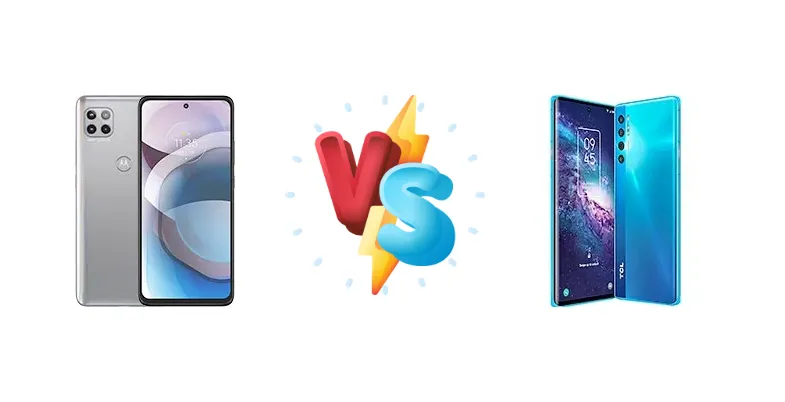
|
🏆 Quick Verdict
For the average user prioritizing convenience, the TCL 20 Pro 5G emerges as the better choice. Its 18W wired and 15W wireless charging capabilities offer a significant advantage over the Motorola One 5G Ace’s 15W wired charging, while the slightly lower CPU clock speed is unlikely to be noticeable in everyday tasks.
| PHONES | ||
|---|---|---|
| Phone Names | Motorola One 5G Ace | TCL 20 Pro 5G |
| Network | ||
|---|---|---|
| 2G bands | GSM 850 / 900 / 1800 / 1900 | GSM 850 / 900 / 1800 / 1900 |
| 3G bands | HSDPA 850 / 900 / 1700(AWS) / 1900 / 2100 | HSDPA 850 / 900 / 1900 / 2100 - International |
| 4G bands | 1, 2, 3, 4, 5, 7, 8, 12, 13, 14, 17, 18, 19, 20, 25, 26, 29, 30, 38, 39, 40, 41, 66, 71 | 1, 2, 3, 4, 5, 7, 8, 20, 28, 32, 38, 40, 41 - International |
| 5G bands | 2, 5, 25, 41, 66, 71 Sub6 | 1, 3, 5, 7, 8, 28, 40, 41, 78 SA/NSA/Sub6 - International |
| Speed | HSPA, LTE, 5G | HSPA 42.2/5.76 Mbps, LTE Cat18 1200/150 Mbps, 5G 2.7 Gbps DL, 625 Mbps UL |
| Technology | GSM / HSPA / LTE / 5G | GSM / HSPA / LTE / 5G |
| Launch | ||
|---|---|---|
| Announced | 2021, January 08 | 2021, April 14 |
| Status | Available. Released 2021, January 14 | Available. Released 2021, April 14 |
| Body | ||
|---|---|---|
| Build | - | Glass front, glass back |
| Dimensions | 166.1 x 76.1 x 9.9 mm (6.54 x 3.00 x 0.39 in) | 164.2 x 73 x 8.8 mm (6.46 x 2.87 x 0.35 in) |
| SIM | Nano-SIM | · Nano-SIM· Nano-SIM + Nano-SIM |
| Weight | 212 g (7.48 oz) | 190 g (6.70 oz) |
| Water-repellent coating | - | |
| Display | ||
|---|---|---|
| Resolution | 1080 x 2400 pixels, 20:9 ratio (~393 ppi density) | 1080 x 2400 pixels, 20:9 ratio (~395 ppi density) |
| Size | 6.7 inches, 108.4 cm2 (~85.7% screen-to-body ratio) | 6.67 inches, 107.4 cm2 (~89.6% screen-to-body ratio) |
| Type | IPS LCD, HDR10 | AMOLED, HDR10, 420 nits (typ) |
| Platform | ||
|---|---|---|
| CPU | Octa-core (2x2.2 GHz Kryo 570 & 6x1.8 GHz Kryo 570) | Octa-core (2x2.0 GHz Kryo 570 & 6x1.7 GHz Kryo 570) |
| Chipset | Qualcomm SM7225 Snapdragon 750G 5G (8 nm) | Qualcomm SM7225 Snapdragon 750G 5G (8 nm) |
| GPU | Adreno 619 | Adreno 619 |
| OS | Android 10 | Android 11, TCL UI |
| Memory | ||
|---|---|---|
| Card slot | microSDXC (dedicated slot) | microSDXC (uses shared SIM slot) |
| Internal | 64GB 4GB RAM, 128GB 6GB RAM | 256GB 6GB RAM |
| Main Camera | ||
|---|---|---|
| Features | LED flash, HDR, panorama | Dual LED flash, HDR, panorama |
| Quad | - | 48 MP, f/1.8, 26mm (wide), 1/2.0", 0.8µm, PDAF, OIS 16 MP, f/2.4, 16mm, 123˚ (ultrawide), 1/3.0", 1.12µm 2 MP (macro)/ 5 MP (USA only) Auxiliary lens |
| Triple | 48 MP, f/1.7, 26mm (wide), 1/2.0", 0.8µm, PDAF 8 MP, f/2.2, 118˚ (ultrawide), 1.12µm 2 MP (macro), AF | - |
| Video | 4K@30fps, 1080p@30/60fps, gyro-EIS | 4K@30fps, 1080p@30/60fps, gyro-EIS |
| Selfie camera | ||
|---|---|---|
| Features | HDR | HDR |
| Single | 16 MP, f/2.2, (wide), 1.0µm | 32 MP, f/2.5, (wide), 0.8µm |
| Video | 1080p@30fps | 4K@30fps, 1080p@30/60fps, HDR |
| Sound | ||
|---|---|---|
| 3.5mm jack | Yes | - |
| 35mm jack | Yes | Yes |
| Loudspeaker | Yes | Yes |
| Comms | ||
|---|---|---|
| Bluetooth | 5.1, A2DP, LE | 5.1, A2DP, LE |
| NFC | Yes | Yes |
| Positioning | GPS (L1+L5), GLONASS, GALILEO | GPS (L1+L5), GLONASS, BDS, GALILEO |
| Radio | Unspecified | No |
| USB | USB Type-C 2.0 | USB Type-C 2.0, OTG |
| WLAN | Wi-Fi 802.11 a/b/g/n/ac, dual-band, Wi-Fi Direct | Wi-Fi 802.11 a/b/g/n/ac, dual-band, Wi-Fi Direct |
| Features | ||
|---|---|---|
| Sensors | Fingerprint (rear-mounted), accelerometer, gyro, proximity, compass, barometer | Fingerprint (under display, optical), accelerometer, gyro, proximity, compass |
| Battery | ||
|---|---|---|
| Charging | 15W wired | 18W wired 15W wireless |
| Type | Li-Po 5000 mAh | Li-Po 4500 mAh |
| Misc | ||
|---|---|---|
| Colors | Volcanic Gray, Frosted Silver | Moondust Gray, Marine Blue |
| Models | XT2113-2, XT2113-5 | T810H |
| Price | About 50 EUR | About 440 EUR |
Motorola One 5G Ace
- Potentially slightly faster CPU clock speeds
- More affordable price point (likely)
- Clean Android experience (typical of Motorola)
- Slower charging speed (15W wired only)
- No wireless charging support
- Potentially less refined camera system
TCL 20 Pro 5G
- Faster 18W wired charging
- 15W wireless charging support
- Potentially better camera performance
- Slightly slower CPU clock speeds
- Potentially higher price point
- TCL's software skin can be divisive
Display Comparison
Both devices lack detailed display specifications in the provided data. However, given their market positioning, we can infer both likely utilize LCD panels. The TCL 20 Pro 5G, being positioned as a 'Pro' model, *may* have slightly better color accuracy or peak brightness, but this is speculative. Bezels are likely comparable, focusing on maximizing screen real estate within the budget constraints.
Camera Comparison
Without detailed camera specifications, a direct comparison is limited. Both phones likely feature multi-camera systems, but the quality will depend on sensor size, lens aperture, and image processing algorithms. The TCL 20 Pro 5G, as a 'Pro' model, *may* have a larger main sensor or more advanced image processing, potentially resulting in better low-light performance. However, without specific details, this remains an assumption. It's likely both phones include standard features like HDR and portrait modes.
Performance
Both the Motorola One 5G Ace and TCL 20 Pro 5G are equipped with the Qualcomm SM7225 Snapdragon 750G 5G (8 nm) chipset. The key difference lies in the CPU configuration: the Motorola features a 2x2.2 GHz Kryo 570 and 6x1.8 GHz Kryo 570 setup, while the TCL has a 2x2.0 GHz Kryo 570 and 6x1.7 GHz Kryo 570 configuration. This means the Motorola has a 200MHz clock speed advantage on its prime cores. While measurable in benchmarks, this difference is unlikely to translate into a significant real-world performance boost for most users. Both devices will handle everyday tasks and moderate gaming without issue. The 8nm process node ensures reasonable thermal efficiency, but sustained heavy loads could lead to throttling.
Battery Life
The Motorola One 5G Ace supports 15W wired charging, while the TCL 20 Pro 5G offers both 18W wired and 15W wireless charging. This is a significant differentiator. While the exact battery capacity isn't specified, the TCL’s faster wired charging and the addition of wireless charging provide greater flexibility and convenience. A full charge on the TCL will likely be achieved faster, and the wireless charging option eliminates the need for cables. The 15W wireless charging on the TCL, while not the fastest available, is a valuable addition for users who prefer cable-free charging.
Buying Guide
Buy the Motorola One 5G Ace if you need a reliable 5G phone with a focus on simplicity and affordability, and aren't concerned with wireless charging. Buy the TCL 20 Pro 5G if you prefer the added convenience of wireless charging, a slightly faster charging experience, and a potentially more refined software experience, even if it comes at a small price premium.