
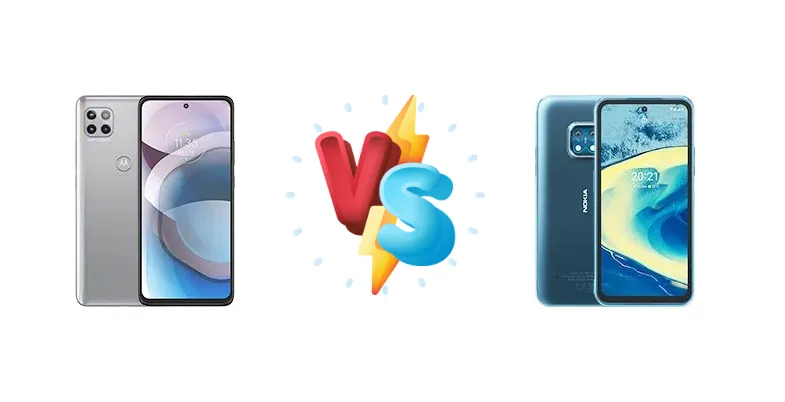
Motorola One 5G Ace vs. Nokia XR20: A Detailed 5G Smartphone Comparison
| Phones Images | |||||
|---|---|---|---|---|---|
|
🏆 Quick Verdict
For most users, the Motorola One 5G Ace emerges as the better choice. Its Snapdragon 750G chipset provides a noticeable performance advantage over the XR20’s Snapdragon 480, making it more suitable for gaming and demanding applications. While the Nokia XR20 offers wireless charging and a more durable build, the performance gap justifies the trade-off for the average user.
| PHONES | ||
|---|---|---|
| Phone Names | Motorola One 5G Ace | Nokia XR20 |
| Network | ||
|---|---|---|
| 2G bands | GSM 850 / 900 / 1800 / 1900 | GSM 850 / 900 / 1800 / 1900 |
| 3G bands | HSDPA 850 / 900 / 1700(AWS) / 1900 / 2100 | HSDPA 850 / 900 / 1700(AWS) / 1900 / 2100 |
| 4G bands | 1, 2, 3, 4, 5, 7, 8, 12, 13, 14, 17, 18, 19, 20, 25, 26, 29, 30, 38, 39, 40, 41, 66, 71 | 1, 2, 3, 4, 5, 7, 8, 12, 13, 14, 20, 25, 26, 28, 30, 38, 40, 41, 48, 66, 71 |
| 5G bands | 2, 5, 25, 41, 66, 71 Sub6 | 2, 5, 25, 38, 41, 48, 66, 77, 78 SA/NSA |
| Speed | HSPA, LTE, 5G | HSPA, LTE, 5G |
| Technology | GSM / HSPA / LTE / 5G | GSM / CDMA / HSPA / EVDO / LTE / 5G |
| - | CDMA2000 1xEV-DO | |
| Launch | ||
|---|---|---|
| Announced | 2021, January 08 | 2021, July 27 |
| Status | Available. Released 2021, January 14 | Available. Released 2021, August 04 |
| Body | ||
|---|---|---|
| Dimensions | 166.1 x 76.1 x 9.9 mm (6.54 x 3.00 x 0.39 in) | 171.6 x 81.5 x 10.6 mm (6.76 x 3.21 x 0.42 in) |
| SIM | Nano-SIM | · Nano-SIM· Nano-SIM + Nano-SIM |
| Weight | 212 g (7.48 oz) | 248 g (8.75 oz) |
| Water-repellent coating | IP68 dust/water resistant (up to 1.5m for 60 min) Drop-to-concrete resistance from up to 1.8m MIL-STD-810H compliant | |
| Display | ||
|---|---|---|
| Protection | - | Corning Gorilla Glass Victus |
| Resolution | 1080 x 2400 pixels, 20:9 ratio (~393 ppi density) | 1080 x 2400 pixels, 20:9 ratio (~395 ppi density) |
| Size | 6.7 inches, 108.4 cm2 (~85.7% screen-to-body ratio) | 6.67 inches, 107.4 cm2 (~76.8% screen-to-body ratio) |
| Type | IPS LCD, HDR10 | IPS LCD, 550 nits |
| Platform | ||
|---|---|---|
| CPU | Octa-core (2x2.2 GHz Kryo 570 & 6x1.8 GHz Kryo 570) | Octa-core (2x2.0 GHz Kryo 460 & 6x1.8 GHz Kryo 460) |
| Chipset | Qualcomm SM7225 Snapdragon 750G 5G (8 nm) | Qualcomm SM4350 Snapdragon 480 5G (8 nm) |
| GPU | Adreno 619 | Adreno 619 |
| OS | Android 10 | Android 11, upgradable to Android 13 |
| Memory | ||
|---|---|---|
| Card slot | microSDXC (dedicated slot) | microSDXC (uses shared SIM slot) |
| Internal | 64GB 4GB RAM, 128GB 6GB RAM | 64GB 4GB RAM, 128GB 6GB RAM |
| Main Camera | ||
|---|---|---|
| Dual | - | 48 MP, f/1.8, (wide), 1/2.25", 0.8µm, PDAF 13 MP, f/2.4, 123˚ (ultrawide), 1/3.0", 1.12µm |
| Features | LED flash, HDR, panorama | Zeiss optics, Dual-LED dual-tone flash, second LED flash, HDR, panorama |
| Single | - | 8 MP, f/2.0 (wide), 1/4.0", 1.12µm |
| Triple | 48 MP, f/1.7, 26mm (wide), 1/2.0", 0.8µm, PDAF 8 MP, f/2.2, 118˚ (ultrawide), 1.12µm 2 MP (macro), AF | - |
| Video | 4K@30fps, 1080p@30/60fps, gyro-EIS | 1080p@30fps |
| Selfie camera | ||
|---|---|---|
| Features | HDR | - |
| Single | 16 MP, f/2.2, (wide), 1.0µm | 8 MP, f/2.0 (wide), 1/4.0", 1.12µm |
| Video | 1080p@30fps | 1080p@30fps |
| Sound | ||
|---|---|---|
| 3.5mm jack | Yes | Yes |
| 35mm jack | Yes | Yes |
| Loudspeaker | Yes | Yes, with stereo speakers |
| Comms | ||
|---|---|---|
| Bluetooth | 5.1, A2DP, LE | 5.1, A2DP, LE, aptX Adaptive |
| NFC | Yes | Yes |
| Positioning | GPS (L1+L5), GLONASS, GALILEO | GPS (L1+L5), GLONASS, BDS, GALILEO, QZSS, NavIC |
| Radio | Unspecified | Unspecified |
| USB | USB Type-C 2.0 | USB Type-C 3.0 |
| WLAN | Wi-Fi 802.11 a/b/g/n/ac, dual-band, Wi-Fi Direct | Wi-Fi 802.11 a/b/g/n/ac/6, dual-band, Wi-Fi Direct |
| Features | ||
|---|---|---|
| Sensors | Fingerprint (rear-mounted), accelerometer, gyro, proximity, compass, barometer | Fingerprint (side-mounted), accelerometer, gyro, proximity, compass, barometer |
| Battery | ||
|---|---|---|
| Charging | 15W wired | 18W wired 15W wireless |
| Type | Li-Po 5000 mAh | Li-Po 4630 mAh |
| Misc | ||
|---|---|---|
| Colors | Volcanic Gray, Frosted Silver | Ultra Blue, Granite Gray |
| Models | XT2113-2, XT2113-5 | TA-1368, TA-1362 |
| Price | About 50 EUR | About 270 EUR |
| SAR EU | - | 1.13 W/kg (head) 1.43 W/kg (body) |
Motorola One 5G Ace
- Superior processing power with Snapdragon 750G
- Better performance for gaming and multitasking
- More responsive user experience
- Limited to 15W wired charging
- Lacks wireless charging
- Less durable build quality
Nokia XR20
- Rugged design for enhanced durability
- 18W wired and 15W wireless charging
- Potential for longer software support (Nokia's promise)
- Slower performance with Snapdragon 480
- Less capable GPU for gaming
- May exhibit lag with demanding apps
Display Comparison
Neither phone boasts a standout display. Both likely utilize LCD panels, a common cost-saving measure in this price bracket. The focus here isn't on visual fidelity. While specific display specs are missing, the Motorola's performance advantage suggests it may be able to drive a slightly higher refresh rate, resulting in smoother scrolling. Bezels are likely comparable, reflecting the budget nature of both devices.
Camera Comparison
Camera performance is likely similar, with both phones aiming for acceptable results in good lighting conditions. Without specific sensor details, it’s difficult to make a definitive judgment. However, the Motorola’s stronger processing power could lead to slightly better image processing and noise reduction. The inclusion of Optical Image Stabilization (OIS) on either device is unlikely at this price point. The 2MP macro lenses found on many phones in this segment are generally of limited utility, and should not be a deciding factor.
Performance
The core difference lies in the chipsets. The Motorola One 5G Ace’s Qualcomm SM7225 Snapdragon 750G 5G (8nm) significantly outperforms the Nokia XR20’s Snapdragon 480 5G (8nm). The 750G’s Kryo 570 cores, clocked at up to 2.2 GHz, offer a substantial CPU performance boost compared to the XR20’s Kryo 460 cores at 2.0 GHz. This translates to faster app launches, smoother multitasking, and a more responsive overall experience. While both are 8nm chips, the architectural improvements in the 750G are key. Gamers will find the 750G’s Adreno 619 GPU a more capable partner for demanding titles. The XR20’s Adreno 610 will struggle with higher settings.
Battery Life
The Nokia XR20 gains an edge with its 18W wired charging and the addition of 15W wireless charging. The Motorola One 5G Ace is limited to 15W wired charging. While battery capacity isn’t specified, the XR20’s wireless charging capability offers convenience for users already invested in wireless charging ecosystems. The 18W charging will likely result in a faster 0-100% charge time compared to the Motorola, offsetting any potential capacity differences.
Buying Guide
Buy the Motorola One 5G Ace if you need a phone that can handle multitasking, streaming, and light gaming without slowdowns. It’s ideal for users who prioritize a smooth user experience and faster app loading times. Buy the Nokia XR20 if you prioritize durability and require wireless charging, especially if you work in challenging environments or are prone to dropping your phone. It’s a solid choice for those who value longevity and a rugged design over raw performance.