
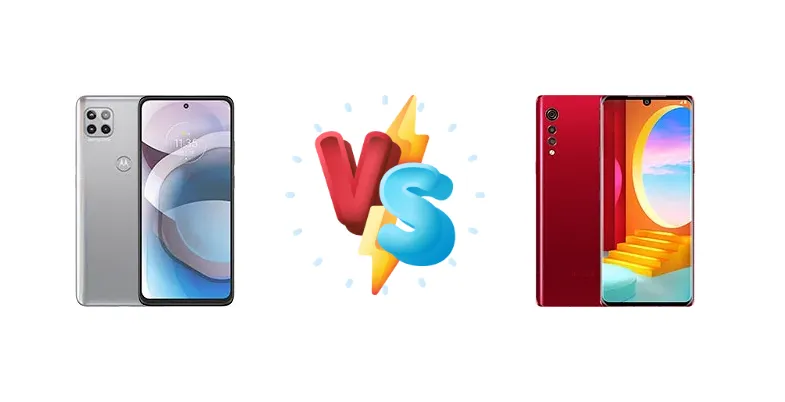
Motorola One 5G Ace vs. LG Velvet 5G UW: A Detailed Comparison
| Phones Images | |||||
|---|---|---|---|---|---|
|
🏆 Quick Verdict
For the average user prioritizing value and decent performance, the Motorola One 5G Ace is the better choice. However, the LG Velvet 5G UW pulls ahead for those who value faster 25W charging (with PD3.0 and QC4 support) and the convenience of 9W wireless charging, even if it comes at a potentially higher cost.
| PHONES | ||
|---|---|---|
| Phone Names | Motorola One 5G Ace | LG Velvet 5G UW |
| Network | ||
|---|---|---|
| 2G bands | GSM 850 / 900 / 1800 / 1900 | GSM 850 / 900 / 1800 / 1900 |
| 3G bands | HSDPA 850 / 900 / 1700(AWS) / 1900 / 2100 | HSDPA 850 / 900 / 1700(AWS) / 1900 / 2100 |
| 4G bands | 1, 2, 3, 4, 5, 7, 8, 12, 13, 14, 17, 18, 19, 20, 25, 26, 29, 30, 38, 39, 40, 41, 66, 71 | 2, 3, 4, 5, 7, 12, 13, 20, 28, 46, 48, 66 |
| 5G bands | 2, 5, 25, 41, 66, 71 Sub6 | 260, 261 mmWave |
| Speed | HSPA, LTE, 5G | HSPA 42.2/5.76 Mbps, LTE (5CA) Cat16 1000/75 Mbps, 5G 2Gbps |
| Technology | GSM / HSPA / LTE / 5G | GSM / CDMA / HSPA / LTE / 5G |
| - | CDMA 800 / 1900 | |
| Launch | ||
|---|---|---|
| Announced | 2021, January 08 | 2020, August 19. Released 2020, August 21 |
| Status | Available. Released 2021, January 14 | Discontinued |
| Body | ||
|---|---|---|
| Build | - | Glass front, glass back, aluminum frame |
| Dimensions | 166.1 x 76.1 x 9.9 mm (6.54 x 3.00 x 0.39 in) | 167.2 x 74.1 x 7.9 mm (6.58 x 2.92 x 0.31 in) |
| SIM | Nano-SIM | Nano-SIM (pre-installed) |
| Weight | 212 g (7.48 oz) | - |
| Water-repellent coating | IP68 dust/water resistant (up to 1.5m for 30 mins) MIL-STD-810G compliant* *does not guarantee ruggedness or use in extreme conditions | |
| Display | ||
|---|---|---|
| Resolution | 1080 x 2400 pixels, 20:9 ratio (~393 ppi density) | 1080 x 2460 pixels (~395 ppi density) |
| Size | 6.7 inches, 108.4 cm2 (~85.7% screen-to-body ratio) | 6.8 inches, 109.8 cm2 (~88.6% screen-to-body ratio) |
| Type | IPS LCD, HDR10 | P-OLED |
| Platform | ||
|---|---|---|
| CPU | Octa-core (2x2.2 GHz Kryo 570 & 6x1.8 GHz Kryo 570) | Octa-core (1x2.4 GHz Kryo 475 Prime & 1x2.2 GHz Kryo 475 Gold & 6x1.8 GHz Kryo 475 Silver) |
| Chipset | Qualcomm SM7225 Snapdragon 750G 5G (8 nm) | Qualcomm SM7250 Snapdragon 765G 5G (7 nm) |
| GPU | Adreno 619 | Adreno 620 |
| OS | Android 10 | Android 10, upgradable to Android 11, LG UX |
| Memory | ||
|---|---|---|
| Card slot | microSDXC (dedicated slot) | microSDXC (uses shared SIM slot) |
| Internal | 64GB 4GB RAM, 128GB 6GB RAM | 128GB 6GB RAM |
| - | UFS 2.1 | |
| Main Camera | ||
|---|---|---|
| Features | LED flash, HDR, panorama | LED flash, panorama, HDR |
| Triple | 48 MP, f/1.7, 26mm (wide), 1/2.0", 0.8µm, PDAF 8 MP, f/2.2, 118˚ (ultrawide), 1.12µm 2 MP (macro), AF | 48 MP, f/1.8, 26mm (wide), 1/2.0", 0.8µm, PDAF 8 MP, f/2.2, 120˚, 15mm (ultrawide), 1/4.0", 1.12µm Auxiliary lens |
| Video | 4K@30fps, 1080p@30/60fps, gyro-EIS | 4K@30fps, 1080p@30/60fps, gyro-EIS |
| Selfie camera | ||
|---|---|---|
| Features | HDR | HDR |
| Single | 16 MP, f/2.2, (wide), 1.0µm | 16 MP, f/1.9, 29mm (standard), 1/3.06, 1.0µm |
| Video | 1080p@30fps | 1080p@30fps |
| Sound | ||
|---|---|---|
| 3.5mm jack | Yes | Yes |
| 35mm jack | Yes | Yes |
| Loudspeaker | Yes | Yes, with stereo speakers |
| Comms | ||
|---|---|---|
| Bluetooth | 5.1, A2DP, LE | 5.1, A2DP, LE, aptX HD |
| NFC | Yes | Yes |
| Positioning | GPS (L1+L5), GLONASS, GALILEO | GPS (L1+L5), GLONASS, BDS, GALILEO, QZSS |
| Radio | Unspecified | No |
| USB | USB Type-C 2.0 | USB Type-C 2.0, OTG |
| WLAN | Wi-Fi 802.11 a/b/g/n/ac, dual-band, Wi-Fi Direct | Wi-Fi 802.11 a/b/g/n/ac, dual-band, Wi-Fi Direct, DLNA |
| Features | ||
|---|---|---|
| Sensors | Fingerprint (rear-mounted), accelerometer, gyro, proximity, compass, barometer | Fingerprint (under display, optical), accelerometer, gyro, proximity, compass, barometer |
| Battery | ||
|---|---|---|
| Charging | 15W wired | 25W wired, PD3.0, QC4 9W wireless |
| Type | Li-Po 5000 mAh | Li-Po 4300 mAh |
| Misc | ||
|---|---|---|
| Colors | Volcanic Gray, Frosted Silver | Aurora Red |
| Models | XT2113-2, XT2113-5 | LM-G900V, LM-G900V |
| Price | About 50 EUR | About 590 EUR |
Motorola One 5G Ace
- More affordable price point
- Decent 5G performance for everyday tasks
- Clean Android experience (likely)
- Slower 15W charging
- Less powerful processor than the Velvet
- Potentially lower camera image quality
LG Velvet 5G UW
- Faster 25W wired charging with PD3.0/QC4
- 9W wireless charging support
- Slightly more powerful Snapdragon 765G processor
- Higher price compared to the Motorola Ace
- Potentially less optimized software experience
- May not offer significantly better performance in all scenarios
Display Comparison
Neither device boasts a standout display. While specific display specs (resolution, refresh rate) are missing, the focus here is on the underlying chipset's impact on graphics rendering. The LG Velvet 5G UW's Snapdragon 765G, built on a 7nm process, has a slight edge in GPU performance, potentially translating to smoother visuals in games, though the difference will likely be subtle. Both phones likely utilize LCD panels given their price points, and neither is expected to offer high peak brightness or HDR support.
Camera Comparison
Without detailed camera specs, it's difficult to make a definitive judgment. However, the Snapdragon 765G in the Velvet generally offers slightly better image signal processing (ISP) capabilities than the 750G in the Ace. This could result in improved dynamic range and noise reduction in photos and videos. The absence of information regarding sensor sizes and optical image stabilization (OIS) makes a precise comparison impossible, but the Velvet’s processor gives it a marginal advantage in image quality. We can assume both phones include standard wide, ultrawide, and potentially macro lenses, but the quality of these will vary significantly.
Performance
The core difference lies in the chipsets: the Motorola One 5G Ace features the Qualcomm SM7225 Snapdragon 750G (8nm), while the LG Velvet 5G UW uses the SM7250 Snapdragon 765G (7nm). The 7nm process of the 765G generally offers better power efficiency and slightly higher clock speeds (2.4 GHz prime core vs 2.2 GHz on the Ace). The Velvet’s CPU configuration – a tri-cluster setup with Kryo 475 Prime, Gold, and Silver cores – is more sophisticated than the Ace’s dual-cluster Kryo 570 arrangement, potentially improving multi-tasking performance. This translates to quicker app launches and smoother switching between applications for the Velvet.
Battery Life
The LG Velvet 5G UW’s 25W wired charging, coupled with support for Power Delivery 3.0 (PD3.0) and Quick Charge 4 (QC4), is a significant advantage over the Motorola One 5G Ace’s 15W charging. This means the Velvet will charge considerably faster, reducing downtime. The addition of 9W wireless charging on the Velvet provides further convenience. While battery capacity isn’t specified, the more efficient Snapdragon 765G and optimized charging capabilities of the Velvet likely offset any potential capacity differences, resulting in comparable real-world battery life.
Buying Guide
Buy the Motorola One 5G Ace if you need a reliable 5G phone for everyday tasks, streaming, and light gaming, and are on a strict budget. Its Snapdragon 750G provides sufficient power for most users. Buy the LG Velvet 5G UW if you prefer faster charging speeds, wireless charging capabilities, and a slightly more refined processor for demanding applications, and are willing to spend a bit more.