
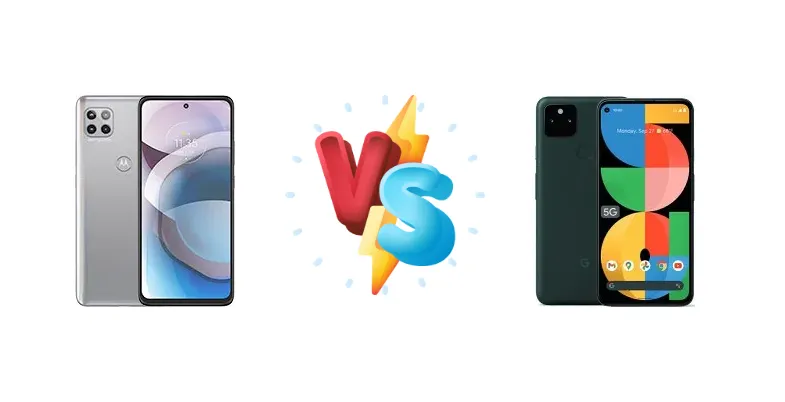
Motorola One 5G Ace vs. Google Pixel 5a 5G: A Detailed Comparison
| Phones Images | |||||
|---|---|---|---|---|---|
|
🏆 Quick Verdict
For the average user prioritizing camera quality and display experience, the Google Pixel 5a 5G is the better choice. However, the Motorola One 5G Ace offers compelling value, particularly for those focused on 5G connectivity and less demanding tasks, making it a strong contender in its price bracket.
| PHONES | ||
|---|---|---|
| Phone Names | Motorola One 5G Ace | Google Pixel 5a 5G |
| Network | ||
|---|---|---|
| 2G bands | GSM 850 / 900 / 1800 / 1900 | GSM 850 / 900 / 1800 / 1900 |
| 3G bands | HSDPA 850 / 900 / 1700(AWS) / 1900 / 2100 | HSDPA 850 / 900 / 1700(AWS) / 1900 / 2100 |
| 4G bands | 1, 2, 3, 4, 5, 7, 8, 12, 13, 14, 17, 18, 19, 20, 25, 26, 29, 30, 38, 39, 40, 41, 66, 71 | 1, 2, 3, 4, 5, 7, 8, 12, 13, 14, 17, 18, 19, 20, 25, 26, 28, 29, 30, 32, 38, 39, 40, 41, 42, 46, 48, 66, 71 |
| 5G bands | 2, 5, 25, 41, 66, 71 Sub6 | 1, 2, 5, 12, 25, 28, 41, 66, 71, 77, 78 SA/NSA/Sub6 |
| Speed | HSPA, LTE, 5G | HSPA, LTE, 5G |
| Technology | GSM / HSPA / LTE / 5G | GSM / HSPA / EVDO / LTE / 5G |
| - | CDMA2000 1xEV-DO | |
| Launch | ||
|---|---|---|
| Announced | 2021, January 08 | 2021, August 17 |
| Status | Available. Released 2021, January 14 | Available. Released 2021, August 26 |
| Body | ||
|---|---|---|
| Build | - | Glass front (Gorilla Glass 3), aluminum frame, aluminum back |
| Dimensions | 166.1 x 76.1 x 9.9 mm (6.54 x 3.00 x 0.39 in) | 156.2 x 73.2 x 8.8 mm (6.15 x 2.88 x 0.35 in) |
| SIM | Nano-SIM | Nano-SIM + eSIM |
| Weight | 212 g (7.48 oz) | 183 g (6.46 oz) |
| Water-repellent coating | IP67 dust/water resistant (up to 1m for 30 min) | |
| Display | ||
|---|---|---|
| Protection | - | Corning Gorilla Glass 3 |
| Resolution | 1080 x 2400 pixels, 20:9 ratio (~393 ppi density) | 1080 x 2400 pixels, 20:9 ratio (~415 ppi density) |
| Size | 6.7 inches, 108.4 cm2 (~85.7% screen-to-body ratio) | 6.34 inches, 97.0 cm2 (~84.9% screen-to-body ratio) |
| Type | IPS LCD, HDR10 | OLED, HDR |
| - | Always-on display | |
| Platform | ||
|---|---|---|
| CPU | Octa-core (2x2.2 GHz Kryo 570 & 6x1.8 GHz Kryo 570) | Octa-core (1x2.4 GHz Kryo 475 Prime & 1x2.2 GHz Kryo 475 Gold & 6x1.8 GHz Kryo 475 Silver) |
| Chipset | Qualcomm SM7225 Snapdragon 750G 5G (8 nm) | Qualcomm SM7250 Snapdragon 765G 5G (7 nm) |
| GPU | Adreno 619 | Adreno 620 |
| OS | Android 10 | Android 11, upgradable to Android 14 |
| Memory | ||
|---|---|---|
| Card slot | microSDXC (dedicated slot) | No |
| Internal | 64GB 4GB RAM, 128GB 6GB RAM | 128GB 6GB RAM |
| Main Camera | ||
|---|---|---|
| Dual | - | 12.2 MP, f/1.7, 27mm, (wide), 1/2.55", 1.4µm, dual pixel PDAF, OIS 16 MP, f/2.2, 119˚ (ultrawide), 1.0µm |
| Features | LED flash, HDR, panorama | LED flash, Pixel Shift, Auto-HDR, panorama |
| Single | - | 8 MP, f/2.0, 24mm (wide), 1.12µm |
| Triple | 48 MP, f/1.7, 26mm (wide), 1/2.0", 0.8µm, PDAF 8 MP, f/2.2, 118˚ (ultrawide), 1.12µm 2 MP (macro), AF | - |
| Video | 4K@30fps, 1080p@30/60fps, gyro-EIS | 4K@30/60fps, 1080p@30/60/120/240fps; gyro-EIS |
| Selfie camera | ||
|---|---|---|
| Features | HDR | HDR |
| Single | 16 MP, f/2.2, (wide), 1.0µm | 8 MP, f/2.0, 24mm (wide), 1.12µm |
| Video | 1080p@30fps | 1080p@30fps |
| Sound | ||
|---|---|---|
| 3.5mm jack | Yes | Yes |
| 35mm jack | Yes | Yes |
| Loudspeaker | Yes | Yes, with stereo speakers |
| Comms | ||
|---|---|---|
| Bluetooth | 5.1, A2DP, LE | 5.0, A2DP, LE, aptX HD |
| NFC | Yes | Yes |
| Positioning | GPS (L1+L5), GLONASS, GALILEO | GPS, GLONASS, GALILEO, QZSS, BDS |
| Radio | Unspecified | No |
| USB | USB Type-C 2.0 | USB Type-C 3.1 |
| WLAN | Wi-Fi 802.11 a/b/g/n/ac, dual-band, Wi-Fi Direct | Wi-Fi 802.11 a/b/g/n/ac, dual-band, Wi-Fi Direct |
| Features | ||
|---|---|---|
| Sensors | Fingerprint (rear-mounted), accelerometer, gyro, proximity, compass, barometer | Fingerprint (rear-mounted), accelerometer, gyro, proximity, compass, barometer |
| Battery | ||
|---|---|---|
| Charging | 15W wired | 18W wired, PD2.0 |
| Type | Li-Po 5000 mAh | Li-Po 4680 mAh |
| Misc | ||
|---|---|---|
| Colors | Volcanic Gray, Frosted Silver | Mostly Black |
| Models | XT2113-2, XT2113-5 | G1F8F, G4S1M |
| Price | About 50 EUR | $ 189.00 / C$ 249.99 |
| Tests | ||
|---|---|---|
| Battery life | - | Endurance rating 122h |
| Display | - | Contrast ratio: Infinite (nominal) |
| Performance | - | AnTuTu: 291303 (v8) GeekBench: 1337 (v5.1) GFXBench: 19fps (ES 3.1 onscreen) |
Motorola One 5G Ace
- More affordable price point
- Modern Snapdragon 750G 5G chipset
- Reliable 5G connectivity
- Less impressive display quality
- Inferior camera performance compared to Pixel 5a
- Slower charging speed
Google Pixel 5a 5G
- Superior display brightness and quality
- Exceptional camera performance with Google’s software
- Faster charging with PD2.0 support
- Higher price tag
- Slightly older Snapdragon 765G chipset
- May be harder to find new
Display Comparison
The Google Pixel 5a 5G boasts a significantly brighter display, reaching a measured 861 nits, compared to an unlisted value for the Motorola One 5G Ace. This brightness advantage translates to better outdoor visibility. While both have an 'infinite' (nominal) contrast ratio, the Pixel 5a’s superior brightness is a clear win. The Pixel 5a’s display is likely to offer a more vibrant and enjoyable viewing experience, especially in bright conditions. The Motorola Ace’s display specs are less defined, suggesting a more basic panel.
Camera Comparison
The Pixel 5a 5G’s camera system is a key differentiator. While specific sensor sizes aren’t provided, Google’s computational photography prowess, combined with its image processing algorithms, consistently delivers excellent image quality, particularly in low-light conditions. The Motorola One 5G Ace likely relies more on hardware specifications, and without detailed information, it’s difficult to assess its camera capabilities. The Pixel 5a’s software optimizations are a significant advantage, often surpassing the capabilities of phones with superior hardware on paper. The Ace likely includes standard features, but won't match the Pixel's consistency.
Performance
Both phones utilize Qualcomm Snapdragon 7-series chipsets, but the Pixel 5a 5G features the Snapdragon 765G (7nm) while the Motorola One 5G Ace uses the Snapdragon 750G (8nm). The 7nm process of the 765G generally allows for slightly higher sustained performance and better thermal efficiency compared to the 8nm 750G. The Pixel 5a’s CPU configuration, with a Kryo 475 Prime core, offers a performance edge over the Ace’s dual Kryo 570 cores. While both CPUs have 6x 1.8 GHz cores, the architectural differences favor the Pixel 5a in demanding applications. The Ace’s 5G modem is a benefit, but the 765G is still capable.
Battery Life
Both devices share an endurance rating of 122 hours, suggesting comparable battery life under similar usage scenarios. However, the Pixel 5a 5G supports 18W charging with PD2.0, offering faster and more efficient charging compared to the Motorola One 5G Ace’s 15W wired charging. While the difference isn’t massive, the Pixel 5a’s faster charging can shave off valuable time when topping up the battery. The similar endurance ratings suggest that despite potential chipset efficiency differences, both phones are optimized for all-day battery life.
Buying Guide
Buy the Motorola One 5G Ace if you need a reliable 5G phone on a tight budget and prioritize connectivity over camera prowess. It’s ideal for streaming, social media, and everyday tasks. Buy the Google Pixel 5a 5G if you prefer a superior display, exceptional camera performance powered by Google’s computational photography, and a more refined software experience, even if it means paying a slight premium.