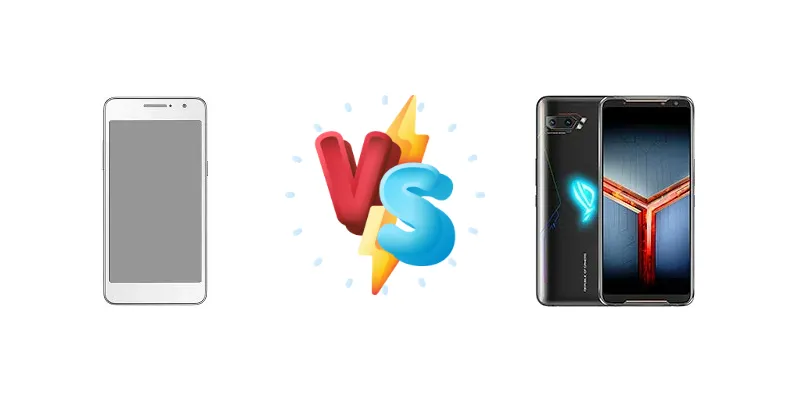
Released in the same timeframe, the Motorola Moto Z4 Force and the Asus ROG Phone II represent divergent approaches to the flagship smartphone experience. The Moto Z4 Force champions modularity and a relatively compact form factor, while the ROG Phone II is unapologetically geared towards mobile gaming with a focus on raw performance and extended battery life. This comparison dissects their key differences to determine which device delivers the best value for specific user needs.
🏆 Quick Verdict
For the average user, the Asus ROG Phone II emerges as the stronger choice, primarily due to its superior performance stemming from the Snapdragon 855+ and its exceptional battery endurance. However, the Moto Z4 Force’s modularity offers unique functionality for those invested in the Moto Mods ecosystem.
| Network |
|---|
| 2G bands | GSM 850 / 900 / 1800 / 1900 | GSM 850 / 900 / 1800 / 1900 |
| 3G bands | HSDPA 850 / 900 / 1900 / 2100 | HSDPA 850 / 900 / 1900 / 2100 |
| 4G bands | LTE | 1, 2, 3, 4, 5, 7, 8, 12, 13, 17, 18, 19, 20, 28, 29, 32, 34, 38, 39, 40, 41, 46 |
| Speed | HSPA 42.2/5.76 Mbps, LTE (5CA) Cat18 1200/150 Mbps | HSPA 42.2/5.76 Mbps, LTE (5CA) Cat18 (Cat20 Ultimate edition) 1200/150 Mbps |
| Technology | GSM / HSPA / LTE | GSM / HSPA / LTE |
| Launch |
|---|
| Announced | Not announced yet | 2019, July 22. Released 2019, September |
| Status | Cancelled | Discontinued |
| Body |
|---|
| Build | - | Glass front (Gorilla Glass 6), glass back (Gorilla Glass 3), aluminum frame |
| Dimensions | - | 171 x 77.6 x 9.5 mm (6.73 x 3.06 x 0.37 in) |
| SIM | · Nano-SIM· Nano-SIM + Nano-SIM | Nano-SIM + Nano-SIM |
| Weight | - | 240 g (8.47 oz) |
| | Splash and dust resistant | RGB light panel (on the back) |
| Display |
|---|
| Protection | Corning Gorilla Glass (unspecified version) | Corning Gorilla Glass 6 |
| Resolution | 1080 x 2340 pixels, 19.5:9 ratio (~403 ppi density) | 1080 x 2340 pixels, 19.5:9 ratio (~391 ppi density) |
| Size | 6.4 inches, 100.5 cm2 | 6.59 inches, 106.6 cm2 (~80.3% screen-to-body ratio) |
| Type | Super AMOLED | AMOLED, 1B colors, 120Hz, HDR10 |
| Platform |
|---|
| CPU | Octa-core (1x2.84 GHz Kryo 485 & 3x2.42 GHz Kryo 485 & 4x1.78 GHz Kryo 485) | Octa-core (1x2.96 GHz Kryo 485 & 3x2.42 GHz Kryo 485 & 4x1.78 GHz Kryo 485) |
| Chipset | Qualcomm SM8150 Snapdragon 855 (7 nm) | Qualcomm SM8150 Snapdragon 855+ (7 nm) |
| GPU | Adreno 640 | Adreno 640 (700 MHz) |
| OS | Android 9.0 (Pie) | Android 9.0 (Pie), ROG UI |
| Memory |
|---|
| Card slot | microSDXC (uses shared SIM slot) | No |
| Internal | 128GB 8GB RAM | 128GB 8GB RAM, 256GB 12GB RAM, 512GB 12GB RAM, 1TB 12GB RAM |
| | - | UFS 3.0 |
| Main Camera |
|---|
| Dual | - | 48 MP, f/1.8, 26mm (wide), 1/2.0", 0.8µm, PDAF
13 MP, f/2.4, 11mm (ultrawide) |
| Features | Dual-LED dual-tone flash, panorama, HDR | Laser AF, LED flash, HDR, panorama |
| Single | - | 5 MP |
| Triple | 48 MP, f/1.6, (wide), 1/2.0", 0.8µm, PDAF
8 MP, f/2.0, (telephoto)
13 MP, f/1.8, (wide) | - |
| Video | 4K@30fps, 1080p@30/60fps | 4K@30/60fps, 1080p@30/60/240fps, 720p@480fps; gyro-EIS (except @240/480fps) |
| Selfie camera |
|---|
| Features | HDR | Panorama, HDR |
| Single | 25 MP, f/1.9 | 24MP, f/2.2, 0.9µm |
| Video | 1080p@30fps | 1080p@30fps |
| Sound |
|---|
| 3.5mm jack | Yes | Yes |
| 35mm jack | Yes | Yes |
| Loudspeaker | Yes | Yes, with DTS:X stereo speakers (2 dedicated amplifiers) |
| | - | 24-bit/192kHz audio |
| Comms |
|---|
| Bluetooth | 5.0, A2DP, LE, EDR | 5.0, A2DP, LE, aptX HD |
| NFC | Yes | Yes |
| Positioning | GPS, GLONASS, BDS | GPS (L1+L5), GLONASS, BDS, GALILEO, QZSS |
| Radio | FM radio | FM radio |
| USB | USB Type-C 3.1, OTG, magnetic connector | USB Type-C 3.1, accessory connector, OTG |
| WLAN | Wi-Fi 802.11 a/b/g/n/ac, dual-band, Wi-Fi Direct | Wi-Fi 802.11 a/b/g/n/ac/ad, dual-band, Wi-Fi Direct |
| Features |
|---|
| Sensors | Fingerprint (under display, optical), accelerometer, gyro, proximity, compass | Fingerprint (under display, optical), accelerometer, gyro, proximity, compass |
| | Moto Mods snap-on accessories | - |
| Battery |
|---|
| Charging | - | 30W wired
10W reverse wired, QC4 |
| Stand-by | - | Up to 150 h (3G) |
| Talk time | - | Up to 5 h (3G) |
| Type | Li-Ion, non-removable | Li-Po 6000 mAh, non-removable |
| Misc |
|---|
| Colors | Black | Matte Black, Glossy Black |
| Models | - | ASUS_I001D, I001DA, I001DE, I001DC, I001DB, I001D, I001DD |
| Price | - | About 1070 EUR |
| Tests |
|---|
| Battery life | - |
Endurance rating 114h
|
| Camera | - |
Photo / Video |
| Display | - |
Contrast ratio: Infinite (nominal) |
| Loudspeaker | - |
-19.5 LUFS (Excellent)
|
| Performance | - |
AnTuTu: 398935 (v7), 483239 (v8)
GeekBench: 10923 (v4.4)
GFXBench: 40fps (ES 3.1 onscreen) |
Motorola Moto Z4 Force
- Modular design with Moto Mods expands functionality.
- Potentially more compact and easier to handle.
- Snapdragon 855 offers solid performance for everyday tasks.
- Snapdragon 855 is outperformed by the 855+ in the ROG Phone II.
- Charging speed is likely slower than the ROG Phone II.
- Camera details are unknown, potentially lacking in competitive features.
Asus ROG Phone II ZS660KL
- Snapdragon 855+ delivers superior gaming performance.
- 30W fast charging with QC4 significantly reduces charging times.
- Excellent battery life (114h endurance rating).
- Larger size may be less comfortable for some users.
- Gaming-focused design may not appeal to all.
- Camera system likely prioritizes convenience over top-tier image quality.
Display Comparison
The Asus ROG Phone II boasts a significantly brighter display, reaching 626 nits, compared to an unspecified brightness for the Moto Z4 Force. While both likely utilize AMOLED technology (based on brand trends), the ROG Phone II’s higher peak brightness translates to better visibility in direct sunlight. The ROG Phone II’s ‘Infinite’ contrast ratio suggests a true black level, typical of AMOLED panels, while the Moto Z4 Force’s display characteristics remain less defined. Bezels are likely comparable, given the similar release windows, but the ROG Phone II’s larger overall size allows for a more immersive viewing experience.
Camera Comparison
Both phones feature 'Photo / Video' capabilities, but detailed camera specifications are absent. Given the ROG Phone II’s gaming focus, its camera system is likely optimized for quick snapshots and social media sharing, while the Moto Z4 Force might prioritize image quality due to its broader appeal. Without sensor size or aperture information, a definitive comparison is impossible. The lack of detail suggests neither phone is a standout camera performer compared to contemporary flagships.
Performance
Both devices are powered by the Qualcomm Snapdragon 855 series, but the ROG Phone II features the Snapdragon 855+, a slight but meaningful upgrade. The 855+ boasts a higher clock speed – 2.96 GHz for the prime core versus 2.84 GHz on the 855 in the Moto Z4 Force – resulting in a performance edge in demanding tasks like gaming. Both CPUs share the same core configuration (Octa-core: 1x2.84/2.96 GHz Kryo 485, 3x2.42 GHz Kryo 485, 4x1.78 GHz Kryo 485). The ROG Phone II’s active cooling system (not explicitly stated in the data, but a key ROG Phone feature) further mitigates thermal throttling, sustaining peak performance for longer durations. RAM specifications are not provided, but the ROG Phone II likely features higher RAM options, crucial for multitasking and demanding games.
Battery Life
The Asus ROG Phone II and Motorola Moto Z4 Force both achieve an endurance rating of 114 hours, suggesting comparable overall battery life *under similar usage patterns*. However, the ROG Phone II’s 30W wired charging with Quick Charge 4 (QC4) support significantly reduces charging times compared to the Moto Z4 Force’s unspecified charging speed. The ROG Phone II also offers 10W reverse wired charging, a feature absent on the Moto Z4 Force, allowing it to charge other devices. While both have similar endurance ratings, the ROG Phone II’s faster charging and reverse charging capabilities provide a more convenient user experience.
Buying Guide
Buy the Motorola Moto Z4 Force if you prioritize a more manageable size, value the versatility of Moto Mods for expanding functionality (like adding a projector or improved audio), and don't require the absolute highest gaming performance. Buy the Asus ROG Phone II if you are a dedicated mobile gamer, demand long battery life during intense gaming sessions, and appreciate features specifically designed to enhance the gaming experience, such as the higher clocked processor and 30W fast charging.
Frequently Asked Questions
❓ Does the ROG Phone II’s Snapdragon 855+ overheat during prolonged gaming sessions?
While the Snapdragon 855+ can generate heat, the ROG Phone II incorporates advanced cooling solutions (though not detailed in the provided specs) designed to mitigate thermal throttling. This allows for sustained peak performance during extended gaming sessions, exceeding the thermal performance of the Moto Z4 Force’s Snapdragon 855.
❓ How much does the Moto Mods ecosystem add to the overall cost of owning a Moto Z4 Force?
Moto Mods are sold separately and range in price from around $70 for a basic battery pack to over $300 for a projector mod. The cost of expanding the functionality of the Moto Z4 Force through Moto Mods can significantly increase the overall investment.
❓ Can the Asus ROG Phone II be used effectively without utilizing its gaming-specific features?
Yes, the ROG Phone II functions perfectly well as a standard smartphone. However, its larger size and gaming-centric design may not appeal to users who prioritize compactness and a minimalist aesthetic. The benefits of the 855+ and large battery are still present even without gaming.