
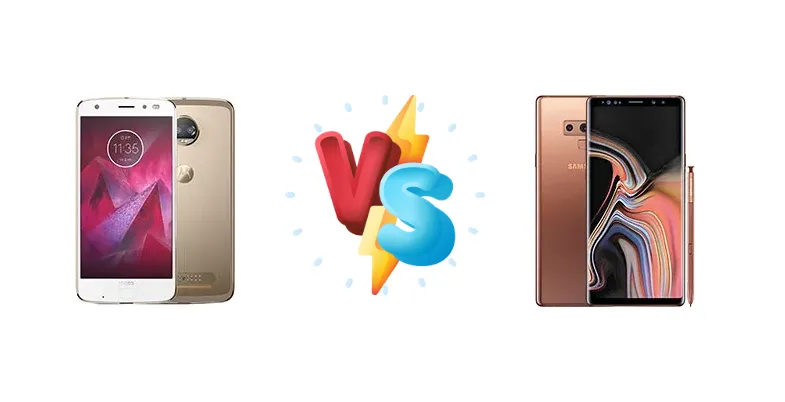
Motorola Moto Z2 Force vs Samsung Galaxy Note9: A Clash of Titans
| Phones Images | |||||
|---|---|---|---|---|---|
|
🏆 Quick Verdict
The Samsung Galaxy Note9 is the clear winner. While the Moto Z2 Force offered a unique modular system and decent performance for its time, the Note9 boasts superior battery life, a stunning display, a more versatile camera, and the added functionality of the S Pen. It's a more modern and feature-rich experience.
| PHONES | ||
|---|---|---|
| Phone Names | Motorola Moto Z2 Force | Samsung Galaxy Note9 |
| Network | ||
|---|---|---|
| 2G bands | GSM 850 / 900 / 1800 / 1900 - SIM 1 & SIM 2 (dual-SIM model only) | GSM 850 / 900 / 1800 / 1900 |
| 3G bands | HSDPA 800 / 850 / 900 / 1700(AWS) / 1900 / 2100 | HSDPA 850 / 900 / 1700(AWS) / 1900 / 2100 |
| 4G bands | 1, 2, 3, 4, 5, 7, 8, 12, 17, 18, 19, 20, 26, 28, 34, 38, 39, 40, 41, 46 | 1, 2, 3, 4, 5, 7, 8, 12, 13, 17, 18, 19, 20, 25, 26, 28, 32, 38, 39, 40, 41, 66, 71 - Global |
| Speed | HSPA, LTE | HSPA 42.2/5.76 Mbps, LTE (5CA) Cat18 1200/200 Mbps |
| Technology | GSM / HSPA / LTE | GSM / CDMA / HSPA / EVDO / LTE |
| - | 1, 2, 3, 4, 5, 7, 8, 12, 13, 14, 17, 18, 19, 20, 25, 26, 28, 29, 30, 38, 39, 40, 41, 46, 66, 71 - USA | |
| Launch | ||
|---|---|---|
| Announced | 2017, July. Released 2017, August | 2018, August 09. Released 2018, August 24 |
| Status | Discontinued | Discontinued |
| Body | ||
|---|---|---|
| Build | Plastic front, aluminum back, aluminum frame | Glass front (Gorilla Glass 5), glass back (Gorilla Glass 5), aluminum frame |
| Dimensions | 155.8 x 76 x 6.1 mm (6.13 x 2.99 x 0.24 in) | 161.9 x 76.4 x 8.8 mm (6.37 x 3.01 x 0.35 in) |
| SIM | · Nano-SIM· Nano-SIM + Nano-SIM | · Nano-SIM· Nano-SIM + Nano-SIM |
| Weight | 143 g (5.04 oz) | 201 g (7.09 oz) |
| Splash resistant | IP68 dust/water resistant (up to 1.5m for 30 min) Stylus (Bluetooth integration) | |
| Display | ||
|---|---|---|
| Protection | Shatterproof | Corning Gorilla Glass 5 |
| Resolution | 1440 x 2560 pixels, 16:9 ratio (~534 ppi density) | 1440 x 2960 pixels, 18.5:9 ratio (~516 ppi density) |
| Size | 5.5 inches, 83.4 cm2 (~70.4% screen-to-body ratio) | 6.4 inches, 103.2 cm2 (~83.4% screen-to-body ratio) |
| Type | P-OLED | Super AMOLED, HDR10 |
| - | Always-on display | |
| Platform | ||
|---|---|---|
| CPU | Octa-core (4x2.35 GHz Kryo & 4x1.9 GHz Kryo) | Octa-core (4x2.7 GHz Mongoose M3 & 4x1.8 GHz Cortex-A55) - EMEAOcta-core (4x2.8 GHz Kryo 385 Gold & 4x1.7 GHz Kryo 385 Silver) - USA/LATAM, China |
| Chipset | Qualcomm MSM8998 Snapdragon 835 (10 nm) | Exynos 9810 (10 nm) - EMEAQualcomm SDM845 Snapdragon 845 (10 nm) - USA/LATAM, China |
| GPU | Adreno 540 | Mali-G72 MP18 - EMEAAdreno 630 - USA/LATAM, China |
| OS | Android 7.1.1 (Nougat), upgradable to Android 9.0 (Pie) | Android 8.1 (Oreo), upgradable to Android 10, One UI 2.5 |
| Memory | ||
|---|---|---|
| Card slot | microSDXC (dedicated slot) | microSDXC (uses shared SIM slot) |
| Internal | 64GB 4GB RAM, 64GB 6GB RAM, 128GB 6GB RAM | 128GB 6GB RAM, 128GB 8GB RAM, 512GB 8GB RAM |
| - | UFS 2.1 | |
| Main Camera | ||
|---|---|---|
| Dual | - | 12 MP, f/1.5-2.4, 26mm (wide), 1/2.55", 1.4µm, dual pixel PDAF, OIS 12 MP, f/2.4, 52mm (telephoto), 1/3.4", 1.0µm, AF, OIS, 2x optical zoom |
| Features | Laser AF, Dual-LED dual-tone flash, HDR, panorama | LED flash, auto-HDR, panorama |
| Single | 12 MP, f/2.0, 1/2.8", 1.25µm, PDAF 12 MP B/W, f/2.0, 1/2.9", 1.25µm, PDAF | - |
| Video | 4K@30fps, 1080p@30/60/120fps, 720p@240fps | 4K@60fps (no OIS/EIS), 4K@30fps, 1080p@30/60/240fps, 720p@960fps, HDR, stereo sound rec., gyro-EIS & OIS |
| Selfie camera | ||
|---|---|---|
| Dual | - | 8 MP, f/1.7, 25mm (wide), 1/3.6", 1.22µm, AF 2 MP (dedicated iris scanner camera) |
| Features | Dual-LED dual-tone flash | HDR |
| Single | 5 MP, f/2.2 | - |
| Video | - | 1440p@30fps |
| Sound | ||
|---|---|---|
| 3.5mm jack | No | Yes |
| 35mm jack | No | Yes |
| Loudspeaker | Yes | Yes, with stereo speakers |
| - | 32-bit/384kHz audio | |
| Comms | ||
|---|---|---|
| Bluetooth | 4.2, A2DP, EDR, LE (5.0 after SW update), aptX | 5.0, A2DP, LE, aptX |
| NFC | Yes | Yes |
| Positioning | GPS | GPS, GLONASS, BDS, GALILEO |
| Radio | No | No |
| USB | USB Type-C, OTG, magnetic connector | USB Type-C 3.1 |
| WLAN | Wi-Fi 802.11 a/b/g/n/ac, dual-band, Wi-Fi Direct | Wi-Fi 802.11 a/b/g/n/ac, dual-band, Wi-Fi Direct |
| Features | ||
|---|---|---|
| Sensors | Fingerprint (front-mounted), accelerometer, gyro, proximity, compass, barometer | Iris scanner, fingerprint (rear-mounted), accelerometer, gyro, proximity, compass, barometer, heart rate, SpO2 |
| Moto Mods snap-on accessories | Samsung DeX (desktop experience support) ANT+ Bixby natural language commands and dictation Samsung Pay (Visa, MasterCard certified) | |
| Battery | ||
|---|---|---|
| Charging | 15W wired | 15W wired Wireless (Qi) (market dependent) |
| Type | Li-Ion 2730 mAh, non-removable | Li-Ion 4000 mAh, non-removable |
| Misc | ||
|---|---|---|
| Colors | Super Black, Fine Gold, Lunar Grey | Metallic Copper, Lavender Purple, Ocean Blue, Midnight Black, Pure White, Alpine White |
| Models | XT1789-05 | SM-N960F, SM-N9600, SM-N960F, SM-N960U, SM-N960U1, SM-N960N, SM-N960W, SM-N960X, SCV40 |
| Price | About 320 EUR | About 430 EUR |
| SAR | 0.87 W/kg (head) 1.10 W/kg (body) | 1.29 W/kg (head) 1.03 W/kg (body) |
| SAR EU | 0.41 W/kg (head) 1.45 W/kg (body) | 0.38 W/kg (head) 1.51 W/kg (body) |
| Tests | ||
|---|---|---|
| Audio quality | - | Noise -93.7dB / Crosstalk -94.1dB |
| Battery life | Endurance rating 69h | Endurance rating 97h |
| Camera | Photo / Video | Photo / Video |
| Display | - | Contrast ratio: Infinite (nominal), 4.531 (sunlight) |
| Loudspeaker | Voice 68dB / Noise 70dB / Ring 86dB | Voice 71dB / Noise 74dB / Ring 80dB |
| Performance | AnTuTu: 209779 (v7) GeekBench: 6629 (v4.4) GFXBench: 15fps (ES 3.1 onscreen) | AnTuTu: 248823 (v7), 315447 (v8) GeekBench: 9026 (v4.4), 2092 (v5.1) GFXBench: 15fps (ES 3.1 onscreen) |
Motorola Moto Z2 Force
- Compact and relatively lightweight
- Rugged design
- Modular Moto Mods support (limited ecosystem)
- Decent performance for its time
- Outdated chipset
- Shorter battery life
- Less impressive camera
- Limited software updates
Samsung Galaxy Note9
- Excellent display with vibrant colors and high contrast
- Long battery life
- Versatile and high-quality camera
- Powerful performance
- S Pen stylus for productivity
- Modern design
- Larger size may not be ideal for everyone
- Can be expensive (especially now, being an older model)
Display Comparison
The Galaxy Note9's display is significantly better. Its 'Infinity' display offers a near bezel-less design with vibrant colors and excellent contrast (rated at Infinite nominal and 4.531 in sunlight). The Z2 Force's display, while adequate, lacks the Note9's visual impact and modern design. The Note9's larger size also contributes to a more immersive viewing experience.
Camera Comparison
The Galaxy Note9's camera system is more versatile and generally produces better results. It features a dual-lens setup with improved low-light performance and more advanced features. The Z2 Force's camera is capable, but it doesn't match the Note9's image quality or feature set. Video recording capabilities are also superior on the Note9.
Performance
Both phones utilize powerful chipsets – the Z2 Force with the Snapdragon 835 and the Note9 with either the Exynos 9810 or Snapdragon 845 (region dependent). While the 835 was a top performer in its time, the Note9's processors offer a noticeable performance boost, especially in demanding tasks and multitasking. The Note9's RAM also provides a smoother experience.
Battery Life
The Note9's battery life is a major advantage. With an endurance rating of 97 hours, it significantly outlasts the Z2 Force's 69 hours. This difference translates to noticeably longer usage between charges, making the Note9 a more practical choice for users who rely on their phones throughout the day.
Buying Guide
The Motorola Moto Z2 Force is best suited for users who prioritize a compact, rugged design and are intrigued by the modular Moto Mods system (though the ecosystem is now limited). The Samsung Galaxy Note9 is ideal for power users who want a large, vibrant display, excellent camera capabilities, long battery life, and the productivity benefits of the S Pen.