
Motorola Moto Z2 Force vs. Moto Z3: A Detailed Comparison
| Phones Images | |||||
|---|---|---|---|---|---|
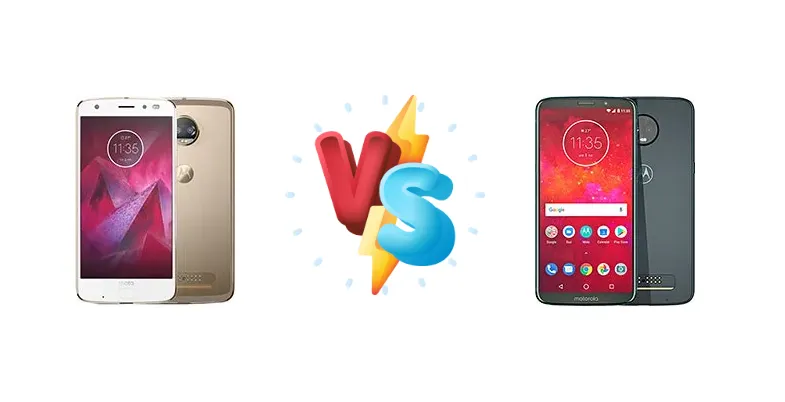
|
🏆 Quick Verdict
The Moto Z3 edges out the Z2 Force primarily due to its improved battery life. While both share the same Snapdragon 835 chipset, the Z3's optimization and slightly larger battery provide a noticeable advantage. If battery endurance is a priority, the Z3 is the clear winner.
| PHONES | ||
|---|---|---|
| Phone Names | Motorola Moto Z2 Force | Motorola Moto Z3 |
| Network | ||
|---|---|---|
| 2G bands | GSM 850 / 900 / 1800 / 1900 - SIM 1 & SIM 2 (dual-SIM model only) | GSM 850 / 900 / 1800 / 1900 |
| 3G bands | HSDPA 800 / 850 / 900 / 1700(AWS) / 1900 / 2100 | HSDPA 850 / 900 / 1700(AWS) / 1900 / 2100 |
| 4G bands | 1, 2, 3, 4, 5, 7, 8, 12, 17, 18, 19, 20, 26, 28, 34, 38, 39, 40, 41, 46 | 1, 3, 4, 5, 7, 8, 12, 17, 18, 19, 20, 26, 28, 38, 40, 41 |
| Speed | HSPA, LTE | HSPA 42.2/5.76 Mbps, LTE (5CA) Cat16 1024/150 Mbps |
| Technology | GSM / HSPA / LTE | GSM / HSPA / LTE |
| Launch | ||
|---|---|---|
| Announced | 2017, July. Released 2017, August | 2018, August. Released 2018, August |
| Status | Discontinued | Discontinued |
| Body | ||
|---|---|---|
| Build | Plastic front, aluminum back, aluminum frame | Glass front (Gorilla Glass 3), glass back (Gorilla Glass 3), aluminum frame (6000 series) |
| Dimensions | 155.8 x 76 x 6.1 mm (6.13 x 2.99 x 0.24 in) | 156.5 x 76.5 x 6.8 mm (6.16 x 3.01 x 0.27 in) |
| SIM | · Nano-SIM· Nano-SIM + Nano-SIM | · Nano-SIM· Nano-SIM + Nano-SIM |
| Weight | 143 g (5.04 oz) | 156 g (5.50 oz) |
| Splash resistant | Splash and dust resistant | |
| Display | ||
|---|---|---|
| Protection | Shatterproof | Corning Gorilla Glass 3 |
| Resolution | 1440 x 2560 pixels, 16:9 ratio (~534 ppi density) | 1080 x 2160 pixels, 18:9 ratio (~402 ppi density) |
| Size | 5.5 inches, 83.4 cm2 (~70.4% screen-to-body ratio) | 6.01 inches, 93.2 cm2 (~77.9% screen-to-body ratio) |
| Type | P-OLED | Super AMOLED |
| Platform | ||
|---|---|---|
| CPU | Octa-core (4x2.35 GHz Kryo & 4x1.9 GHz Kryo) | Octa-core (4x2.35 GHz Kryo & 4x1.9 GHz Kryo) |
| Chipset | Qualcomm MSM8998 Snapdragon 835 (10 nm) | Qualcomm MSM8998 Snapdragon 835 (10 nm) |
| GPU | Adreno 540 | Adreno 540 |
| OS | Android 7.1.1 (Nougat), upgradable to Android 9.0 (Pie) | Android 8.1 (Oreo), upgradable to Android 9.0 (Pie) |
| Memory | ||
|---|---|---|
| Card slot | microSDXC (dedicated slot) | microSDXC (dedicated slot) |
| Internal | 64GB 4GB RAM, 64GB 6GB RAM, 128GB 6GB RAM | 64GB 4GB RAM, 128GB 6GB RAM |
| Main Camera | ||
|---|---|---|
| Dual | - | 12 MP, f/2.0, 1/2.8", 1.25µm, PDAF 12 MP B/W |
| Features | Laser AF, Dual-LED dual-tone flash, HDR, panorama | Laser AF, Dual-LED dual-tone flash, panorama |
| Single | 12 MP, f/2.0, 1/2.8", 1.25µm, PDAF 12 MP B/W, f/2.0, 1/2.9", 1.25µm, PDAF | - |
| Video | 4K@30fps, 1080p@30/60/120fps, 720p@240fps | 4K@30fps, 1080p@30/60fps |
| Selfie camera | ||
|---|---|---|
| Features | Dual-LED dual-tone flash | - |
| Single | 5 MP, f/2.2 | 8 MP, f/2.0, 1/4.0", 24mm (wide), 1.12µm |
| Video | - | 1080p@30fps |
| Sound | ||
|---|---|---|
| 3.5mm jack | No | No |
| 35mm jack | No | No |
| Loudspeaker | Yes | Yes |
| Comms | ||
|---|---|---|
| Bluetooth | 4.2, A2DP, EDR, LE (5.0 after SW update), aptX | 5.0, A2DP, EDR, LE, aptX |
| NFC | Yes | Yes |
| Positioning | GPS | GPS, GLONASS, BDS |
| Radio | No | FM radio |
| USB | USB Type-C, OTG, magnetic connector | USB Type-C 3.1, OTG, magnetic connector |
| WLAN | Wi-Fi 802.11 a/b/g/n/ac, dual-band, Wi-Fi Direct | Wi-Fi 802.11 a/b/g/n/ac, dual-band, Wi-Fi Direct |
| Features | ||
|---|---|---|
| Sensors | Fingerprint (front-mounted), accelerometer, gyro, proximity, compass, barometer | Fingerprint (side-mounted), accelerometer, gyro, proximity, compass |
| Moto Mods snap-on accessories | Moto Mods snap-on accessories | |
| Battery | ||
|---|---|---|
| Charging | 15W wired | 15W wired |
| Type | Li-Ion 2730 mAh, non-removable | Li-Ion 3000 mAh, non-removable |
| Misc | ||
|---|---|---|
| Colors | Super Black, Fine Gold, Lunar Grey | Ceramic Black |
| Models | XT1789-05 | - |
| Price | About 320 EUR | About 250 EUR |
| SAR | 0.87 W/kg (head) 1.10 W/kg (body) | 1.11 W/kg (head) 1.18 W/kg (body) |
| SAR EU | 0.41 W/kg (head) 1.45 W/kg (body) | 0.56 W/kg (head) 1.44 W/kg (body) |
| Tests | ||
|---|---|---|
| Audio quality | - | Noise -92.9dB / Crosstalk -92.8dB |
| Battery life | Endurance rating 69h | Endurance rating 86h |
| Camera | Photo / Video | - |
| Loudspeaker | Voice 68dB / Noise 70dB / Ring 86dB | Voice 80dB / Noise 73dB / Ring 85dB |
| Performance | AnTuTu: 209779 (v7) GeekBench: 6629 (v4.4) GFXBench: 15fps (ES 3.1 onscreen) | AnTuTu: 207903 (v7) GeekBench: 6614 (v4.4) GFXBench: 23fps (ES 3.1 onscreen) |
Motorola Moto Z2 Force
- Shattershield display for enhanced durability
- Compact and ergonomic design
- Modular Moto Mods support
- Good camera performance in good lighting
- Older chipset and software
- Shorter battery life
- Larger bezels compared to newer phones
- 15W charging is relatively slow
Motorola Moto Z3
- Improved battery life
- Slightly better performance due to optimizations
- More modern design with smaller bezels
- Modular Moto Mods support
- Still uses Snapdragon 835 (not the latest chipset)
- 15W charging is relatively slow
- Moto Mods accessories are an additional cost
Display Comparison
Both phones feature a 5.93-inch display, but the Z3 boasts a slightly more modern design with smaller bezels. The Z2 Force has a more pronounced chin. Both offer a 1080 x 1920 resolution, providing a sharp and vibrant viewing experience. The Z3's design offers a more immersive feel.
Camera Comparison
The Moto Z2 Force was known for its 12MP + 12MP dual camera setup with optical image stabilization (OIS). The Moto Z3 also features a 12MP dual camera, but with improved image processing algorithms. While both capture decent photos in good lighting, the Z3 generally produces more vibrant and detailed images, especially in low-light conditions. Video recording capabilities are comparable on both devices.
Performance
Despite sharing the same Snapdragon 835 chipset and CPU, the Moto Z3 demonstrates slightly better performance due to software optimizations. Both phones handle everyday tasks and moderate gaming with ease, but the Z3 exhibits marginally smoother multitasking and responsiveness. The Z2 Force's older software might show some minor slowdowns over time.
Battery Life
This is where the Moto Z3 truly shines. The Z3 boasts an endurance rating of 86 hours, significantly higher than the Z2 Force's 69 hours. This translates to noticeably longer battery life for the Z3, allowing for a full day of heavy use without needing to recharge.
Buying Guide
The Moto Z2 Force is a good choice for users who prioritize a compact design and a rugged build (shattershield). The Moto Z3 is ideal for those seeking longer battery life and a slightly more modern design, while still leveraging the modular Moto Mods ecosystem.