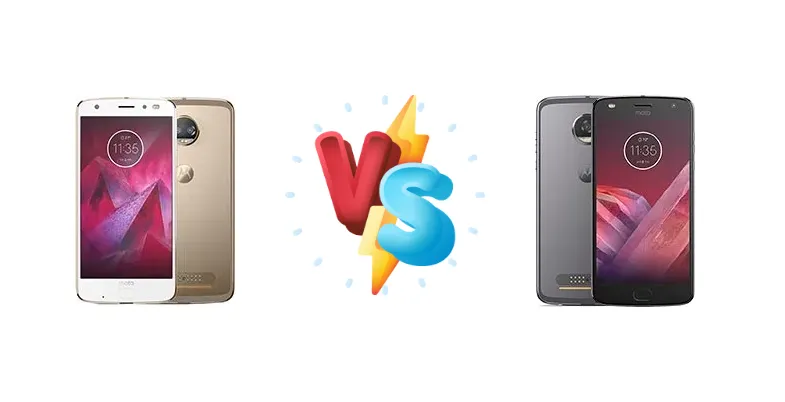
The Motorola Moto Z2 Force and Z2 Play were both solid contenders in their time, offering modularity and a respectable Android experience. But which one truly shines? This comprehensive comparison dives deep into their specs, performance, and features to help you decide which phone is the better choice, especially if you're considering a used purchase.
🏆 Quick Verdict
The Moto Z2 Play edges out the Z2 Force thanks to its slightly better battery life and faster charging. While the Z2 Force boasts a more powerful Snapdragon 835 chipset, the Z2 Play's overall value and endurance make it the more compelling option for most users, particularly given their age.
| Network |
|---|
| 2G bands | GSM 850 / 900 / 1800 / 1900 - SIM 1 & SIM 2 (dual-SIM model only) | GSM 850 / 900 / 1800 / 1900 - SIM 1 & SIM 2 (dual-SIM model only) |
| 3G bands | HSDPA 800 / 850 / 900 / 1700(AWS) / 1900 / 2100 | HSDPA 850 / 900 / 1900 / 2100 |
| 4G bands | 1, 2, 3, 4, 5, 7, 8, 12, 17, 18, 19, 20, 26, 28, 34, 38, 39, 40, 41, 46 | 1, 3, 5, 7, 8, 19, 20, 28, 38, 40, 41 |
| Speed | HSPA, LTE | HSPA, LTE |
| Technology | GSM / HSPA / LTE | GSM / HSPA / LTE |
| Launch |
|---|
| Announced | 2017, July. Released 2017, August | 2017, June. Released 2017, June |
| Status | Discontinued | Discontinued |
| Body |
|---|
| Build | Plastic front, aluminum back, aluminum frame | Glass front (Gorilla Glass 3), aluminum back, aluminum frame |
| Dimensions | 155.8 x 76 x 6.1 mm (6.13 x 2.99 x 0.24 in) | 156.2 x 76.2 x 6 mm (6.15 x 3.00 x 0.24 in) |
| SIM | · Nano-SIM· Nano-SIM + Nano-SIM | · Nano-SIM· Nano-SIM + Nano-SIM |
| Weight | 143 g (5.04 oz) | 145 g (5.11 oz) |
| | Splash resistant | Splash and dust resistant |
| Display |
|---|
| Protection | Shatterproof | Corning Gorilla Glass 3 |
| Resolution | 1440 x 2560 pixels, 16:9 ratio (~534 ppi density) | 1080 x 1920 pixels, 16:9 ratio (~401 ppi density) |
| Size | 5.5 inches, 83.4 cm2 (~70.4% screen-to-body ratio) | 5.5 inches, 83.4 cm2 (~70.1% screen-to-body ratio) |
| Type | P-OLED | Super AMOLED |
| Platform |
|---|
| CPU | Octa-core (4x2.35 GHz Kryo & 4x1.9 GHz Kryo) | Octa-core 2.2 GHz Cortex-A53 |
| Chipset | Qualcomm MSM8998 Snapdragon 835 (10 nm) | Qualcomm MSM8953-Pro Snapdragon 626 (14 nm) |
| GPU | Adreno 540 | Adreno 506 |
| OS | Android 7.1.1 (Nougat), upgradable to Android 9.0 (Pie) | Android 7.1.1 (Nougat), upgradable to Android 9.0 (Pie) |
| Memory |
|---|
| Card slot | microSDXC (dedicated slot) | microSDXC (dedicated slot) |
| Internal | 64GB 4GB RAM, 64GB 6GB RAM, 128GB 6GB RAM | 32GB 3GB RAM, 64GB 4GB RAM |
| | - | eMMC 5.1 |
| Main Camera |
|---|
| Features | Laser AF, Dual-LED dual-tone flash, HDR, panorama | Laser AF, Dual-LED dual-tone flash, panorama |
| Single | 12 MP, f/2.0, 1/2.8", 1.25µm, PDAF
12 MP B/W, f/2.0, 1/2.9", 1.25µm, PDAF | 12 MP, f/1.7, 1/2.55", 1.4µm, dual pixel PDAF |
| Video | 4K@30fps, 1080p@30/60/120fps, 720p@240fps | 4K@30fps, 1080p@60fps, 720p@120fps |
| Selfie camera |
|---|
| Features | Dual-LED dual-tone flash | Dual-LED dual-tone flash |
| Single | 5 MP, f/2.2 | 5 MP, f/2.2, 1/4.0", 1.4µm |
| Video | - | 1080p@30fps |
| Sound |
|---|
| 3.5mm jack | No | Yes |
| 35mm jack | No | Yes |
| Loudspeaker | Yes | Yes |
| Comms |
|---|
| Bluetooth | 4.2, A2DP, EDR, LE (5.0 after SW update), aptX | 4.2, A2DP, EDR, LE, aptX |
| NFC | Yes | Yes |
| Positioning | GPS | GPS, GLONASS |
| Radio | No | FM radio |
| USB | USB Type-C, OTG, magnetic connector | USB Type-C 3.1, OTG, magnetic connector |
| WLAN | Wi-Fi 802.11 a/b/g/n/ac, dual-band, Wi-Fi Direct | Wi-Fi 802.11 a/b/g/n, Wi-Fi Direct |
| Features |
|---|
| Sensors | Fingerprint (front-mounted), accelerometer, gyro, proximity, compass, barometer | Fingerprint (front-mounted), accelerometer, gyro, proximity, compass |
| | Moto Mods snap-on accessories | Moto Mods snap-on accessories |
| Battery |
|---|
| Charging | 15W wired | 15W wired, 50% in 30 min |
| Talk time | - | Up to 30 h (3G) |
| Type | Li-Ion 2730 mAh, non-removable | Li-Ion 3000 mAh, non-removable |
| Misc |
|---|
| Colors | Super Black, Fine Gold, Lunar Grey | Lunar Gray, Fine Gold, Nimbus Blue |
| Models | XT1789-05 | XT1710-09, XT1710-10, XT1710-07, XT1710-07, XT1710-01, XT1710-02, XT1710-08 |
| Price | About 320 EUR | About 230 EUR |
| SAR | 0.87 W/kg (head) 1.10 W/kg (body) | 1.30 W/kg (head) 1.20 W/kg (body) |
| SAR EU | 0.41 W/kg (head) 1.45 W/kg (body) | 0.67 W/kg (head) 1.68 W/kg (body) |
| Tests |
|---|
| Audio quality | - |
Noise -93.4dB / Crosstalk -94.4dB |
| Battery life |
Endurance rating 69h
|
Endurance rating 76h
|
| Camera |
Photo / Video |
Photo / Video |
| Display | - |
Contrast ratio: Infinite (nominal), 4.459 (sunlight) |
| Loudspeaker |
Voice 68dB / Noise 70dB / Ring 86dB
|
Voice 66dB / Noise 70dB / Ring 85dB
|
| Performance |
AnTuTu: 209779 (v7)
GeekBench: 6629 (v4.4)
GFXBench: 15fps (ES 3.1 onscreen) |
GFXBench: 3.8fps (ES 3.1 onscreen) |
Motorola Moto Z2 Force
- More powerful Snapdragon 835 chipset
- Moto Mods compatibility
- Potentially slightly better camera image processing
- Premium build quality
- Shorter battery life
- Slower charging
- Older model, potentially limited software updates
- Higher price on the used market
Motorola Moto Z2 Play
- Longer battery life
- Faster charging
- More affordable (especially used)
- Good outdoor display visibility
- Less powerful chipset
- Slightly less premium build
- Moto Mods compatibility (though less critical with age)
Display Comparison
Both phones feature similar contrast ratios (Infinite nominal, 4.459 in sunlight), suggesting comparable outdoor visibility. However, the Z2 Force likely has a slightly brighter display due to its higher-end chipset, though specific brightness measurements are needed for a definitive comparison. The Z2 Play's display is generally considered adequate for its price point.
Camera Comparison
Camera performance is a complex area. Both phones have capable cameras, but the Z2 Force's Snapdragon 835 generally allows for better image processing. The Z2 Force likely has slightly better low-light performance. Both phones offer standard photo and video capabilities, but don't expect flagship-level results.
Performance
The Z2 Force holds a significant advantage here. Its Snapdragon 835 chipset is considerably more powerful than the Z2 Play's Snapdragon 626. This translates to smoother multitasking, faster app loading times, and better performance in demanding games. The Z2 Play is still capable for everyday tasks, but will struggle with more intensive applications.
Battery Life
The Z2 Play takes the lead in battery life, boasting an endurance rating of 76 hours compared to the Z2 Force's 69 hours. This difference, while not massive, is noticeable in real-world usage. The Z2 Play also features faster charging (50% in 30 minutes) which is a significant convenience.
Buying Guide
The Motorola Moto Z2 Force is ideal for users who prioritize raw processing power and are willing to compromise on battery life. It's a good choice for those who still want to utilize Motorola's Moto Mods. The Moto Z2 Play is better suited for users who value all-day battery life, faster charging, and a more budget-friendly option, even in the used market.
Frequently Asked Questions
❓ Are Motorola Moto Mods still worth it?
Moto Mods offer unique functionality, but their relevance has diminished with advancements in smartphone technology. Consider if the specific Mods you want are essential before investing.
❓ Which phone will receive software updates for longer?
Neither phone is actively receiving major Android updates. Security patches may be available for a limited time, but don't expect significant OS upgrades.
❓ Is the Z2 Force's Snapdragon 835 still relevant today?
While not top-of-the-line anymore, the Snapdragon 835 is still capable for everyday tasks and light gaming. However, newer chipsets offer significantly better performance and efficiency.