
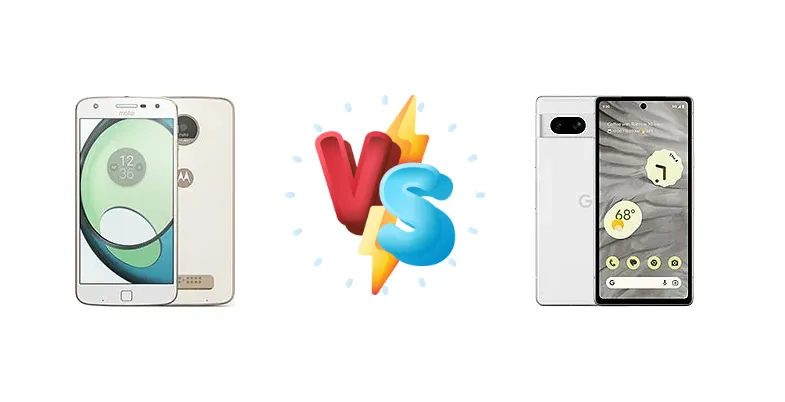
Motorola Moto Z Play vs Google Pixel 7a: A Head-to-Head Showdown
| Phones Images | |||||
|---|---|---|---|---|---|
|
🏆 Quick Verdict
The Google Pixel 7a is the clear winner. While the Moto Z Play boasts incredible battery life on paper, the Pixel 7a’s superior performance, camera, and modern features like wireless charging make it a more compelling choice for most users. It's a significant upgrade in almost every area.
| PHONES | ||
|---|---|---|
| Phone Names | Motorola Moto Z Play | Google Pixel 7a |
| Network | ||
|---|---|---|
| 2G bands | GSM 850 / 900 / 1800 / 1900 - SIM 1 & SIM 2 (dual-SIM model only) | GSM 850 / 900 / 1800 / 1900 |
| 3G bands | HSDPA 850 / 900 / 1700(AWS) / 1900 / 2100 | HSDPA 800 / 850 / 900 / 1700(AWS) / 1900 / 2100 |
| 4G bands | 1, 2, 3, 4, 5, 7, 8, 12, 17, 19, 20, 28, 38, 40 - USA | 1, 2, 3, 4, 5, 7, 8, 12, 13, 14, 17, 20, 25, 26, 28, 29, 30, 38, 40, 41, 48, 66, 71 - GWKK3, G0DZQ |
| 5G bands | - | 1, 2, 3, 5, 7, 8, 12, 14, 20, 25, 28, 30, 38, 41, 48, 66, 71, 77, 78 SA/NSA/Sub6 - GWKK3 |
| Speed | HSPA, LTE | HSPA, LTE, 5G |
| Technology | GSM / CDMA / HSPA / LTE | GSM / HSPA / LTE / 5G |
| 1, 2, 3, 4, 5, 7, 8, 12, 17, 19, 20, 28 - Europe | 1, 2, 3, 5, 7, 8, 12, 20, 25, 28, 38, 40, 41, 66, 75, 76, 77, 78, 79 SA/NSA/Sub6 - GHL1X, G82U8 | |
| Launch | ||
|---|---|---|
| Announced | 2016, August. Released 2016, September | 2023, May 10 |
| Status | Discontinued | Available. Released 2023, May 10 |
| Body | ||
|---|---|---|
| Build | Glass front (Gorilla Glass 3), glass back, aluminum frame | Glass front (Gorilla Glass 3), aluminum frame, plastic back |
| Dimensions | 156.4 x 76.4 x 7 mm (6.16 x 3.01 x 0.28 in) | 152 x 72.9 x 9 mm (5.98 x 2.87 x 0.35 in) |
| SIM | · Nano-SIM· Nano-SIM + Nano-SIM | Nano-SIM + eSIM |
| Weight | 165 g (5.82 oz) | 193.5 g (6.84 oz) |
| Splash and dust resistant | IP67 dust/water resistant (up to 1m for 30 min) | |
| Display | ||
|---|---|---|
| Protection | Corning Gorilla Glass 3 | Corning Gorilla Glass 3 |
| Resolution | 1080 x 1920 pixels, 16:9 ratio (~403 ppi density) | 1080 x 2400 pixels, 20:9 ratio (~429 ppi density) |
| Size | 5.5 inches, 82.6 cm2 (~69.1% screen-to-body ratio) | 6.1 inches, 90.7 cm2 (~81.8% screen-to-body ratio) |
| Type | Super AMOLED | OLED, HDR, 90Hz |
| - | Always-on display | |
| Platform | ||
|---|---|---|
| CPU | Octa-core 2.0 GHz Cortex-A53 | Octa-core (2x2.85 GHz Cortex-X1 & 2x2.35 GHz Cortex-A78 & 4x1.80 GHz Cortex-A55) |
| Chipset | Qualcomm MSM8953 Snapdragon 625 (14 nm) | Google Tensor G2 (5 nm) |
| GPU | Adreno 506 | Mali-G710 MP7 |
| OS | Android 6.0.1 (Marshmallow), upgradable to Android 8.0 (Oreo) | Android 13, upgradable to Android 15, up to 5 major Android upgrades |
| Memory | ||
|---|---|---|
| Card slot | microSDXC (dedicated slot) | No |
| Internal | 32GB 3GB RAM | 128GB 8GB RAM |
| eMMC 5.1 | UFS 3.1 | |
| Main Camera | ||
|---|---|---|
| Dual | - | 64 MP, f/1.9, 26mm (wide), 1/1.73", 0.8µm, dual pixel PDAF, OIS 13 MP, f/2.2, 120˚ (ultrawide), 1.12µm |
| Features | Laser AF, Dual-LED dual-tone flash, panorama | Dual-LED flash, Pixel Shift, Auto-HDR, panorama |
| Single | 16 MP, f/2.0, 1.3µm, PDAF | - |
| Video | 4K@30fps, 1080p@30fps, 720p@120fps | 4K@30/60fps, 1080p@30/60/120/240fps, OIS |
| Selfie camera | ||
|---|---|---|
| Features | LED flash | HDR, panorama |
| Single | 5 MP, f/2.2, 1/4.0", 1.4µm | 13 MP, f/2.2, 20mm (ultrawide), 1.12µm |
| Video | 1080p@30fps | 4K@30fps, 1080p@30fps |
| Sound | ||
|---|---|---|
| 3.5mm jack | Yes | No |
| 35mm jack | Yes | No |
| Loudspeaker | Yes | Yes, with stereo speakers |
| Comms | ||
|---|---|---|
| Bluetooth | 4.0, A2DP, LE, aptX | 5.3, A2DP, LE |
| NFC | Yes | Yes |
| Positioning | GPS, GLONASS | GPS, GLONASS, GALILEO, BDS, QZSS, NavIC |
| Radio | No | No |
| USB | USB Type-C, magnetic connector | USB Type-C 3.2 |
| WLAN | Wi-Fi 802.11 a/b/g/n, Wi-Fi Direct | Wi-Fi 802.11 a/b/g/n/ac/6e, tri-band |
| Features | ||
|---|---|---|
| Sensors | Fingerprint (front-mounted), accelerometer, gyro, proximity, compass | Fingerprint (under display, optical), accelerometer, gyro, proximity, compass, barometer |
| Moto Mods snap-on accessories | - | |
| Battery | ||
|---|---|---|
| Charging | 15W wired | 18W wired, PD3.0 7.5W wireless |
| Type | Li-Ion 3510 mAh, non-removable | Li-Po 4385 mAh |
| Misc | ||
|---|---|---|
| Colors | Black/Silver/Black Slate, White/Fine Gold/Sugar White | Charcoal, Snow, Sea, Coral |
| Models | XT1635-02, XT1635-01, XT1635-03 | GWKK3, GHL1X, G0DZQ, G82U8 |
| Price | About 220 EUR | € 179.90 / $ 150.00 / £ 170.00 / ₹ 25,980 |
| SAR | 1.45 W/kg (head) 1.15 W/kg (body) | - |
| SAR EU | 0.40 W/kg (head) 1.40 W/kg (body) | - |
| Tests | ||
|---|---|---|
| Audio quality | Noise-93.0dB / Crosstalk -93.8dB | - |
| Battery life | Endurance rating 100h | - |
| Camera | Photo / Video | - |
| Display | Contrast ratio: Infinite (nominal), 3.526 (sunlight) | - |
| Performance | GFXBench: 3.7fps (ES 3.1 onscreen) | - |
Motorola Moto Z Play
- Exceptional battery life (on paper)
- Very affordable
- Modular design (Moto Mods)
- Outdated processor
- Lower screen brightness
- Less impressive camera
- Slow charging
Google Pixel 7a
- Excellent camera
- Smooth performance
- Modern Android experience
- Wireless charging
- Bright display
- Battery life not as extreme as Moto Z Play (on paper)
- Charging speed could be faster
Display Comparison
The Pixel 7a’s display is significantly brighter, reaching 1070 nits, making it much easier to see outdoors. While the Moto Z Play’s contrast ratio is technically 'infinite' (likely a marketing term), the actual sunlight visibility is much lower at 3.526. The Pixel 7a also offers a more modern display technology, likely OLED, compared to the Moto Z Play's LCD.
Camera Comparison
Google's Pixel phones are renowned for their camera prowess, and the 7a is no exception. Expect superior image quality, better low-light performance, and advanced computational photography features. The Moto Z Play's camera is adequate but lacks the sophistication and image processing of the Pixel 7a.
Performance
The Google Pixel 7a’s Google Tensor G2 chipset and octa-core CPU (with Cortex-X1 and Cortex-A78 cores) absolutely trounce the Moto Z Play’s Snapdragon 625. Expect significantly faster app loading, smoother multitasking, and better gaming performance on the Pixel 7a. The Moto Z Play's CPU is showing its age.
Battery Life
On paper, the Moto Z Play has a massive advantage with a reported 100h endurance rating. However, this rating is likely based on very light usage. The Pixel 7a, with its 76h rating, still offers solid battery life, and its faster charging (18W wired, 7.5W wireless) makes up for any difference in longevity.
Buying Guide
Who should buy the Motorola Moto Z Play? Users prioritizing extreme battery life above all else and those seeking a very budget-friendly option. Who should buy the Google Pixel 7a? Anyone wanting a fantastic camera, smooth performance, and a modern Android experience, even on a budget.