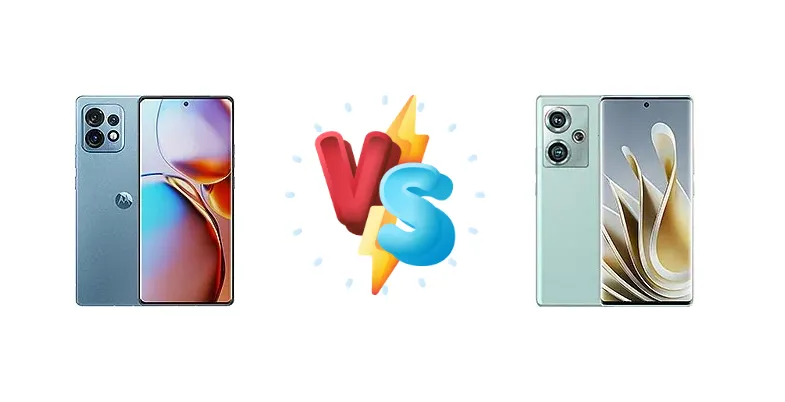
The Snapdragon 8 Gen 2 is here, powering some of the hottest smartphones of the year. Today, we're pitting two contenders against each other: the Motorola Moto X40 and the ZTE nubia Z50. Both offer flagship performance, but significant differences in charging, design, and potentially camera capabilities make this a compelling comparison.
🏆 Quick Verdict
The Moto X40 takes the lead thanks to its significantly faster 125W wired charging, 15W wireless charging, and reverse wireless charging. While the nubia Z50 boasts a potentially superior display and design, the X40's charging versatility and overall feature set make it the more compelling choice for most users.
| Network |
|---|
| 2G bands | GSM 850 / 900 / 1800 / 1900 | GSM 850 / 900 / 1800 / 1900 |
| 3G bands | HSDPA 850 / 900 / 1700(AWS) / 1900 / 2100 | HSDPA 850 / 900 / 1700(AWS) / 1900 / 2100 |
| 4G bands | 1, 2, 3, 4, 5, 7, 8, 12, 13, 17, 18, 19, 20, 25, 26, 28, 32, 38, 39, 40, 41, 42, 43, 48, 66 | LTE |
| 5G bands | 1, 2, 3, 5, 7, 8, 20, 28, 38, 40, 41, 66, 77, 78 SA/NSA/Sub6 | SA/NSA |
| Speed | HSPA, LTE, 5G | HSPA, LTE, 5G |
| Technology | GSM / CDMA / HSPA / LTE / 5G | GSM / CDMA / HSPA / LTE / 5G |
| | CDMA 800 | CDMA 800 |
| Launch |
|---|
| Announced | 2022, December 15 | 2022, December 19 |
| Status | Available. Released 2022, December 22 | Available. Released 2022, December 26 |
| Body |
|---|
| Build | Glass front, glass back (Gorilla Glass Victus), aluminum frame | Glass front, aluminum frame, glass back or eco leather back |
| Dimensions | 161.2 x 74 x 8.6 mm (6.35 x 2.91 x 0.34 in) | 162.9 x 72.9 x 8.5 mm or 8.7 mm |
| SIM | Nano-SIM + Nano-SIM | Nano-SIM + Nano-SIM |
| Weight | 199 g (7.02 oz) | 197 g or 199 g (6.95 oz) |
| | IP68 dust/water resistant (up to 1.5m for 30 min) | - |
| Display |
|---|
| Resolution | 1080 x 2400 pixels, 20:9 ratio (~393 ppi density) | 1080 x 2400 pixels, 20:9 ratio (~395 ppi density) |
| Size | 6.7 inches, 108.4 cm2 (~90.9% screen-to-body ratio) | 6.67 inches, 107.4 cm2 (~90.4% screen-to-body ratio) |
| Type | OLED, 1B colors, 165Hz, HDR10+ | AMOLED, 1B colors, 144Hz, HDR10+, 1000 nits |
| Platform |
|---|
| CPU | Octa-core (1x3.2 GHz Cortex-X3 & 2x2.8 GHz Cortex-A715 & 2x2.8 GHz Cortex-A710 & 3x2.0 GHz Cortex-A510) | Octa-core (1x3.2 GHz Cortex-X3 & 2x2.8 GHz Cortex-A715 & 2x2.8 GHz Cortex-A710 & 3x2.0 GHz Cortex-A510) |
| Chipset | Qualcomm SM8550-AB Snapdragon 8 Gen 2 (4 nm) | Qualcomm SM8550-AB Snapdragon 8 Gen 2 (4 nm) |
| GPU | Adreno 740 | Adreno 740 |
| OS | Android 13, upgradable to Android 14, MYUI 6.0 | Android 13, MyOS 13 |
| Memory |
|---|
| Card slot | No | No |
| Internal | 128GB 8GB RAM, 256GB 12GB RAM, 512GB 12GB RAM | 128GB 8GB RAM, 256GB 8GB RAM, 256GB 12GB RAM, 512GB 12GB RAM, 1TB 16GB RAM |
| | UFS 3.1 - 128GB
UFS 4.0 - 256GB/512GB | UFS 4.0
UFS 3.1 (128GB only) |
| Main Camera |
|---|
| Dual | - | 64 MP, f/1.6, 35mm (standard), 1/1.7", PDAF, OIS
50 MP, f/2.2, 14mm, 116˚ (ultrawide), AF |
| Features | Dual-LED flash, panorama, HDR | Ring-LED flash (4 LEDs), panorama, HDR |
| Single | - | 16 MP, (wide) |
| Triple | 50 MP, f/1.9, (wide), 1/1.55", 1.0µm, dual pixel PDAF, OIS
12 MP, f/1.6, (telephoto), 1/2.93", 1.22µm, PDAF, 2x optical zoom
50 MP, f/2.2, 117˚ (ultrawide), 1/2.76", 0.64µm, AF | - |
| Video | 8K@30fps, 4K@30/60fps, 1080p@30/60/120/240/960fps, 10-bit HDR10+, gyro-EIS | 8K, 4K |
| Selfie camera |
|---|
| Features | HDR | HDR |
| Single | 60 MP, f/2.2, (wide), 1/2.8", 0.61µm | 16 MP, (wide) |
| Video | 4K@30fps, 1080p@30/60fps | 1080p@30fps |
| Sound |
|---|
| 3.5mm jack | No | No |
| 35mm jack | No | No |
| Loudspeaker | Yes, with stereo speakers | Yes, with stereo speakers |
| | - | 24-bit/192kHz audio |
| Comms |
|---|
| Bluetooth | 5.3, A2DP, LE, aptX HD, aptX Adaptive | 5.3, A2DP, LE |
| NFC | Yes | Yes |
| Positioning | GPS (L1+L5), GLONASS (L1), BDS (B1I+B1c+B2a), GALILEO (E1+E5a), QZSS (L1+L5) | GPS (L1+L5), GLONASS, BDS, GALILEO, QZSS |
| Radio | No | No |
| USB | USB Type-C, OTG | USB Type-C 3.1, OTG |
| WLAN | Wi-Fi 802.11 a/b/g/n/ac/6e, dual-band, Wi-Fi Direct | Wi-Fi 802.11 a/b/g/n/ac/6e, dual-band, Wi-Fi Direct |
| Features |
|---|
| Sensors | Fingerprint (under display, optical), accelerometer, gyro, proximity, compass | Fingerprint (under display, optical), accelerometer, gyro, proximity, compass |
| | Ready For 3.5 support | - |
| Battery |
|---|
| Charging | 125W wired, PD3.0, QC5, 50% in 7 min
15W wireless
5W reverse wired | 80W wired |
| Type | Li-Po 4600 mAh | Li-Po 5000 mAh |
| Misc |
|---|
| Colors | Black, Blue | Black, Silver, Mint, Rabit red |
| Models | XT2301-5 | NX711J |
| Price | About 540 EUR | About 400 EUR |
Motorola Moto X40
- 125W Wired Charging
- 15W Wireless Charging
- 5W Reverse Wireless Charging
- Potentially more refined software experience
- Good overall value
- Design may be less premium than nubia Z50
- Camera performance needs further review
- Display may not be as bright as nubia Z50
ZTE nubia Z50
- Potentially superior display (brightness, color accuracy)
- Premium design
- Good camera hardware
- 80W Wired Charging (slower than Moto X40)
- Lacks wireless charging
- Software support may be less consistent
Display Comparison
Both phones likely feature high-quality AMOLED displays with 120Hz refresh rates, but the nubia Z50 is rumored to have a slightly brighter and more color-accurate panel. The Moto X40 may offer a more standard display, but still provides a smooth and vibrant viewing experience. Further reviews are needed to confirm the display differences.
Camera Comparison
The Moto X40 is expected to have a versatile camera system, potentially including a 50MP main sensor, ultrawide, and depth sensor. The nubia Z50 is rumored to have a 64MP main sensor and a focus on computational photography. Camera performance will depend heavily on software processing and image tuning.
Performance
Both devices are powered by the Snapdragon 8 Gen 2, ensuring top-tier performance for gaming, multitasking, and demanding applications. Expect virtually identical performance in benchmarks and real-world usage. Software optimization will be a key differentiator here.
Battery Life
The Moto X40 likely has a 4600mAh battery, while the nubia Z50 is expected to have a similar capacity. However, the Moto X40's 125W wired charging provides a massive advantage, allowing for incredibly fast charging times. The nubia Z50's 80W charging is still fast, but not as impressive.
Buying Guide
The Motorola Moto X40 is ideal for users prioritizing fast charging, wireless charging capabilities, and a well-rounded feature set. The ZTE nubia Z50 is a good fit for those who value a premium design, potentially a better display (though unconfirmed), and are less concerned about charging speed.
Frequently Asked Questions
❓ Which phone has better battery life?
While both have similar battery capacities, the Moto X40's significantly faster charging gives it an advantage in overall battery management and convenience.
❓ Is the nubia Z50 worth it if I don't care about fast charging?
If you prioritize a potentially better display and premium design and don't need fast charging, the nubia Z50 could be a good option. However, consider the potential trade-offs in software support and wireless charging capabilities.