
Motorola Moto X40 vs. Samsung Galaxy S23 FE: Which Flagship Reigns Supreme?
| Phones Images | |||||
|---|---|---|---|---|---|
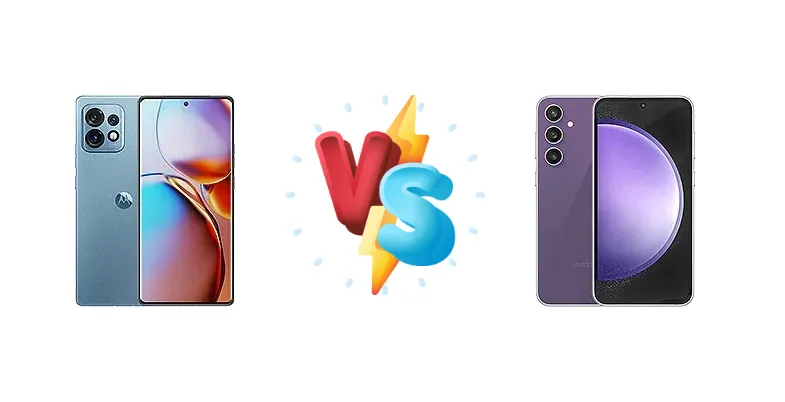
|
🏆 Quick Verdict
For users prioritizing peak performance and blazing-fast charging, the Motorola Moto X40 is the clear winner. Its Snapdragon 8 Gen 2 offers a significant advantage over the Exynos 2200 (International) or Snapdragon 8 Gen 1 (USA) found in the S23 FE, making it ideal for demanding tasks and gaming. However, the S23 FE’s more refined software and established brand recognition make it a strong contender for those valuing a polished user experience.
| PHONES | ||
|---|---|---|
| Phone Names | Motorola Moto X40 | Samsung Galaxy S23 FE |
| Network | ||
|---|---|---|
| 2G bands | GSM 850 / 900 / 1800 / 1900 | GSM 850 / 900 / 1800 / 1900 |
| 3G bands | HSDPA 850 / 900 / 1700(AWS) / 1900 / 2100 | HSDPA 850 / 900 / 1700(AWS) / 1900 / 2100 |
| 4G bands | 1, 2, 3, 4, 5, 7, 8, 12, 13, 17, 18, 19, 20, 25, 26, 28, 32, 38, 39, 40, 41, 42, 43, 48, 66 | 1, 2, 3, 4, 5, 7, 8, 12, 13, 17, 20, 26, 28, 38, 40, 41, 66 - International |
| 5G bands | 1, 2, 3, 5, 7, 8, 20, 28, 38, 40, 41, 66, 77, 78 SA/NSA/Sub6 | 1, 2, 3, 5, 7, 8, 20, 28, 38, 40, 41, 66, 77, 78 SA/NSA/Sub6 - International |
| Speed | HSPA, LTE, 5G | HSPA, LTE, 5G |
| Technology | GSM / CDMA / HSPA / LTE / 5G | GSM / HSPA / LTE / 5G |
| CDMA 800 | - | |
| Launch | ||
|---|---|---|
| Announced | 2022, December 15 | 2023, October 04 |
| Status | Available. Released 2022, December 22 | Available. Released 2023, October 05 |
| Body | ||
|---|---|---|
| Build | Glass front, glass back (Gorilla Glass Victus), aluminum frame | Glass front (Gorilla Glass 5), glass back (Gorilla Glass 5), aluminum frame |
| Dimensions | 161.2 x 74 x 8.6 mm (6.35 x 2.91 x 0.34 in) | 158 x 76.5 x 8.2 mm (6.22 x 3.01 x 0.32 in) |
| SIM | Nano-SIM + Nano-SIM | · Nano-SIM· Nano-SIM + Nano-SIM· Nano-SIM + Nano-SIM + eSIM (max 2 at a time) |
| Weight | 199 g (7.02 oz) | 209 g (7.37 oz) |
| IP68 dust/water resistant (up to 1.5m for 30 min) | - | |
| Display | ||
|---|---|---|
| Protection | - | Corning Gorilla Glass 5 |
| Resolution | 1080 x 2400 pixels, 20:9 ratio (~393 ppi density) | 1080 x 2340 pixels, 19.5:9 ratio (~403 ppi density) |
| Size | 6.7 inches, 108.4 cm2 (~90.9% screen-to-body ratio) | 6.4 inches, 100.5 cm2 (~83.2% screen-to-body ratio) |
| Type | OLED, 1B colors, 165Hz, HDR10+ | Dynamic AMOLED 2X, 120Hz, HDR10+, 1450 nits (peak) |
| Platform | ||
|---|---|---|
| CPU | Octa-core (1x3.2 GHz Cortex-X3 & 2x2.8 GHz Cortex-A715 & 2x2.8 GHz Cortex-A710 & 3x2.0 GHz Cortex-A510) | Octa-core (1x2.8 GHz Cortex-X2 & 3x2.50 GHz Cortex-A710 & 4x1.8 GHz Cortex-A510) - InternationalOcta-core (1x3.00 GHz Cortex-X2 & 3x2.50 GHz Cortex-A710 & 4x1.80 GHz Cortex-A510) - USA |
| Chipset | Qualcomm SM8550-AB Snapdragon 8 Gen 2 (4 nm) | Exynos 2200 (4 nm) - InternationalQualcomm SM8450 Snapdragon 8 Gen 1 (4 nm) - USA |
| GPU | Adreno 740 | Xclipse 920 - InternationalAdreno 730 - USA |
| OS | Android 13, upgradable to Android 14, MYUI 6.0 | Android 13, up to 4 major Android upgrades, One UI 8 |
| Memory | ||
|---|---|---|
| Card slot | No | No |
| Internal | 128GB 8GB RAM, 256GB 12GB RAM, 512GB 12GB RAM | 128GB 8GB RAM, 256GB 8GB RAM |
| UFS 3.1 - 128GB UFS 4.0 - 256GB/512GB | - | |
| Main Camera | ||
|---|---|---|
| Features | Dual-LED flash, panorama, HDR | LED flash, HDR, panorama |
| Triple | 50 MP, f/1.9, (wide), 1/1.55", 1.0µm, dual pixel PDAF, OIS 12 MP, f/1.6, (telephoto), 1/2.93", 1.22µm, PDAF, 2x optical zoom 50 MP, f/2.2, 117˚ (ultrawide), 1/2.76", 0.64µm, AF | 50 MP, f/1.8, 23mm (wide), 1/1.57", 1.0µm, dual pixel PDAF, OIS 8 MP, f/2.4, 76mm (telephoto), 1/4.5", 1.0µm, PDAF, OIS, 3x optical zoom 12 MP, f/2.2, 13mm, 123˚ (ultrawide), 1/3.0", 1.12µm |
| Video | 8K@30fps, 4K@30/60fps, 1080p@30/60/120/240/960fps, 10-bit HDR10+, gyro-EIS | 8K@24fps, 4K@30/60fps, 1080p@30/60/120/240fps |
| Selfie camera | ||
|---|---|---|
| Features | HDR | - |
| Single | 60 MP, f/2.2, (wide), 1/2.8", 0.61µm | 10 MP, f/2.4, 25mm (wide), 1/3.0", 1.22µm |
| Video | 4K@30fps, 1080p@30/60fps | 4K@30/60fps, 1080p@30/60fps; gyro-EIS |
| Sound | ||
|---|---|---|
| 3.5mm jack | No | - |
| 35mm jack | No | No |
| Loudspeaker | Yes, with stereo speakers | Yes, with stereo speakers |
| Comms | ||
|---|---|---|
| Bluetooth | 5.3, A2DP, LE, aptX HD, aptX Adaptive | 5.3, A2DP, LE |
| NFC | Yes | Yes |
| Positioning | GPS (L1+L5), GLONASS (L1), BDS (B1I+B1c+B2a), GALILEO (E1+E5a), QZSS (L1+L5) | GPS, GLONASS, GALILEO, BDS |
| Radio | No | Unspecified |
| USB | USB Type-C, OTG | USB Type-C, OTG |
| WLAN | Wi-Fi 802.11 a/b/g/n/ac/6e, dual-band, Wi-Fi Direct | Wi-Fi 802.11 a/b/g/n/ac/6e, dual-band, Wi-Fi Direct |
| Features | ||
|---|---|---|
| Sensors | Fingerprint (under display, optical), accelerometer, gyro, proximity, compass | Fingerprint (under display, optical), accelerometer, gyro, compass |
| Ready For 3.5 support | - | |
| Battery | ||
|---|---|---|
| Charging | 125W wired, PD3.0, QC5, 50% in 7 min 15W wireless 5W reverse wired | 25W wired, PD3.0, 50% in 30 min 15W wireless Reverse wireless |
| Type | Li-Po 4600 mAh | Li-Ion 4500 mAh |
| Misc | ||
|---|---|---|
| Colors | Black, Blue | Mint, Cream, Graphite, Purple, Indigo, Tangerine |
| Models | XT2301-5 | SM-S711B, SM-S711B/DS, SM-S711U1, SM-S711U, SM-S711W, SM-S7110, SM-S711N |
| Price | About 540 EUR | $ 219.95 / C$ 327.90 / £ 248.99 / € 272.00 / ₹ 34,999 |
| SAR | - | 0.80 W/kg (head) 0.72 W/kg (body) |
| SAR EU | - | 0.76 W/kg (head) 1.04 W/kg (body) |
Motorola Moto X40
- Significantly faster processor (Snapdragon 8 Gen 2)
- Blazing-fast 125W wired charging
- Potentially superior thermal management
- Limited information on camera specifications
- Motorola’s software update track record is less consistent than Samsung’s
Samsung Galaxy S23 FE
- Well-established brand and ecosystem
- Vibrant and color-accurate display
- Solid all-day battery life
- Chipset performance lags behind the Moto X40
- Slower charging speeds (25W wired)
Display Comparison
The Samsung Galaxy S23 FE boasts a peak brightness of 985 nits, a respectable figure, but the Moto X40’s display specifications are currently unavailable for direct comparison. However, given Motorola’s recent focus on high refresh rate panels, it’s likely competitive. The S23 FE’s display is likely to benefit from Samsung’s color science, known for its vibrant and punchy visuals. Without PWM frequency data for the Moto X40, it’s difficult to assess potential eye strain concerns, a factor where Samsung typically excels.
Camera Comparison
While both phones feature capable camera systems, detailed sensor information for the Moto X40 is missing. The S23 FE’s camera performance is generally strong, focusing on vibrant colors and pleasing image processing. However, the Moto X40’s potential advantage lies in its processing power, allowing for more sophisticated computational photography algorithms. Without knowing the main sensor size and aperture of the Moto X40, it’s difficult to assess low-light performance. The S23 FE’s video capabilities are well-regarded, but the Snapdragon 8 Gen 2 in the Moto X40 could offer superior video encoding and stabilization.
Performance
The Motorola Moto X40’s Qualcomm SM8550-AB Snapdragon 8 Gen 2 (4nm) is a generational leap ahead of the Samsung Galaxy S23 FE’s chipset options. The Snapdragon 8 Gen 2’s Cortex-X3 prime core, clocked at 3.2 GHz, significantly outperforms the Cortex-X2 in the Exynos 2200 (2.8 GHz) and Snapdragon 8 Gen 1 (3.0 GHz). The 4nm process node of the Snapdragon 8 Gen 2 also provides superior thermal efficiency, reducing the likelihood of throttling during sustained workloads. The S23 FE’s Exynos variant, in particular, has been known to struggle with heat management. The Moto X40’s LPDDR5x RAM further enhances memory bandwidth, contributing to smoother multitasking and faster application loading times.
Battery Life
The Samsung Galaxy S23 FE achieves an active use score of 8:28h, providing a solid all-day battery life for most users. The Moto X40’s battery capacity is unknown, but its 125W wired charging is a game-changer, achieving 50% charge in just 7 minutes. This dramatically outperforms the S23 FE’s 25W charging, which takes 30 minutes to reach 50%. While the S23 FE offers 15W wireless and reverse wireless charging, the Moto X40 also supports 15W wireless and 5W reverse wired, making it a versatile charging solution. The faster charging of the Moto X40 could offset a potentially smaller battery capacity.
Buying Guide
Buy the Motorola Moto X40 if you need uncompromising performance for gaming, content creation, or heavy multitasking, and value the fastest possible charging speeds. Buy the Samsung Galaxy S23 FE if you prefer a more compact form factor, a well-established ecosystem, and a camera system tuned for vibrant, social media-ready images, even if it means sacrificing some raw processing power.