
Motorola Moto X40 vs Samsung Galaxy A14: A Clash of Titans
| Phones Images | |||||
|---|---|---|---|---|---|
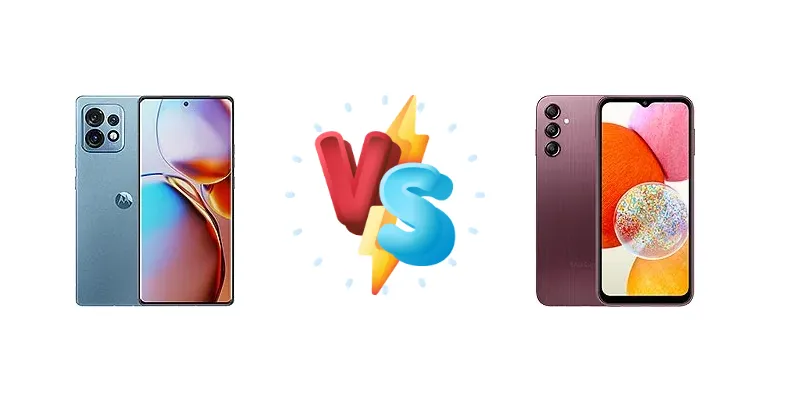
|
🏆 Quick Verdict
The Moto X40 is the clear winner in terms of performance and charging speed, thanks to its Snapdragon 8 Gen 2 chipset and 125W charging. However, the Galaxy A14 offers a more budget-friendly option with a reliable Samsung experience, making it suitable for users prioritizing affordability and brand familiarity.
| PHONES | ||
|---|---|---|
| Phone Names | Motorola Moto X40 | Samsung Galaxy A14 |
| Network | ||
|---|---|---|
| 2G bands | GSM 850 / 900 / 1800 / 1900 | GSM 850 / 900 / 1800 / 1900 |
| 3G bands | HSDPA 850 / 900 / 1700(AWS) / 1900 / 2100 | HSDPA 850 / 900 / 2100 |
| 4G bands | 1, 2, 3, 4, 5, 7, 8, 12, 13, 17, 18, 19, 20, 25, 26, 28, 32, 38, 39, 40, 41, 42, 43, 48, 66 | 1, 3, 5, 7, 8, 20, 28, 38, 40, 41 |
| 5G bands | 1, 2, 3, 5, 7, 8, 20, 28, 38, 40, 41, 66, 77, 78 SA/NSA/Sub6 | - |
| Speed | HSPA, LTE, 5G | HSPA, LTE |
| Technology | GSM / CDMA / HSPA / LTE / 5G | GSM / HSPA / LTE |
| CDMA 800 | - | |
| Launch | ||
|---|---|---|
| Announced | 2022, December 15 | 2023, February 28 |
| Status | Available. Released 2022, December 22 | Available. Released 2023, March 27 |
| Body | ||
|---|---|---|
| Build | Glass front, glass back (Gorilla Glass Victus), aluminum frame | Glass front, plastic back, plastic frame |
| Dimensions | 161.2 x 74 x 8.6 mm (6.35 x 2.91 x 0.34 in) | 167.7 x 78 x 9.1 mm (6.60 x 3.07 x 0.36 in) |
| SIM | Nano-SIM + Nano-SIM | · Nano-SIM· Nano-SIM + Nano-SIM |
| Weight | 199 g (7.02 oz) | 201 g (7.09 oz) |
| IP68 dust/water resistant (up to 1.5m for 30 min) | - | |
| Display | ||
|---|---|---|
| Resolution | 1080 x 2400 pixels, 20:9 ratio (~393 ppi density) | 1080 x 2408 pixels, 20:9 ratio (~400 ppi density) |
| Size | 6.7 inches, 108.4 cm2 (~90.9% screen-to-body ratio) | 6.6 inches, 104.9 cm2 (~80.2% screen-to-body ratio) |
| Type | OLED, 1B colors, 165Hz, HDR10+ | PLS LCD |
| Platform | ||
|---|---|---|
| CPU | Octa-core (1x3.2 GHz Cortex-X3 & 2x2.8 GHz Cortex-A715 & 2x2.8 GHz Cortex-A710 & 3x2.0 GHz Cortex-A510) | Octa-core (2x2.0 GHz Cortex-A75 & 6x1.8 GHz Cortex-A55) - Version AOcta-core (4x2.0 GHz Cortex-A55 & 4x2.0 GHz Cortex-A55) - Version B |
| Chipset | Qualcomm SM8550-AB Snapdragon 8 Gen 2 (4 nm) | Mediatek MT6769 Helio G80 (12 nm) - Version AExynos 850 (8 nm) - Version B |
| GPU | Adreno 740 | Mali-G52 MC2 |
| OS | Android 13, upgradable to Android 14, MYUI 6.0 | Android 13, upgradable to Android 15, One UI 7 |
| Memory | ||
|---|---|---|
| Card slot | No | microSDXC (dedicated slot) |
| Internal | 128GB 8GB RAM, 256GB 12GB RAM, 512GB 12GB RAM | 64GB 4GB RAM, 128GB 4GB RAM, 128GB 6GB RAM |
| UFS 3.1 - 128GB UFS 4.0 - 256GB/512GB | - | |
| Main Camera | ||
|---|---|---|
| Features | Dual-LED flash, panorama, HDR | LED flash, panorama, HDR |
| Single | - | 13 MP, f/2.0, (wide) |
| Triple | 50 MP, f/1.9, (wide), 1/1.55", 1.0µm, dual pixel PDAF, OIS 12 MP, f/1.6, (telephoto), 1/2.93", 1.22µm, PDAF, 2x optical zoom 50 MP, f/2.2, 117˚ (ultrawide), 1/2.76", 0.64µm, AF | 50 MP, f/1.8, 26mm (wide), 1/2.75", 0.64µm, PDAF 5 MP, f/2.2, 17mm (ultrawide), 1/5.0", 1.12µm 2 MP (macro) |
| Video | 8K@30fps, 4K@30/60fps, 1080p@30/60/120/240/960fps, 10-bit HDR10+, gyro-EIS | 1080p@30fps |
| Selfie camera | ||
|---|---|---|
| Features | HDR | - |
| Single | 60 MP, f/2.2, (wide), 1/2.8", 0.61µm | 13 MP, f/2.0, 26mm (wide), 1/3.1", 1.12µm |
| Video | 4K@30fps, 1080p@30/60fps | 1080p@30fps |
| Sound | ||
|---|---|---|
| 3.5mm jack | No | Yes |
| 35mm jack | No | Yes |
| Loudspeaker | Yes, with stereo speakers | Yes |
| Comms | ||
|---|---|---|
| Bluetooth | 5.3, A2DP, LE, aptX HD, aptX Adaptive | 5.1 or 5.3, A2DP, LE |
| NFC | Yes | Yes (market/region dependent) |
| Positioning | GPS (L1+L5), GLONASS (L1), BDS (B1I+B1c+B2a), GALILEO (E1+E5a), QZSS (L1+L5) | GPS, GALILEO, GLONASS, BDS, QZSS |
| Radio | No | Unspecified |
| USB | USB Type-C, OTG | USB Type-C 2.0 |
| WLAN | Wi-Fi 802.11 a/b/g/n/ac/6e, dual-band, Wi-Fi Direct | Wi-Fi 802.11 a/b/g/n/ac, dual-band, Wi-Fi Direct |
| Features | ||
|---|---|---|
| Sensors | Fingerprint (under display, optical), accelerometer, gyro, proximity, compass | Fingerprint (side-mounted), accelerometer, proximity, compass |
| Ready For 3.5 support | - | |
| Battery | ||
|---|---|---|
| Charging | 125W wired, PD3.0, QC5, 50% in 7 min 15W wireless 5W reverse wired | 15W wired |
| Type | Li-Po 4600 mAh | Li-Po 5000 mAh |
| Misc | ||
|---|---|---|
| Colors | Black, Blue | Black, Dark Red, Silver, Green |
| Models | XT2301-5 | SM-A145F, SM-A145F/DSN, SM-A145M, SM-A145M/DS, SM-A145P, SM-A145R |
| Price | About 540 EUR | € 85.76 / $ 147.60 / £ 79.95 |
| SAR EU | - | 0.46 W/kg (head) 1.37 W/kg (body) |
Motorola Moto X40
- Blazing-fast Snapdragon 8 Gen 2 performance
- Incredibly fast 125W charging
- Likely superior display quality (OLED, high refresh rate)
- Potentially better camera performance
- Higher price point
- May lack some Samsung-specific features
- Potentially less software support compared to Samsung
Samsung Galaxy A14
- More affordable
- Reliable Samsung brand and software experience
- Decent battery life
- Expandable storage (likely)
- Significantly slower performance
- Slow 15W charging
- Likely LCD display with lower refresh rate
- Less impressive camera
Display Comparison
The Moto X40 likely boasts a superior display with a higher refresh rate (likely 144Hz) and potentially OLED technology, offering vibrant colors and deeper blacks. The Galaxy A14 probably features an LCD display, which is generally less vibrant but more energy-efficient. Screen size is likely similar, around 6.5-6.7 inches.
Camera Comparison
While the Galaxy A14 might have a higher megapixel count on its main sensor, the Moto X40's image processing capabilities, powered by its superior chipset, are likely to result in better overall image quality, especially in low light. The X40 likely offers more advanced camera features and video recording capabilities.
Performance
The Snapdragon 8 Gen 2 in the Moto X40 provides a massive performance advantage over the Helio G80 (or Exynos 850) in the Galaxy A14. Expect significantly faster app loading, smoother multitasking, and a much better gaming experience on the X40. The A14 will handle everyday tasks adequately, but struggles with demanding applications.
Battery Life
The Moto X40's 125W charging is a game-changer, allowing for incredibly fast charging times. While the Galaxy A14 has a decent battery capacity, its 15W charging is significantly slower. Both phones likely offer all-day battery life with moderate usage, but the X40's charging speed provides a significant advantage.
Buying Guide
The Motorola Moto X40 is ideal for power users, gamers, and those who demand top-tier performance and fast charging. The Samsung Galaxy A14 is a great choice for budget-conscious buyers, students, or anyone seeking a dependable and familiar Android experience without breaking the bank.