
Motorola Moto X40 vs. Oppo Find X6 Pro: A Deep Dive into Snapdragon 8 Gen 2 Flagships
| Phones Images | |||||
|---|---|---|---|---|---|
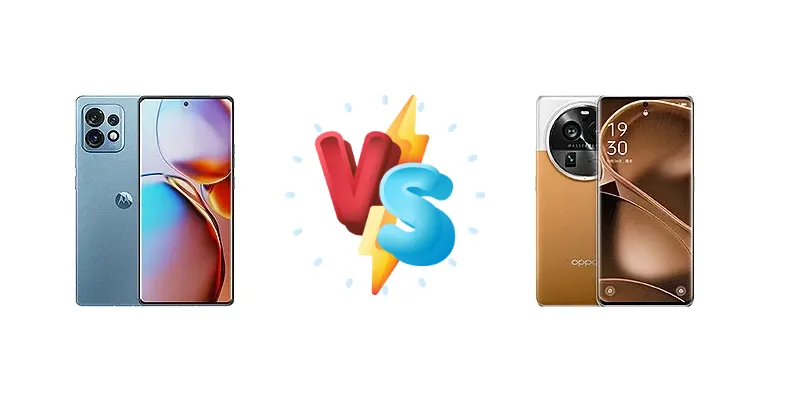
|
🏆 Quick Verdict
For users prioritizing the absolute fastest charging and a potentially more streamlined software experience, the Motorola Moto X40 is the winner. However, the Oppo Find X6 Pro counters with a brighter display and potentially more refined camera processing, making it a strong contender for multimedia enthusiasts.
| PHONES | ||
|---|---|---|
| Phone Names | Motorola Moto X40 | Oppo Find X6 Pro |
| Network | ||
|---|---|---|
| 2G bands | GSM 850 / 900 / 1800 / 1900 | GSM 850 / 900 / 1800 / 1900 |
| 3G bands | HSDPA 850 / 900 / 1700(AWS) / 1900 / 2100 | HSDPA 800 / 850 / 900 / 1700(AWS) / 1900 / 2100 |
| 4G bands | 1, 2, 3, 4, 5, 7, 8, 12, 13, 17, 18, 19, 20, 25, 26, 28, 32, 38, 39, 40, 41, 42, 43, 48, 66 | 1, 2, 3, 4, 5, 7, 8, 12, 17, 18, 19, 20, 26, 28, 34, 38, 39, 40, 41, 66 |
| 5G bands | 1, 2, 3, 5, 7, 8, 20, 28, 38, 40, 41, 66, 77, 78 SA/NSA/Sub6 | 1, 3, 5, 7, 8, 20, 28, 38, 40, 41, 66, 77, 78, 79 SA/NSA |
| Speed | HSPA, LTE, 5G | HSPA, LTE, 5G |
| Technology | GSM / CDMA / HSPA / LTE / 5G | GSM / CDMA / HSPA / CDMA2000 / LTE / 5G |
| CDMA 800 | CDMA2000 1x | |
| Launch | ||
|---|---|---|
| Announced | 2022, December 15 | 2023, March 21 |
| Status | Available. Released 2022, December 22 | Available. Released 2023, March 24 |
| Body | ||
|---|---|---|
| Build | Glass front, glass back (Gorilla Glass Victus), aluminum frame | Glass front (Gorilla Glass Victus 2), glass back (Gorilla Glass 5) or eco leather back, aluminum frame |
| Dimensions | 161.2 x 74 x 8.6 mm (6.35 x 2.91 x 0.34 in) | 164.8 x 76.2 x 9.1 mm or 9.5 mm |
| SIM | Nano-SIM + Nano-SIM | Nano-SIM + Nano-SIM |
| Weight | 199 g (7.02 oz) | 216 g or 218 g (7.62 oz) |
| IP68 dust/water resistant (up to 1.5m for 30 min) | IP68 dust/water resistant (up to 1.5m for 30 min) | |
| Display | ||
|---|---|---|
| Protection | - | Corning Gorilla Glass Victus 2 |
| Resolution | 1080 x 2400 pixels, 20:9 ratio (~393 ppi density) | 1440 x 3168 pixels (~510 ppi density) |
| Size | 6.7 inches, 108.4 cm2 (~90.9% screen-to-body ratio) | 6.82 inches, 113.0 cm2 (~90.0% screen-to-body ratio) |
| Type | OLED, 1B colors, 165Hz, HDR10+ | LTPO3 AMOLED, 1B colors, 120Hz, Dolby Vision, HDR10+, 800 nits (typ), 1500 nits (HBM), 2500 nits (peak) |
| Platform | ||
|---|---|---|
| CPU | Octa-core (1x3.2 GHz Cortex-X3 & 2x2.8 GHz Cortex-A715 & 2x2.8 GHz Cortex-A710 & 3x2.0 GHz Cortex-A510) | Octa-core (1x3.2 GHz Cortex-X3 & 2x2.8 GHz Cortex-A715 & 2x2.8 GHz Cortex-A710 & 3x2.0 GHz Cortex-A510) |
| Chipset | Qualcomm SM8550-AB Snapdragon 8 Gen 2 (4 nm) | Qualcomm SM8550-AB Snapdragon 8 Gen 2 (4 nm) |
| GPU | Adreno 740 | Adreno 740 |
| OS | Android 13, upgradable to Android 14, MYUI 6.0 | Android 13, up to 4 major Android upgrades, ColorOS 14 |
| Memory | ||
|---|---|---|
| Card slot | No | No |
| Internal | 128GB 8GB RAM, 256GB 12GB RAM, 512GB 12GB RAM | 256GB 12GB RAM, 256GB 16GB RAM, 512GB 16GB RAM |
| UFS 3.1 - 128GB UFS 4.0 - 256GB/512GB | UFS 4.0 | |
| Main Camera | ||
|---|---|---|
| Features | Dual-LED flash, panorama, HDR | Laser AF, color spectrum sensor, Hasselblad Color Calibration, LED flash, HDR, panorama |
| Triple | 50 MP, f/1.9, (wide), 1/1.55", 1.0µm, dual pixel PDAF, OIS 12 MP, f/1.6, (telephoto), 1/2.93", 1.22µm, PDAF, 2x optical zoom 50 MP, f/2.2, 117˚ (ultrawide), 1/2.76", 0.64µm, AF | 50 MP, f/1.8, 23mm (wide), 1.0"-type, 1.6µm, dual pixel PDAF, OIS 50 MP, f/2.6, 65mm (periscope telephoto), 1/1.56", 1.0µm, 2.8x optical zoom, multi-directional PDAF, OIS 50 MP, f/2.2, 15mm, 110˚ (ultrawide), 1/1.56", 1.0µm, multi-directional PDAF |
| Video | 8K@30fps, 4K@30/60fps, 1080p@30/60/120/240/960fps, 10-bit HDR10+, gyro-EIS | 4K@30/60fps, 1080p@30/60/240fps; gyro-EIS; HDR, 10‑bit video, Dolby Vision |
| Selfie camera | ||
|---|---|---|
| Features | HDR | Panorama |
| Single | 60 MP, f/2.2, (wide), 1/2.8", 0.61µm | 32 MP, f/2.4, 21mm (wide), 1/2.74", 0.8µm, PDAF |
| Video | 4K@30fps, 1080p@30/60fps | 4K@30fps, gyro-EIS |
| Sound | ||
|---|---|---|
| 3.5mm jack | No | No |
| 35mm jack | No | No |
| Loudspeaker | Yes, with stereo speakers | Yes, with stereo speakers |
| Comms | ||
|---|---|---|
| Bluetooth | 5.3, A2DP, LE, aptX HD, aptX Adaptive | 5.3, A2DP, LE, aptX HD |
| Infrared port | - | Yes |
| NFC | Yes | Yes |
| Positioning | GPS (L1+L5), GLONASS (L1), BDS (B1I+B1c+B2a), GALILEO (E1+E5a), QZSS (L1+L5) | GPS (L1+L5), GLONASS (G1), BDS (B1I+B1c+B2a), GALILEO (E1+E5a), QZSS (L1+L5) |
| Radio | No | No |
| USB | USB Type-C, OTG | USB Type-C 3.1, OTG |
| WLAN | Wi-Fi 802.11 a/b/g/n/ac/6e, dual-band, Wi-Fi Direct | Wi-Fi 802.11 a/b/g/n/ac/6e/7, tri-band, Wi-Fi Direct |
| Features | ||
|---|---|---|
| Sensors | Fingerprint (under display, optical), accelerometer, gyro, proximity, compass | Fingerprint (under display, optical), accelerometer, gyro, proximity, compass |
| Ready For 3.5 support | - | |
| Battery | ||
|---|---|---|
| Charging | 125W wired, PD3.0, QC5, 50% in 7 min 15W wireless 5W reverse wired | 100W wired, PD, 45% in 10 min, 100% in 30 min 50W wireless, 50% in 22 min, 100% in 51 min 10W reverse wireless |
| Type | Li-Po 4600 mAh | Li-Po 5000 mAh |
| Misc | ||
|---|---|---|
| Colors | Black, Blue | Black, Green, Brown |
| Models | XT2301-5 | PGEM110, PGEM10 |
| Price | About 540 EUR | About 820 EUR |
| Tests | ||
|---|---|---|
| Battery life | - | Endurance rating 114h |
| Camera | - | Photo / Video |
| Display | - | Contrast ratio: Infinite (nominal) |
| Loudspeaker | - | -25.1 LUFS (Very good) |
| Performance | - | AnTuTu: 1294797 (v9) GeekBench: 4791 (v5.1), 5226 (v6) GFXBench: 60fps (ES 3.1 onscreen) |
Motorola Moto X40
- Ultra-fast 125W wired charging
- Potentially cleaner software experience
- Reverse wired charging capability
- Wireless charging is slower than Oppo
- Display brightness likely lower than Oppo
- Camera details are currently limited
Oppo Find X6 Pro
- Brighter display for outdoor visibility
- Faster wireless charging (50W)
- Potentially superior camera image processing
- Wired charging is slower than Moto X40
- Software experience may be more customized
- Endurance rating doesn't guarantee real-world performance
Display Comparison
The Oppo Find X6 Pro boasts a significantly brighter display, reaching a measured 1318 nits, compared to an unspecified peak brightness for the Moto X40. This difference is crucial for outdoor usability, where the Oppo will remain far more legible in direct sunlight. While both likely utilize LTPO technology for adaptive refresh rates (a common feature in this segment), the Oppo’s higher peak brightness is a clear advantage. Contrast ratio is listed as infinite for the Oppo, suggesting excellent black levels, while the Moto X40’s display characteristics remain less defined.
Camera Comparison
Both devices feature advanced camera systems, but detailed sensor information is limited. The Oppo Find X6 Pro is known for its photographic capabilities, likely employing a sophisticated multi-camera setup with a focus on image quality and processing. While both phones offer photo and video recording, the Oppo’s reputation suggests a more refined image processing pipeline. The absence of specific sensor details for the Moto X40 makes a direct comparison challenging, but it’s likely to rely on computational photography to enhance image quality. We can assume both will have OIS on the main sensor.
Performance
Both the Motorola Moto X40 and the Oppo Find X6 Pro are equipped with the Qualcomm SM8550-AB Snapdragon 8 Gen 2 (4 nm) chipset, featuring the same Octa-core CPU configuration (1x3.2 GHz Cortex-X3, 2x2.8 GHz Cortex-A715, 2x2.8 GHz Cortex-A710, and 3x2.0 GHz Cortex-A510). This means raw processing power will be nearly identical. However, thermal management and sustained performance could differ based on cooling solutions and software optimization. The 4nm process node contributes to improved thermal efficiency compared to older generations, minimizing throttling during extended gaming sessions. RAM specifications are not provided, but both are expected to utilize LPDDR5x for fast memory access.
Battery Life
The Oppo Find X6 Pro has an endurance rating of 114 hours, indicating solid battery life. The Moto X40’s battery capacity is not specified, but its 125W wired charging is a standout feature, capable of charging 50% in just 7 minutes. The Oppo offers 100W wired charging (45% in 10 minutes, 100% in 30 minutes) and significantly faster 50W wireless charging (50% in 22 minutes, 100% in 51 minutes) compared to the Moto X40’s 15W wireless. The Moto X40 also offers 5W reverse wired charging, while the Oppo provides 10W reverse wireless. The faster wired charging of the Moto X40 could offset a potentially smaller battery capacity.
Buying Guide
Buy the Motorola Moto X40 if you need blazing-fast 125W wired charging and value a near-stock Android experience. This phone is ideal for power users who frequently top up their battery throughout the day. Buy the Oppo Find X6 Pro if you prefer a display with exceptional brightness for outdoor visibility and anticipate needing robust wireless charging capabilities, alongside a potentially more polished camera experience.