
Motorola Moto X40 vs OnePlus 11R: A Head-to-Head Showdown
| Phones Images | |||||
|---|---|---|---|---|---|
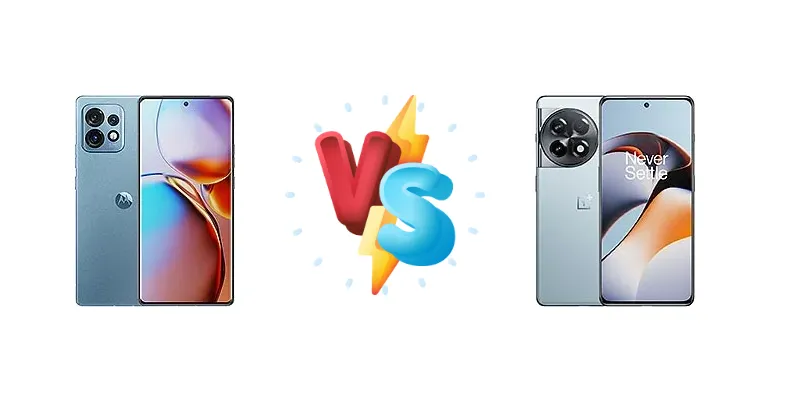
|
🏆 Quick Verdict
The Moto X40 boasts a superior chipset (Snapdragon 8 Gen 2) and faster charging (125W wired, wireless, and reverse wireless), while the OnePlus 11R offers a slightly more streamlined software experience and potentially a more competitive price. The X40 is the overall performance winner, but the 11R is a strong contender.
| PHONES | ||
|---|---|---|
| Phone Names | Motorola Moto X40 | OnePlus 11R |
| Network | ||
|---|---|---|
| 2G bands | GSM 850 / 900 / 1800 / 1900 | GSM 850 / 900 / 1800 / 1900 |
| 3G bands | HSDPA 850 / 900 / 1700(AWS) / 1900 / 2100 | HSDPA 850 / 900 / 1700(AWS) / 2100 |
| 4G bands | 1, 2, 3, 4, 5, 7, 8, 12, 13, 17, 18, 19, 20, 25, 26, 28, 32, 38, 39, 40, 41, 42, 43, 48, 66 | 1, 3, 4, 5, 8, 28, 34, 38, 39, 40, 41 |
| 5G bands | 1, 2, 3, 5, 7, 8, 20, 28, 38, 40, 41, 66, 77, 78 SA/NSA/Sub6 | 1, 3, 5, 8, 28, 40, 41, 77, 78 SA/NSA |
| Speed | HSPA, LTE, 5G | HSPA, LTE (3CA), 5G |
| Technology | GSM / CDMA / HSPA / LTE / 5G | GSM / CDMA / HSPA / LTE / 5G |
| CDMA 800 | CDMA 800 | |
| Launch | ||
|---|---|---|
| Announced | 2022, December 15 | 2023, February 07 |
| Status | Available. Released 2022, December 22 | Available. Released 2023, February 21 |
| Body | ||
|---|---|---|
| Build | Glass front, glass back (Gorilla Glass Victus), aluminum frame | Glass front, glass back (Gorilla Glass 5), plastic frame |
| Dimensions | 161.2 x 74 x 8.6 mm (6.35 x 2.91 x 0.34 in) | 163.4 x 74.3 x 8.7 mm (6.43 x 2.93 x 0.34 in) |
| SIM | Nano-SIM + Nano-SIM | Nano-SIM + Nano-SIM |
| Weight | 199 g (7.02 oz) | 204 g (7.20 oz) |
| IP68 dust/water resistant (up to 1.5m for 30 min) | - | |
| Display | ||
|---|---|---|
| Resolution | 1080 x 2400 pixels, 20:9 ratio (~393 ppi density) | 1240 x 2772 pixels, 20:9 ratio (~451 ppi density) |
| Size | 6.7 inches, 108.4 cm2 (~90.9% screen-to-body ratio) | 6.74 inches, 109.2 cm2 (~90.0% screen-to-body ratio) |
| Type | OLED, 1B colors, 165Hz, HDR10+ | Fluid AMOLED, 1B colors, 120Hz, HDR10+, 1450 nits (peak) |
| Platform | ||
|---|---|---|
| CPU | Octa-core (1x3.2 GHz Cortex-X3 & 2x2.8 GHz Cortex-A715 & 2x2.8 GHz Cortex-A710 & 3x2.0 GHz Cortex-A510) | Octa-core (1x3.0 GHz Cortex-X2 & 3x2.5 GHz Cortex-A710 & 4x1.80 GHz Cortex-A510) |
| Chipset | Qualcomm SM8550-AB Snapdragon 8 Gen 2 (4 nm) | Qualcomm SM8475 Snapdragon 8+ Gen 1 (4 nm) |
| GPU | Adreno 740 | Adreno 730 |
| OS | Android 13, upgradable to Android 14, MYUI 6.0 | Android 13, upgradable to Android 15, OxygenOS 15 |
| Memory | ||
|---|---|---|
| Card slot | No | No |
| Internal | 128GB 8GB RAM, 256GB 12GB RAM, 512GB 12GB RAM | 128GB 8GB RAM, 256GB 16GB RAM, 512GB 18GB RAM |
| UFS 3.1 - 128GB UFS 4.0 - 256GB/512GB | UFS 3.1 | |
| Main Camera | ||
|---|---|---|
| Features | Dual-LED flash, panorama, HDR | Color spectrum sensor, LED flash, HDR, panorama |
| Single | - | 16 MP, f/2.4, 24mm (wide), 1/3.09", 1.0µm |
| Triple | 50 MP, f/1.9, (wide), 1/1.55", 1.0µm, dual pixel PDAF, OIS 12 MP, f/1.6, (telephoto), 1/2.93", 1.22µm, PDAF, 2x optical zoom 50 MP, f/2.2, 117˚ (ultrawide), 1/2.76", 0.64µm, AF | 50 MP, f/1.8, 24mm (wide), 1/1.56", 1.0µm, multi-directional PDAF, OIS 8 MP, f/2.2, 120˚ (ultrawide), 1/4.0", 1.12µm 2 MP (macro) |
| Video | 8K@30fps, 4K@30/60fps, 1080p@30/60/120/240/960fps, 10-bit HDR10+, gyro-EIS | 4K@30/60fps, 1080p@30/60/240fps, gyro-EIS |
| Selfie camera | ||
|---|---|---|
| Features | HDR | HDR |
| Single | 60 MP, f/2.2, (wide), 1/2.8", 0.61µm | 16 MP, f/2.4, 24mm (wide), 1/3.09", 1.0µm |
| Video | 4K@30fps, 1080p@30/60fps | 1080p@30fps |
| Sound | ||
|---|---|---|
| 3.5mm jack | No | No |
| 35mm jack | No | No |
| Loudspeaker | Yes, with stereo speakers | Yes, with stereo speakers |
| - | 24-bit/192kHz audio | |
| Comms | ||
|---|---|---|
| Bluetooth | 5.3, A2DP, LE, aptX HD, aptX Adaptive | 5.3, A2DP, LE, aptX HD |
| Infrared port | - | Yes |
| NFC | Yes | Yes |
| Positioning | GPS (L1+L5), GLONASS (L1), BDS (B1I+B1c+B2a), GALILEO (E1+E5a), QZSS (L1+L5) | GPS (L1+L5), GLONASS (G1), BDS (B1I+B1c+B2a), GALILEO (E1+E5a), QZSS (L1+L5) |
| Radio | No | No |
| USB | USB Type-C, OTG | USB Type-C 2.0 |
| WLAN | Wi-Fi 802.11 a/b/g/n/ac/6e, dual-band, Wi-Fi Direct | Wi-Fi 802.11 a/b/g/n/ac/6, dual-band |
| Features | ||
|---|---|---|
| Sensors | Fingerprint (under display, optical), accelerometer, gyro, proximity, compass | Fingerprint (under display, optical), accelerometer, gyro, proximity, compass |
| Ready For 3.5 support | - | |
| Battery | ||
|---|---|---|
| Charging | 125W wired, PD3.0, QC5, 50% in 7 min 15W wireless 5W reverse wired | 100W wired |
| Type | Li-Po 4600 mAh | Li-Po 5000 mAh |
| Misc | ||
|---|---|---|
| Colors | Black, Blue | Galactic Silver, Sonic Black, Solar Red |
| Models | XT2301-5 | CPH2487 |
| Price | About 540 EUR | About 600 EUR |
| SAR | - | 1.16 W/kg (head) 0.61 W/kg (body) |
Motorola Moto X40
- Superior Snapdragon 8 Gen 2 chipset
- Blazing-fast 125W wired charging
- Wireless and reverse wireless charging
- Potentially better camera performance
- Likely a larger display
- Motorola's software updates can be slower
- May be more expensive than the OnePlus 11R
- Design might not appeal to everyone
OnePlus 11R
- Smooth and clean OxygenOS software
- Fast 100W wired charging
- Potentially more competitive pricing
- Excellent display
- Strong performance with Snapdragon 8+ Gen 1
- Snapdragon 8+ Gen 1 is less powerful than the 8 Gen 2
- No wireless charging
- Camera may not be as advanced as the Moto X40
Display Comparison
Both phones feature excellent AMOLED displays with high refresh rates (likely 120Hz). The Moto X40 may have a slightly larger display and potentially higher peak brightness. We'll need to confirm exact specs for a definitive comparison, but both offer vibrant colors and smooth visuals.
Camera Comparison
While both phones likely offer capable camera systems, the Moto X40 potentially has an edge with its newer hardware and image processing capabilities. Expect detailed photos and videos from both, but the X40 might offer slightly better low-light performance and dynamic range. Specific sensor details are needed for a more precise assessment.
Performance
The Moto X40's Snapdragon 8 Gen 2 provides a significant performance advantage over the OnePlus 11R's Snapdragon 8+ Gen 1. Expect faster app loading times, smoother multitasking, and better gaming performance on the X40. The 11R is still powerful, but the X40 takes the lead here.
Battery Life
The Moto X40's 125W wired charging is a game-changer, allowing for incredibly fast top-ups. The OnePlus 11R's 100W charging is still very fast, but not quite as impressive. Battery capacity is likely similar, so charging speed is the key differentiator here.
Buying Guide
The Motorola Moto X40 is ideal for power users who prioritize raw performance, fast charging, and a more feature-rich experience. The OnePlus 11R is a great choice for those seeking a smooth, fast Android experience with a focus on value and a clean UI, especially if budget is a key consideration.