
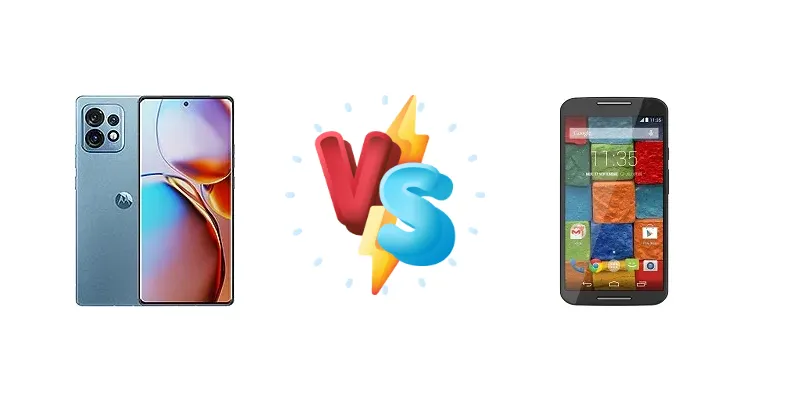
Motorola Moto X40 vs. Moto X (2nd Gen): A Generational Leap?
| Phones Images | |||||
|---|---|---|---|---|---|
|
🏆 Quick Verdict
The Moto X40 is the clear winner in almost every category. Its Snapdragon 8 Gen 2 chipset, 125W charging, and modern features far surpass the Moto X (2nd Gen). However, the older model's impressive battery life and nostalgic appeal might still hold value for some.
| PHONES | ||
|---|---|---|
| Phone Names | Motorola Moto X40 | Motorola Moto X (2nd Gen) |
| Network | ||
|---|---|---|
| 2G bands | GSM 850 / 900 / 1800 / 1900 | GSM 850 / 900 / 1800 / 1900 - all versions |
| 3G bands | HSDPA 850 / 900 / 1700(AWS) / 1900 / 2100 | HSDPA 850 / 900 / 1900 / 2100 - EU, AT&T, Verizon |
| 4G bands | 1, 2, 3, 4, 5, 7, 8, 12, 13, 17, 18, 19, 20, 25, 26, 28, 32, 38, 39, 40, 41, 42, 43, 48, 66 | 2, 3, 4, 5, 7, 17 - XT1097 AT&T, XT1095 T-Mobile |
| 5G bands | 1, 2, 3, 5, 7, 8, 20, 28, 38, 40, 41, 66, 77, 78 SA/NSA/Sub6 | - |
| Speed | HSPA, LTE, 5G | HSPA 42.2/5.76 Mbps, LTE Cat4 150/50 Mbps |
| Technology | GSM / CDMA / HSPA / LTE / 5G | GSM / CDMA / HSPA / LTE |
| CDMA 800 | 1, 3, 7, 20 - India | |
| Launch | ||
|---|---|---|
| Announced | 2022, December 15 | 2014, September. Released 2014, September |
| Status | Available. Released 2022, December 22 | Discontinued |
| Body | ||
|---|---|---|
| Build | Glass front, glass back (Gorilla Glass Victus), aluminum frame | - |
| Dimensions | 161.2 x 74 x 8.6 mm (6.35 x 2.91 x 0.34 in) | 140.8 x 72.4 x 10 mm (5.54 x 2.85 x 0.39 in) |
| SIM | Nano-SIM + Nano-SIM | Nano-SIM |
| Weight | 199 g (7.02 oz) | 144 g (5.08 oz) |
| IP68 dust/water resistant (up to 1.5m for 30 min) | Water resistant | |
| Display | ||
|---|---|---|
| Protection | - | Corning Gorilla Glass 3 |
| Resolution | 1080 x 2400 pixels, 20:9 ratio (~393 ppi density) | 1080 x 1920 pixels, 16:9 ratio (~424 ppi density) |
| Size | 6.7 inches, 108.4 cm2 (~90.9% screen-to-body ratio) | 5.2 inches, 74.5 cm2 (~73.1% screen-to-body ratio) |
| Type | OLED, 1B colors, 165Hz, HDR10+ | AMOLED |
| Platform | ||
|---|---|---|
| CPU | Octa-core (1x3.2 GHz Cortex-X3 & 2x2.8 GHz Cortex-A715 & 2x2.8 GHz Cortex-A710 & 3x2.0 GHz Cortex-A510) | Quad-core 2.5 GHz Krait 400 |
| Chipset | Qualcomm SM8550-AB Snapdragon 8 Gen 2 (4 nm) | Qualcomm MSM8974AC Snapdragon 801 (28 nm) |
| GPU | Adreno 740 | Adreno 330 |
| OS | Android 13, upgradable to Android 14, MYUI 6.0 | Android 4.4.4 (KitKat), upgradable to 6.0 (Marshmallow) |
| Memory | ||
|---|---|---|
| Card slot | No | No |
| Internal | 128GB 8GB RAM, 256GB 12GB RAM, 512GB 12GB RAM | 16GB 2GB RAM, 32GB 2GB RAM, 64GB 2GB RAM (AT&T, T-Mobile) |
| UFS 3.1 - 128GB UFS 4.0 - 256GB/512GB | eMMC 5.0 | |
| Main Camera | ||
|---|---|---|
| Features | Dual-LED flash, panorama, HDR | Dual-LED flash, panorama, HDR |
| Single | - | 13 MP, f/2.2, 29mm (standard), 1/3.1", 1.13µm, AF |
| Triple | 50 MP, f/1.9, (wide), 1/1.55", 1.0µm, dual pixel PDAF, OIS 12 MP, f/1.6, (telephoto), 1/2.93", 1.22µm, PDAF, 2x optical zoom 50 MP, f/2.2, 117˚ (ultrawide), 1/2.76", 0.64µm, AF | - |
| Video | 8K@30fps, 4K@30/60fps, 1080p@30/60/120/240/960fps, 10-bit HDR10+, gyro-EIS | 4K@30fps, 1080p@30fps, HDR |
| Selfie camera | ||
|---|---|---|
| Features | HDR | - |
| Single | 60 MP, f/2.2, (wide), 1/2.8", 0.61µm | 2 MP, f/2.2 |
| Video | 4K@30fps, 1080p@30/60fps | 1080p@30fps |
| Sound | ||
|---|---|---|
| 3.5mm jack | No | Yes |
| 35mm jack | No | Yes |
| Loudspeaker | Yes, with stereo speakers | Yes |
| Comms | ||
|---|---|---|
| Bluetooth | 5.3, A2DP, LE, aptX HD, aptX Adaptive | 4.0, A2DP, EDR, LE, aptX |
| NFC | Yes | Yes |
| Positioning | GPS (L1+L5), GLONASS (L1), BDS (B1I+B1c+B2a), GALILEO (E1+E5a), QZSS (L1+L5) | GPS, GLONASS |
| Radio | No | No |
| USB | USB Type-C, OTG | microUSB 2.0, OTG |
| WLAN | Wi-Fi 802.11 a/b/g/n/ac/6e, dual-band, Wi-Fi Direct | Wi-Fi 802.11 a/b/g/n/ac, dual-band, DLNA, hotspot |
| Features | ||
|---|---|---|
| Sensors | Fingerprint (under display, optical), accelerometer, gyro, proximity, compass | Accelerometer, gyro, proximity, compass, barometer, temperature |
| Ready For 3.5 support | - | |
| Battery | ||
|---|---|---|
| Charging | 125W wired, PD3.0, QC5, 50% in 7 min 15W wireless 5W reverse wired | 15W wired, QC2 |
| Type | Li-Po 4600 mAh | Li-Ion 2300 mAh, non-removable |
| Misc | ||
|---|---|---|
| Colors | Black, Blue | Black, White |
| Models | XT2301-5 | XT1097, XT1096, XT1095, XT1092, XT1085, XT1093 |
| Price | About 540 EUR | About 320 EUR |
| SAR | - | 1.46 W/kg (head) 1.27 W/kg (body) |
| SAR EU | - | 0.49 W/kg (head) 0.69 W/kg (body) |
| Tests | ||
|---|---|---|
| Audio quality | - | Noise -93.5dB / Crosstalk -93.8dB |
| Battery life | - | Endurance rating 48h |
| Camera | - | Photo / Video |
| Loudspeaker | - | Voice 66dB / Noise 66dB / Ring 72dB |
| Performance | - | Basemark OS II 2.0: 1176Basemark X: 11855 |
Motorola Moto X40
- Blazing-fast Snapdragon 8 Gen 2
- 125W Super-Fast Charging
- Modern OLED Display
- Improved Camera System
- 5G Connectivity
- Potentially higher price
- May be larger and heavier than the Moto X (2nd Gen)
- Software updates may eventually cease
Motorola Moto X (2nd Gen)
- Exceptional Battery Life (claimed 48h)
- Compact and Lightweight Design
- Nostalgic Appeal
- Simple and Reliable
- Outdated Snapdragon 801 Chipset
- Slow 15W Charging
- Low-Resolution LCD Display
- Limited Camera Capabilities
- Difficult to find in good condition
Display Comparison
The Moto X40 features a modern OLED display, likely with a high refresh rate (e.g., 120Hz or 144Hz) and vibrant colors, offering a significantly better viewing experience than the Moto X (2nd Gen)'s LCD panel. Expect sharper images, deeper blacks, and smoother scrolling on the X40.
Camera Comparison
While both phones offer 'Photo / Video' capabilities, the Moto X40's camera system is expected to be vastly superior. Expect higher resolution sensors, improved image processing, better low-light performance, and potentially features like optical image stabilization (OIS) and advanced computational photography on the X40. The Moto X (2nd Gen)'s camera is dated by today's standards.
Performance
The Snapdragon 8 Gen 2 in the Moto X40 is a powerhouse, delivering blazing-fast performance for demanding games and applications. The Moto X (2nd Gen)'s Snapdragon 801, while capable in its day, is significantly slower and struggles with modern workloads. The X40's octa-core CPU and advanced architecture provide a massive performance advantage.
Battery Life
Interestingly, both phones are claimed to have an endurance rating of 48 hours. However, the Moto X40's 125W charging allows it to replenish its battery incredibly quickly, while the Moto X (2nd Gen) is limited to 15W charging. While endurance might be similar, charging speed is a huge differentiator.
Buying Guide
The Moto X40 is for users seeking top-tier performance, a stunning display, and fast charging. It's ideal for gamers, power users, and those wanting the latest Android experience. The Moto X (2nd Gen) is a niche buy, primarily for collectors or those seeking a simple, reliable phone with exceptional battery life and a touch of nostalgia – assuming you can find one in working condition.