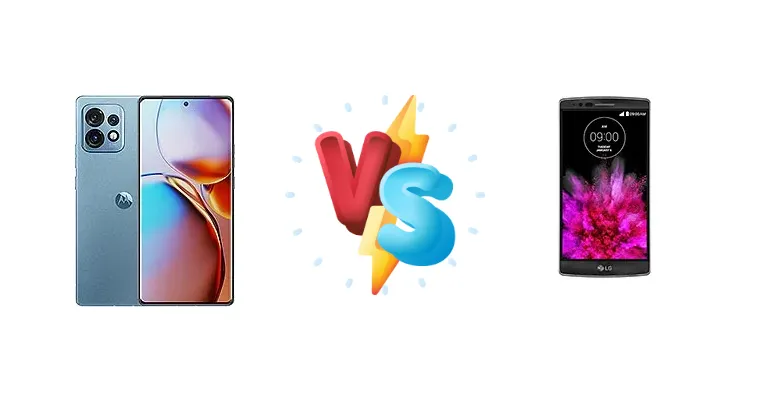
The smartphone landscape has changed dramatically. Today, we pit a modern powerhouse, the Motorola Moto X40, against a classic flex-screen pioneer, the LG G Flex2. This isn't just a comparison; it's a look at how far mobile technology has come.
🏆 Quick Verdict
The Motorola Moto X40 utterly dominates in almost every category. Its Snapdragon 8 Gen 2 chipset, 125W charging, and modern features leave the LG G Flex2 in the dust. However, the G Flex2's impressive endurance rating and unique flexible display offer a nostalgic appeal.
| Network |
|---|
| 2G bands | GSM 850 / 900 / 1800 / 1900 | GSM 850 / 900 / 1800 / 1900 |
| 3G bands | HSDPA 850 / 900 / 1700(AWS) / 1900 / 2100 | HSDPA 850 / 900 / 1900 / 2100 |
| 4G bands | 1, 2, 3, 4, 5, 7, 8, 12, 13, 17, 18, 19, 20, 25, 26, 28, 32, 38, 39, 40, 41, 42, 43, 48, 66 | 1, 3, 7, 8, 20 - H955 |
| 5G bands | 1, 2, 3, 5, 7, 8, 20, 28, 38, 40, 41, 66, 77, 78 SA/NSA/Sub6 | - |
| Speed | HSPA, LTE, 5G | HSPA 42.2/21.1 Mbps, LTE Cat6 300/50 MbpsLTE, EV-DO Rev.A 3.1 Mbps - US995 (U.S. Cellular) |
| Technology | GSM / CDMA / HSPA / LTE / 5G | GSM / CDMA / HSPA / EVDO / LTE |
| | CDMA 800 | LTE - US995 (U.S. Cellular) |
| Launch |
|---|
| Announced | 2022, December 15 | 2015, January. Released 2015, February |
| Status | Available. Released 2022, December 22 | Discontinued |
| Body |
|---|
| Build | Glass front, glass back (Gorilla Glass Victus), aluminum frame | Glass front (Gorilla Glass 3), plastic back, plastic frame |
| Dimensions | 161.2 x 74 x 8.6 mm (6.35 x 2.91 x 0.34 in) | 149.1 x 75.3 x 9.4 mm (5.87 x 2.96 x 0.37 in) |
| SIM | Nano-SIM + Nano-SIM | Micro-SIM |
| Weight | 199 g (7.02 oz) | 152 g (5.36 oz) |
| | IP68 dust/water resistant (up to 1.5m for 30 min) | Self-healing back panel coating |
| Display |
|---|
| Protection | - | Corning Gorilla Glass 3 |
| Resolution | 1080 x 2400 pixels, 20:9 ratio (~393 ppi density) | 1080 x 1920 pixels, 16:9 ratio (~403 ppi density) |
| Size | 6.7 inches, 108.4 cm2 (~90.9% screen-to-body ratio) | 5.5 inches, 82.6 cm2 (~73.5% screen-to-body ratio) |
| Type | OLED, 1B colors, 165Hz, HDR10+ | Curved P-OLED |
| Platform |
|---|
| CPU | Octa-core (1x3.2 GHz Cortex-X3 & 2x2.8 GHz Cortex-A715 & 2x2.8 GHz Cortex-A710 & 3x2.0 GHz Cortex-A510) | Octa-core (4x1.5 GHz Cortex-A53 & 4x2.0 GHz Cortex-A57) |
| Chipset | Qualcomm SM8550-AB Snapdragon 8 Gen 2 (4 nm) | Qualcomm MSM8994 Snapdragon 810 (20 nm) |
| GPU | Adreno 740 | Adreno 430 |
| OS | Android 13, upgradable to Android 14, MYUI 6.0 | Android 5.0.1 (Lollipop), upgradable to 6.0.1 (Marshmallow) |
| Memory |
|---|
| Card slot | No | microSDXC (dedicated slot) |
| Internal | 128GB 8GB RAM, 256GB 12GB RAM, 512GB 12GB RAM | 16GB 2GB RAM, 32GB 3GB RAM |
| | UFS 3.1 - 128GB
UFS 4.0 - 256GB/512GB | eMMC 5.0 |
| Main Camera |
|---|
| Features | Dual-LED flash, panorama, HDR | Laser AF, color spectrum sensor, Dual-LED flash, panorama, HDR |
| Single | - | 13 MP, f/2.4, OIS |
| Triple | 50 MP, f/1.9, (wide), 1/1.55", 1.0µm, dual pixel PDAF, OIS
12 MP, f/1.6, (telephoto), 1/2.93", 1.22µm, PDAF, 2x optical zoom
50 MP, f/2.2, 117˚ (ultrawide), 1/2.76", 0.64µm, AF | - |
| Video | 8K@30fps, 4K@30/60fps, 1080p@30/60/120/240/960fps, 10-bit HDR10+, gyro-EIS | 4K@30fps, 1080p@60fps, HDR, stereo sound rec. |
| Selfie camera |
|---|
| Features | HDR | - |
| Single | 60 MP, f/2.2, (wide), 1/2.8", 0.61µm | 2.1 MP |
| Video | 4K@30fps, 1080p@30/60fps | 1080p@30fps |
| Sound |
|---|
| 3.5mm jack | No | Yes |
| 35mm jack | No | Yes |
| Loudspeaker | Yes, with stereo speakers | Yes |
| Comms |
|---|
| Bluetooth | 5.3, A2DP, LE, aptX HD, aptX Adaptive | 4.1, A2DP, LE, aptX |
| Infrared port | - | Yes |
| NFC | Yes | Yes |
| Positioning | GPS (L1+L5), GLONASS (L1), BDS (B1I+B1c+B2a), GALILEO (E1+E5a), QZSS (L1+L5) | GPS, GLONASS |
| Radio | No | Stereo FM radio, RDS |
| USB | USB Type-C, OTG | microUSB 2.0 (SlimPort), OTG |
| WLAN | Wi-Fi 802.11 a/b/g/n/ac/6e, dual-band, Wi-Fi Direct | Wi-Fi 802.11 a/b/g/n/ac, dual-band, Wi-Fi Direct, DLNA, hotspot |
| Features |
|---|
| Sensors | Fingerprint (under display, optical), accelerometer, gyro, proximity, compass | Accelerometer, gyro, proximity, compass |
| | Ready For 3.5 support | DMB TV tuner (Korean model only) |
| Battery |
|---|
| Charging | 125W wired, PD3.0, QC5, 50% in 7 min
15W wireless
5W reverse wired | 18W wired, QC2 |
| Stand-by | - | Up to 520 h (2G) / Up to 450 h (3G) |
| Talk time | - | Up to 18 h (2G) / Up to 20 h (3G) |
| Type | Li-Po 4600 mAh | Li-Po 3000 mAh, non-removable |
| Misc |
|---|
| Colors | Black, Blue | Platinum Silver, Flamenco Red |
| Models | XT2301-5 | F510, LS996, H950, H955, US995, LGLS996 |
| Price | About 540 EUR | About 270 EUR |
| SAR | - | 1.10 W/kg (head) 1.07 W/kg (body) |
| SAR EU | - | 0.68 W/kg (head) 0.44 W/kg (body) |
| Tests |
|---|
| Battery life | - |
Endurance rating 62h
|
| Camera | - |
Photo / Video |
Motorola Moto X40
- Blazing-fast Snapdragon 8 Gen 2
- 125W Super-Fast Charging
- Modern OLED Display
- Improved Camera System
- Latest Android Features
- Potentially higher price point
- May lack the unique appeal of the G Flex2's flexible design
LG G Flex2
- Unique Flexible Display
- Exceptional Battery Endurance (62h)
- Nostalgic Appeal
- Outdated Snapdragon 810 Chipset
- Lower Resolution Display
- Slow Charging (18W)
- Limited Software Updates
- Older Camera Technology
Display Comparison
The Moto X40 boasts a modern OLED display, likely with a high refresh rate (assumed 120Hz or higher) and vibrant colors. The G Flex2 has a curved, flexible OLED display, a novelty at the time, but likely with lower resolution and color accuracy compared to the X40. The X40's display will offer a significantly better viewing experience.
Camera Comparison
While both have 'Photo/Video' listed, the Moto X40's camera system will almost certainly be superior in terms of image quality, features (like night mode, portrait mode), and video recording capabilities. The X40 likely has multiple lenses and advanced image processing. The G Flex2's camera is likely dated by today's standards.
Performance
The Snapdragon 8 Gen 2 in the Moto X40 is a beast, offering unparalleled performance for gaming and demanding tasks. The Snapdragon 810 in the G Flex2, while powerful in its day, struggles to keep up with modern apps and games. The X40's CPU and GPU are generations ahead.
Battery Life
Interestingly, the LG G Flex2 boasts an impressive endurance rating of 62h. However, the Moto X40's 125W charging means it can replenish its battery far faster, even if its overall capacity is similar or slightly lower. The G Flex2's longevity is impressive, but the X40 offers convenience.
Buying Guide
The Motorola Moto X40 is for users seeking top-tier performance, fast charging, and a modern Android experience. The LG G Flex2 is for enthusiasts interested in a unique, albeit aging, flexible display and exceptionally long battery life, understanding its limitations.
Frequently Asked Questions
❓ Is the LG G Flex2 still usable in 2024?
Yes, but with significant limitations. It will struggle with modern apps and games, and software updates are long gone. Its battery life remains a strong point.
❓ Why is the Moto X40 considered the clear winner?
The Moto X40 offers a vastly superior processor, display, camera, and charging speed compared to the LG G Flex2, representing a significant leap in smartphone technology.