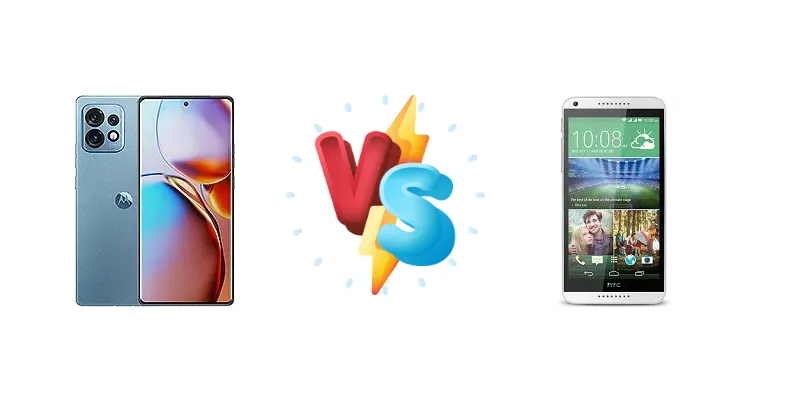
The smartphone landscape is constantly evolving. Today, we pit a modern powerhouse, the Motorola Moto X40, against a significantly older device, the HTC Desire 816G. This comparison highlights the incredible advancements in mobile technology over the years, offering insights for budget-conscious buyers and tech enthusiasts alike.
🏆 Quick Verdict
The Motorola Moto X40 utterly dominates this comparison. Its Snapdragon 8 Gen 2 chipset, blazing-fast charging, and modern features leave the HTC Desire 816G in the dust. The X40 is for performance seekers; the 816G is a nostalgic option for those needing a basic, affordable phone.
| Network |
|---|
| 2G bands | GSM 850 / 900 / 1800 / 1900 | GSM 850 / 900 / 1800 / 1900 - SIM 1 & SIM 2 |
| 3G bands | HSDPA 850 / 900 / 1700(AWS) / 1900 / 2100 | HSDPA 900 / 2100 |
| 4G bands | 1, 2, 3, 4, 5, 7, 8, 12, 13, 17, 18, 19, 20, 25, 26, 28, 32, 38, 39, 40, 41, 42, 43, 48, 66 | - |
| 5G bands | 1, 2, 3, 5, 7, 8, 20, 28, 38, 40, 41, 66, 77, 78 SA/NSA/Sub6 | - |
| Speed | HSPA, LTE, 5G | HSPA 21.1/5.76 Mbps |
| Technology | GSM / CDMA / HSPA / LTE / 5G | GSM / HSPA |
| | CDMA 800 | - |
| Launch |
|---|
| Announced | 2022, December 15 | 2014, September. Released 2014, October |
| Status | Available. Released 2022, December 22 | Discontinued |
| Body |
|---|
| Build | Glass front, glass back (Gorilla Glass Victus), aluminum frame | - |
| Dimensions | 161.2 x 74 x 8.6 mm (6.35 x 2.91 x 0.34 in) | 156.6 x 78.7 x 8 mm (6.17 x 3.10 x 0.31 in) |
| SIM | Nano-SIM + Nano-SIM | Nano-SIM + Nano-SIM |
| Weight | 199 g (7.02 oz) | 158 g (5.57 oz) |
| | IP68 dust/water resistant (up to 1.5m for 30 min) | - |
| Display |
|---|
| Resolution | 1080 x 2400 pixels, 20:9 ratio (~393 ppi density) | 720 x 1280 pixels, 16:9 ratio (~267 ppi density) |
| Size | 6.7 inches, 108.4 cm2 (~90.9% screen-to-body ratio) | 5.5 inches, 83.4 cm2 (~67.7% screen-to-body ratio) |
| Type | OLED, 1B colors, 165Hz, HDR10+ | Super LCD2 |
| Platform |
|---|
| CPU | Octa-core (1x3.2 GHz Cortex-X3 & 2x2.8 GHz Cortex-A715 & 2x2.8 GHz Cortex-A710 & 3x2.0 GHz Cortex-A510) | Quad-core 1.3 GHz Cortex-A7 - India modelOcta-core 1.7 GHz - SEA model |
| Chipset | Qualcomm SM8550-AB Snapdragon 8 Gen 2 (4 nm) | Mediatek MT6582 - India model |
| GPU | Adreno 740 | Mali-400MP2 - India model |
| OS | Android 13, upgradable to Android 14, MYUI 6.0 | Android 4.4.2 (KitKat), Sense UI 6 |
| Memory |
|---|
| Card slot | No | microSDHC (dedicated slot) |
| Internal | 128GB 8GB RAM, 256GB 12GB RAM, 512GB 12GB RAM | 8GB (IN), 16GB (SEA), 1GB RAM |
| | UFS 3.1 - 128GB
UFS 4.0 - 256GB/512GB | - |
| Main Camera |
|---|
| Features | Dual-LED flash, panorama, HDR | LED flash, HDR |
| Single | - | 13 MP, f/2.2, AF |
| Triple | 50 MP, f/1.9, (wide), 1/1.55", 1.0µm, dual pixel PDAF, OIS
12 MP, f/1.6, (telephoto), 1/2.93", 1.22µm, PDAF, 2x optical zoom
50 MP, f/2.2, 117˚ (ultrawide), 1/2.76", 0.64µm, AF | - |
| Video | 8K@30fps, 4K@30/60fps, 1080p@30/60/120/240/960fps, 10-bit HDR10+, gyro-EIS | 1080p@30fps, 720p@60fps |
| Selfie camera |
|---|
| Features | HDR | - |
| Single | 60 MP, f/2.2, (wide), 1/2.8", 0.61µm | 5 MP |
| Video | 4K@30fps, 1080p@30/60fps | 1080p@30fps |
| Sound |
|---|
| 3.5mm jack | No | Yes |
| 35mm jack | No | Yes |
| Loudspeaker | Yes, with stereo speakers | Yes, with stereo speakers |
| Comms |
|---|
| Bluetooth | 5.3, A2DP, LE, aptX HD, aptX Adaptive | 4.0, A2DP, aptX |
| NFC | Yes | No |
| Positioning | GPS (L1+L5), GLONASS (L1), BDS (B1I+B1c+B2a), GALILEO (E1+E5a), QZSS (L1+L5) | GPS, GLONASS |
| Radio | No | FM radio |
| USB | USB Type-C, OTG | microUSB 2.0 |
| WLAN | Wi-Fi 802.11 a/b/g/n/ac/6e, dual-band, Wi-Fi Direct | Wi-Fi 802.11 b/g/n, hotspot |
| Features |
|---|
| Sensors | Fingerprint (under display, optical), accelerometer, gyro, proximity, compass | Accelerometer, proximity, compass |
| | Ready For 3.5 support | - |
| Battery |
|---|
| Charging | 125W wired, PD3.0, QC5, 50% in 7 min
15W wireless
5W reverse wired | - |
| Stand-by | - | Up to 460 h (3G) |
| Talk time | - | Up to 10 h (3G) |
| Type | Li-Po 4600 mAh | Li-Po 2600 mAh, non-removable |
| Misc |
|---|
| Colors | Black, Blue | Black, White |
| Models | XT2301-5 | Desire 816G dual sim, Desire 816, Desire_816G_dual_sim, D816h |
| Price | About 540 EUR | About 260 EUR |
| SAR | - | 0.33 W/kg (head) 0.24 W/kg (body) |
Motorola Moto X40
- Flagship Performance
- Excellent Display
- Fast Charging (125W)
- Modern Features (5G)
- High-Resolution Camera
- Potentially Higher Price
- May be Overkill for Basic Users
HTC Desire 816G dual sim
- Affordable
- Dual SIM Support
- Compact Size
- Outdated Processor
- Low-Resolution Display
- Slow Performance
- Limited Camera Capabilities
- Poor Battery Life Compared to Modern Phones
Display Comparison
The Moto X40 boasts a vibrant, high-resolution OLED display with a high refresh rate, offering a smooth and immersive viewing experience. The HTC Desire 816G features a smaller, lower-resolution LCD display, which is adequate for basic tasks but lacks the visual fidelity and responsiveness of the X40.
Camera Comparison
The Moto X40's camera system is significantly more advanced, offering higher resolution sensors, improved image processing, and features like optical image stabilization. The HTC Desire 816G's camera is adequate for casual snapshots but lacks the detail and dynamic range of the X40.
Performance
The Snapdragon 8 Gen 2 in the Moto X40 delivers flagship-level performance, effortlessly handling demanding games and applications. The HTC Desire 816G's quad/octa-core processor struggles with modern apps and multitasking, resulting in noticeable lag and slowdowns.
Battery Life
The Moto X40 likely has a larger battery capacity and benefits from more efficient power management, providing all-day battery life. The HTC Desire 816G's battery life is decent for its age, but it will require more frequent charging.
Buying Guide
The Motorola Moto X40 is ideal for users who prioritize performance, a high-quality display, and modern features like 5G connectivity and fast charging. The HTC Desire 816G is best suited for users on an extremely tight budget who need a basic smartphone for calls, texts, and light usage, and are comfortable with older technology.
Frequently Asked Questions
❓ Is the HTC Desire 816G still usable in 2024?
Yes, it can still make calls and send texts, but its performance will be significantly limited by its outdated hardware. Don't expect it to run modern apps smoothly.
❓ Why is the Motorola Moto X40 so much better?
The Moto X40 utilizes a modern chipset, a high-resolution display, and advanced camera technology, representing a significant leap forward in smartphone technology compared to the HTC Desire 816G.