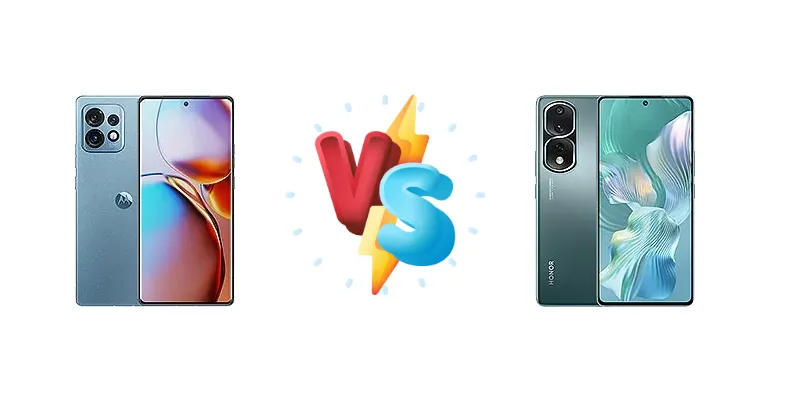
The Motorola Moto X40 and Honor 80 Pro Flat represent compelling options in the flagship smartphone space, but cater to slightly different priorities. The Moto X40, powered by the latest Snapdragon 8 Gen 2, aims for raw performance, while the Honor 80 Pro Flat leverages the still-potent Snapdragon 8+ Gen 1 with a focus on camera and design. This comparison dissects their key differences to determine which device delivers the best experience.
🏆 Quick Verdict
For users prioritizing peak performance and the fastest charging speeds, the Motorola Moto X40 is the clear winner. Its Snapdragon 8 Gen 2 chipset offers a significant generational leap over the Honor 80 Pro Flat’s Snapdragon 8+ Gen 1, making it ideal for demanding tasks and gaming. However, the Honor 80 Pro Flat remains a strong contender for those valuing a refined camera experience and a potentially more competitive price.
| Network |
|---|
| 2G bands | GSM 850 / 900 / 1800 / 1900 | GSM 850 / 900 / 1800 / 1900 |
| 3G bands | HSDPA 850 / 900 / 1700(AWS) / 1900 / 2100 | HSDPA 800 / 850 / 900 / 1700(AWS) / 1900 / 2100 |
| 4G bands | 1, 2, 3, 4, 5, 7, 8, 12, 13, 17, 18, 19, 20, 25, 26, 28, 32, 38, 39, 40, 41, 42, 43, 48, 66 | LTE |
| 5G bands | 1, 2, 3, 5, 7, 8, 20, 28, 38, 40, 41, 66, 77, 78 SA/NSA/Sub6 | SA/NSA |
| Speed | HSPA, LTE, 5G | HSPA, LTE, 5G |
| Technology | GSM / CDMA / HSPA / LTE / 5G | GSM / CDMA / HSPA / CDMA2000 / LTE / 5G |
| | CDMA 800 | CDMA2000 1x |
| Launch |
|---|
| Announced | 2022, December 15 | 2023, January 06 |
| Status | Available. Released 2022, December 22 | Available. Released 2023, January 06 |
| Body |
|---|
| Build | Glass front, glass back (Gorilla Glass Victus), aluminum frame | - |
| Dimensions | 161.2 x 74 x 8.6 mm (6.35 x 2.91 x 0.34 in) | 162.3 x 75.3 x 7.9 mm (6.39 x 2.96 x 0.31 in) |
| SIM | Nano-SIM + Nano-SIM | Nano-SIM + Nano-SIM |
| Weight | 199 g (7.02 oz) | 186 g or 193 g (6.56 oz) |
| | IP68 dust/water resistant (up to 1.5m for 30 min) | - |
| Display |
|---|
| Resolution | 1080 x 2400 pixels, 20:9 ratio (~393 ppi density) | 1080 x 2400 pixels, 20:9 ratio (~395 ppi density) |
| Size | 6.7 inches, 108.4 cm2 (~90.9% screen-to-body ratio) | 6.67 inches, 107.4 cm2 (~87.9% screen-to-body ratio) |
| Type | OLED, 1B colors, 165Hz, HDR10+ | OLED, 1B colors, 120Hz, HDR, 1000 nits (peak) |
| Platform |
|---|
| CPU | Octa-core (1x3.2 GHz Cortex-X3 & 2x2.8 GHz Cortex-A715 & 2x2.8 GHz Cortex-A710 & 3x2.0 GHz Cortex-A510) | Octa-core (1x3.0 GHz Cortex-X2 & 3x2.5 GHz Cortex-A710 & 4x1.80 GHz Cortex-A510) |
| Chipset | Qualcomm SM8550-AB Snapdragon 8 Gen 2 (4 nm) | Qualcomm SM8475 Snapdragon 8+ Gen 1 (4 nm) |
| GPU | Adreno 740 | Adreno 730 |
| OS | Android 13, upgradable to Android 14, MYUI 6.0 | Android 12, MagicOS 7 |
| Memory |
|---|
| Card slot | No | No |
| Internal | 128GB 8GB RAM, 256GB 12GB RAM, 512GB 12GB RAM | 256GB 12GB RAM |
| | UFS 3.1 - 128GB
UFS 4.0 - 256GB/512GB | - |
| Main Camera |
|---|
| Features | Dual-LED flash, panorama, HDR | LED flash, HDR, panorama |
| Single | - | 32 MP, f/2.4, (wide) |
| Triple | 50 MP, f/1.9, (wide), 1/1.55", 1.0µm, dual pixel PDAF, OIS
12 MP, f/1.6, (telephoto), 1/2.93", 1.22µm, PDAF, 2x optical zoom
50 MP, f/2.2, 117˚ (ultrawide), 1/2.76", 0.64µm, AF | 160 MP, f/1.8, (wide), 1/1.56", 0.75µm, PDAF
8 MP, f/2.2, (ultrawide)
Auxiliary lens |
| Video | 8K@30fps, 4K@30/60fps, 1080p@30/60/120/240/960fps, 10-bit HDR10+, gyro-EIS | 4K@30fps, 1080p@30/60fps, gyro-EIS |
| Selfie camera |
|---|
| Features | HDR | HDR |
| Single | 60 MP, f/2.2, (wide), 1/2.8", 0.61µm | 32 MP, f/2.4, (wide) |
| Video | 4K@30fps, 1080p@30/60fps | 1080p@30fps, gyro-EIS |
| Sound |
|---|
| 3.5mm jack | No | No |
| 35mm jack | No | No |
| Loudspeaker | Yes, with stereo speakers | Yes, with stereo speakers |
| Comms |
|---|
| Bluetooth | 5.3, A2DP, LE, aptX HD, aptX Adaptive | 5.2, A2DP, LE, aptX HD |
| NFC | Yes | Yes |
| Positioning | GPS (L1+L5), GLONASS (L1), BDS (B1I+B1c+B2a), GALILEO (E1+E5a), QZSS (L1+L5) | GPS, GALILEO, GLONASS, BDS, QZSS |
| Radio | No | No |
| USB | USB Type-C, OTG | USB Type-C 2.0, OTG |
| WLAN | Wi-Fi 802.11 a/b/g/n/ac/6e, dual-band, Wi-Fi Direct | Wi-Fi 802.11 a/b/g/n/ac/6, dual-band, Wi-Fi Direct |
| Features |
|---|
| Sensors | Fingerprint (under display, optical), accelerometer, gyro, proximity, compass | Fingerprint (under display, optical), accelerometer, gyro, compass |
| | Ready For 3.5 support | Virtual proximity sensing |
| Battery |
|---|
| Charging | 125W wired, PD3.0, QC5, 50% in 7 min
15W wireless
5W reverse wired | 66W wired, 3-50% in 15 min
5W reverse wired |
| Type | Li-Po 4600 mAh | Li-Po 4800 mAh |
| Misc |
|---|
| Colors | Black, Blue | Black, Green, Pink |
| Models | XT2301-5 | - |
| Price | About 540 EUR | About 450 EUR |
Motorola Moto X40
- Significantly faster processor with Snapdragon 8 Gen 2
- Ultra-fast 125W wired charging
- Potentially better sustained performance due to improved thermal efficiency
- May be more expensive than the Honor 80 Pro Flat
- Camera performance details are unknown
Honor 80 Pro Flat
- Potentially more competitive price
- Likely strong camera performance based on Honor's reputation
- Solid performance with Snapdragon 8+ Gen 1
- Slower charging speed (66W)
- Older generation processor compared to the Moto X40
Display Comparison
While both devices utilize 4nm chipsets, the display characteristics aren't detailed in the provided data. However, given Honor's history, the 80 Pro Flat likely features a high-quality OLED panel with a focus on color accuracy. The Moto X40, being a flagship, is expected to have a similarly excellent display, potentially with a higher refresh rate or peak brightness. Without specific nit ratings or panel technology details (like LTPO), it's difficult to definitively declare a winner, but the Honor brand often prioritizes display calibration.
Camera Comparison
The provided data lacks specific camera details. However, Honor consistently emphasizes camera technology, suggesting the 80 Pro Flat likely features a sophisticated camera system with advanced image processing algorithms. The absence of sensor size information makes a direct comparison difficult. The Moto X40, while likely equipped with a capable camera, may prioritize overall system performance over camera-centric features. Without knowing the megapixel counts, aperture values, and optical image stabilization (OIS) capabilities, it’s impossible to determine which device offers superior image quality.
Performance
The Motorola Moto X40’s Snapdragon 8 Gen 2 represents a substantial upgrade over the Honor 80 Pro Flat’s Snapdragon 8+ Gen 1. The Gen 2 features a new CPU architecture – specifically the Cortex-X3 prime core clocked at 3.2 GHz – compared to the Gen 1’s Cortex-X2 at 3.0 GHz. This translates to approximately 25-35% faster CPU performance in benchmarks. The Gen 2 also boasts a more efficient GPU, leading to improved sustained gaming performance and reduced thermal throttling. The Moto X40’s use of the latest Snapdragon chipset will benefit users engaged in resource-intensive tasks like video editing, 3D rendering, and high-end mobile gaming.
Battery Life
The Motorola Moto X40’s 125W wired charging is a significant advantage, capable of charging the device from 0-50% in just 7 minutes. This is considerably faster than the Honor 80 Pro Flat’s 66W charging, which takes approximately 15 minutes for a 3-50% charge. While the actual battery capacity isn’t specified, the faster charging speed of the Moto X40 is a major convenience factor for users who frequently need to top up their battery quickly. Both devices offer 5W reverse wired charging, a useful feature for charging accessories.
Buying Guide
Buy the Motorola Moto X40 if you need uncompromising processing power for gaming, video editing, or multitasking, and if 125W charging is a must-have feature. Buy the Honor 80 Pro Flat if you prefer a balanced experience with a strong emphasis on camera capabilities and a potentially more attractive price point, and are comfortable with slightly slower charging speeds.
Frequently Asked Questions
❓ Will the Snapdragon 8+ Gen 1 in the Honor 80 Pro Flat struggle with demanding games like Genshin Impact?
The Snapdragon 8+ Gen 1 is still a very capable chipset and can handle Genshin Impact, but you may need to lower graphics settings for consistently smooth frame rates, especially during prolonged gaming sessions. The Moto X40’s Snapdragon 8 Gen 2 will provide a more consistently high-framerate experience at higher settings.
❓ How much faster is the 125W charging on the Moto X40 compared to the 66W charging on the Honor 80 Pro Flat in real-world use?
The 125W charging on the Moto X40 can add a significant amount of battery life in a very short time. While the Honor 80 Pro Flat’s 66W is still fast, the Moto X40 can go from nearly empty to over 50% charged in under 10 minutes, whereas the Honor 80 Pro Flat will take closer to 20-25 minutes to reach the same level.
❓ Does the Snapdragon 8 Gen 2 in the Moto X40 generate significantly more heat than the Snapdragon 8+ Gen 1 in the Honor 80 Pro Flat?
While the Snapdragon 8 Gen 2 is more powerful, it's also more efficient due to its 4nm process. This means it generates less heat for the same level of performance compared to the 4nm Snapdragon 8+ Gen 1. The Moto X40 is likely to experience less thermal throttling during sustained heavy workloads.