
Motorola Moto X40 vs Google Pixel 7a: A Deep Dive into Performance and Value
| Phones Images | |||||
|---|---|---|---|---|---|
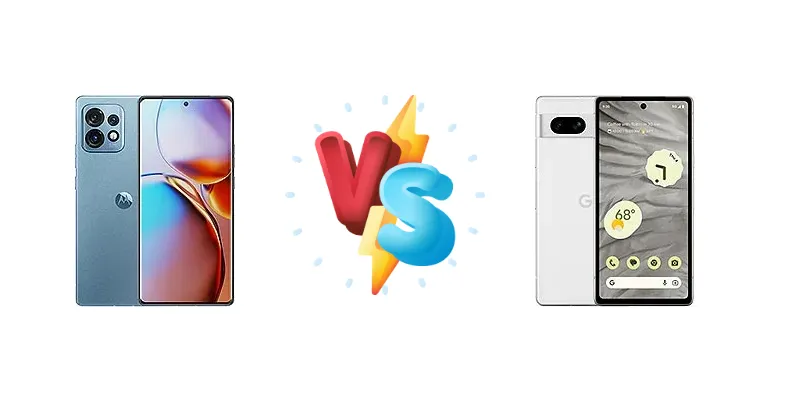
|
🏆 Quick Verdict
For users prioritizing peak performance and rapid charging, the Motorola Moto X40 is the clear winner. Its Snapdragon 8 Gen 2 delivers significantly faster processing speeds. However, the Pixel 7a’s superior camera software and tighter software integration make it a compelling choice for photography enthusiasts and those deeply invested in the Google ecosystem.
| PHONES | ||
|---|---|---|
| Phone Names | Motorola Moto X40 | Google Pixel 7a |
| Network | ||
|---|---|---|
| 2G bands | GSM 850 / 900 / 1800 / 1900 | GSM 850 / 900 / 1800 / 1900 |
| 3G bands | HSDPA 850 / 900 / 1700(AWS) / 1900 / 2100 | HSDPA 800 / 850 / 900 / 1700(AWS) / 1900 / 2100 |
| 4G bands | 1, 2, 3, 4, 5, 7, 8, 12, 13, 17, 18, 19, 20, 25, 26, 28, 32, 38, 39, 40, 41, 42, 43, 48, 66 | 1, 2, 3, 4, 5, 7, 8, 12, 13, 14, 17, 20, 25, 26, 28, 29, 30, 38, 40, 41, 48, 66, 71 - GWKK3, G0DZQ |
| 5G bands | 1, 2, 3, 5, 7, 8, 20, 28, 38, 40, 41, 66, 77, 78 SA/NSA/Sub6 | 1, 2, 3, 5, 7, 8, 12, 14, 20, 25, 28, 30, 38, 41, 48, 66, 71, 77, 78 SA/NSA/Sub6 - GWKK3 |
| Speed | HSPA, LTE, 5G | HSPA, LTE, 5G |
| Technology | GSM / CDMA / HSPA / LTE / 5G | GSM / HSPA / LTE / 5G |
| CDMA 800 | 1, 2, 3, 5, 7, 8, 12, 20, 25, 28, 38, 40, 41, 66, 75, 76, 77, 78, 79 SA/NSA/Sub6 - GHL1X, G82U8 | |
| Launch | ||
|---|---|---|
| Announced | 2022, December 15 | 2023, May 10 |
| Status | Available. Released 2022, December 22 | Available. Released 2023, May 10 |
| Body | ||
|---|---|---|
| Build | Glass front, glass back (Gorilla Glass Victus), aluminum frame | Glass front (Gorilla Glass 3), aluminum frame, plastic back |
| Dimensions | 161.2 x 74 x 8.6 mm (6.35 x 2.91 x 0.34 in) | 152 x 72.9 x 9 mm (5.98 x 2.87 x 0.35 in) |
| SIM | Nano-SIM + Nano-SIM | Nano-SIM + eSIM |
| Weight | 199 g (7.02 oz) | 193.5 g (6.84 oz) |
| IP68 dust/water resistant (up to 1.5m for 30 min) | IP67 dust/water resistant (up to 1m for 30 min) | |
| Display | ||
|---|---|---|
| Protection | - | Corning Gorilla Glass 3 |
| Resolution | 1080 x 2400 pixels, 20:9 ratio (~393 ppi density) | 1080 x 2400 pixels, 20:9 ratio (~429 ppi density) |
| Size | 6.7 inches, 108.4 cm2 (~90.9% screen-to-body ratio) | 6.1 inches, 90.7 cm2 (~81.8% screen-to-body ratio) |
| Type | OLED, 1B colors, 165Hz, HDR10+ | OLED, HDR, 90Hz |
| - | Always-on display | |
| Platform | ||
|---|---|---|
| CPU | Octa-core (1x3.2 GHz Cortex-X3 & 2x2.8 GHz Cortex-A715 & 2x2.8 GHz Cortex-A710 & 3x2.0 GHz Cortex-A510) | Octa-core (2x2.85 GHz Cortex-X1 & 2x2.35 GHz Cortex-A78 & 4x1.80 GHz Cortex-A55) |
| Chipset | Qualcomm SM8550-AB Snapdragon 8 Gen 2 (4 nm) | Google Tensor G2 (5 nm) |
| GPU | Adreno 740 | Mali-G710 MP7 |
| OS | Android 13, upgradable to Android 14, MYUI 6.0 | Android 13, upgradable to Android 15, up to 5 major Android upgrades |
| Memory | ||
|---|---|---|
| Card slot | No | No |
| Internal | 128GB 8GB RAM, 256GB 12GB RAM, 512GB 12GB RAM | 128GB 8GB RAM |
| UFS 3.1 - 128GB UFS 4.0 - 256GB/512GB | UFS 3.1 | |
| Main Camera | ||
|---|---|---|
| Dual | - | 64 MP, f/1.9, 26mm (wide), 1/1.73", 0.8µm, dual pixel PDAF, OIS 13 MP, f/2.2, 120˚ (ultrawide), 1.12µm |
| Features | Dual-LED flash, panorama, HDR | Dual-LED flash, Pixel Shift, Auto-HDR, panorama |
| Triple | 50 MP, f/1.9, (wide), 1/1.55", 1.0µm, dual pixel PDAF, OIS 12 MP, f/1.6, (telephoto), 1/2.93", 1.22µm, PDAF, 2x optical zoom 50 MP, f/2.2, 117˚ (ultrawide), 1/2.76", 0.64µm, AF | - |
| Video | 8K@30fps, 4K@30/60fps, 1080p@30/60/120/240/960fps, 10-bit HDR10+, gyro-EIS | 4K@30/60fps, 1080p@30/60/120/240fps, OIS |
| Selfie camera | ||
|---|---|---|
| Features | HDR | HDR, panorama |
| Single | 60 MP, f/2.2, (wide), 1/2.8", 0.61µm | 13 MP, f/2.2, 20mm (ultrawide), 1.12µm |
| Video | 4K@30fps, 1080p@30/60fps | 4K@30fps, 1080p@30fps |
| Sound | ||
|---|---|---|
| 3.5mm jack | No | No |
| 35mm jack | No | No |
| Loudspeaker | Yes, with stereo speakers | Yes, with stereo speakers |
| Comms | ||
|---|---|---|
| Bluetooth | 5.3, A2DP, LE, aptX HD, aptX Adaptive | 5.3, A2DP, LE |
| NFC | Yes | Yes |
| Positioning | GPS (L1+L5), GLONASS (L1), BDS (B1I+B1c+B2a), GALILEO (E1+E5a), QZSS (L1+L5) | GPS, GLONASS, GALILEO, BDS, QZSS, NavIC |
| Radio | No | No |
| USB | USB Type-C, OTG | USB Type-C 3.2 |
| WLAN | Wi-Fi 802.11 a/b/g/n/ac/6e, dual-band, Wi-Fi Direct | Wi-Fi 802.11 a/b/g/n/ac/6e, tri-band |
| Features | ||
|---|---|---|
| Sensors | Fingerprint (under display, optical), accelerometer, gyro, proximity, compass | Fingerprint (under display, optical), accelerometer, gyro, proximity, compass, barometer |
| Ready For 3.5 support | - | |
| Battery | ||
|---|---|---|
| Charging | 125W wired, PD3.0, QC5, 50% in 7 min 15W wireless 5W reverse wired | 18W wired, PD3.0 7.5W wireless |
| Type | Li-Po 4600 mAh | Li-Po 4385 mAh |
| Misc | ||
|---|---|---|
| Colors | Black, Blue | Charcoal, Snow, Sea, Coral |
| Models | XT2301-5 | GWKK3, GHL1X, G0DZQ, G82U8 |
| Price | About 540 EUR | € 179.90 / $ 150.00 / £ 170.00 / ₹ 25,980 |
Motorola Moto X40
- Significantly faster processor with Snapdragon 8 Gen 2
- Ultra-fast 125W wired charging
- Potential for better thermal management
- Camera performance details unknown
- Software support may not be as consistent as Pixel
Google Pixel 7a
- Exceptional camera software and image processing
- Clean and streamlined Google software experience
- Compact and comfortable form factor
- Slower Tensor G2 processor
- Slow 18W wired charging
- Potential for thermal throttling under heavy load
Display Comparison
The Pixel 7a boasts a measured peak brightness of 1070 nits, providing excellent visibility outdoors. While the Moto X40’s display specifications aren’t provided, Motorola flagships typically prioritize high refresh rates and color accuracy. The Pixel 7a’s display is likely to be more color accurate out of the box due to Google’s calibration. The absence of LTPO technology in the Pixel 7a means it won’t dynamically adjust refresh rates for power saving like some higher-end panels, potentially impacting battery life during static content viewing.
Camera Comparison
The Pixel 7a is renowned for its computational photography prowess, leveraging Google’s image processing algorithms to deliver consistently excellent results. While the Moto X40’s camera specifications are not provided, the Pixel 7a’s software optimizations – including features like Magic Eraser and Photo Unblur – provide a significant advantage. The Pixel 7a’s image processing prioritizes dynamic range and detail, even in challenging lighting conditions. The Moto X40 will likely rely more on hardware capabilities, but without detailed sensor information, it’s difficult to assess its low-light performance relative to the Pixel 7a.
Performance
The Motorola Moto X40’s Qualcomm SM8550-AB Snapdragon 8 Gen 2 (4nm) is a substantial leap ahead of the Google Pixel 7a’s Google Tensor G2 (5nm). The Snapdragon 8 Gen 2’s Cortex-X3 prime core, clocked at 3.2 GHz, offers significantly higher single-core performance than the Pixel 7a’s Cortex-X1 cores at 2.85 GHz. The 4nm process node of the Snapdragon 8 Gen 2 also provides better thermal efficiency, reducing the likelihood of throttling during sustained workloads. The Pixel 7a’s Tensor G2 excels in AI and machine learning tasks, but falls behind in raw CPU and GPU power. The Moto X40’s LPDDR5x RAM further enhances its performance advantage.
Battery Life
The Pixel 7a’s endurance rating of 76 hours suggests respectable battery life, but this is a composite score. The Moto X40’s 125W wired charging is a standout feature, capable of charging the phone to 50% in just 7 minutes. This dramatically reduces downtime compared to the Pixel 7a’s 18W charging. While the Pixel 7a offers 7.5W wireless charging, the Moto X40 supports 15W wireless and 5W reverse wired charging, adding to its versatility. The faster charging of the Moto X40 effectively mitigates any potential disadvantage from a smaller battery capacity (spec not provided).
Buying Guide
Buy the Motorola Moto X40 if you need uncompromising performance for gaming, demanding applications, or future-proofing. Its 125W charging is a game-changer for power users. Buy the Google Pixel 7a if you prefer a streamlined software experience, exceptional camera capabilities, and a more compact form factor, even if it means sacrificing some raw processing power.