
Motorola Moto X30 Pro vs Xiaomi 12S Ultra: A Head-to-Head Flagship Battle
| Phones Images | |||||
|---|---|---|---|---|---|
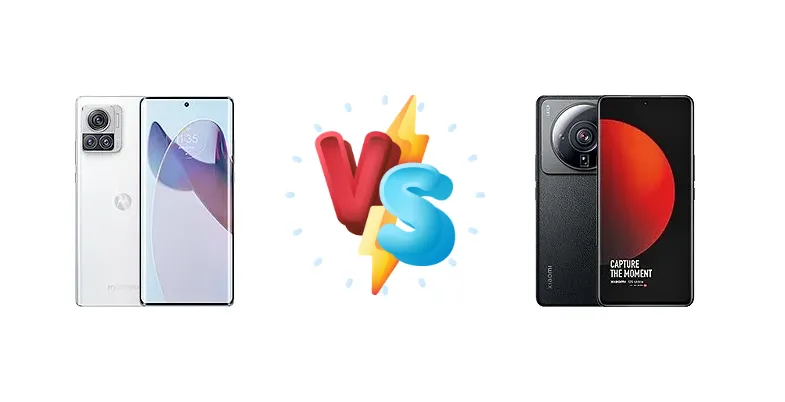
|
🏆 Quick Verdict
For users prioritizing blazing-fast charging and aren't overly concerned with nuanced display quality, the Motorola Moto X30 Pro is the clear winner. Its 125W charging dramatically reduces downtime. However, the Xiaomi 12S Ultra offers a more refined experience with its excellent display and comparable battery endurance.
| PHONES | ||
|---|---|---|
| Phone Names | Motorola Moto X30 Pro | Xiaomi 12S Ultra |
| Network | ||
|---|---|---|
| 2G bands | GSM 850 / 900 / 1800 / 1900 | GSM 850 / 900 / 1800 / 1900 |
| 3G bands | HSDPA 850 / 900 / 1700(AWS) / 1900 / 2100 | HSDPA 800 / 850 / 900 / 1700(AWS) / 1900 / 2100 |
| 4G bands | LTE | 1, 2, 3, 4, 5, 7, 8, 12, 17, 18, 19, 26, 34, 38, 39, 40, 41, 42 |
| 5G bands | SA/NSA/Sub6 | 1, 3, 5, 8, 28, 38, 40, 41, 77, 78, 79 SA/NSA |
| Speed | HSPA, LTE, 5G | HSPA, LTE, 5G |
| Technology | GSM / CDMA / HSPA / LTE / 5G | GSM / CDMA / HSPA / EVDO / LTE / 5G |
| CDMA 800 / 1900 | CDMA2000 1xEV-DO | |
| Launch | ||
|---|---|---|
| Announced | 2022, August 11 | 2022, July 04 |
| Status | Available. Released 2022, August 11 | Available. Released 2022, July 09 |
| Body | ||
|---|---|---|
| Build | Glass front, glass back (Gorilla Glass 5) | Glass front (Gorilla Glass Victus), eco leather back, aluminum frame |
| Dimensions | 161.7 x 73.5 x 8.4 mm (6.37 x 2.89 x 0.33 in) | 163.2 x 75 x 9.1 mm (6.43 x 2.95 x 0.36 in) |
| SIM | Nano-SIM + Nano-SIM | Nano-SIM + Nano-SIM |
| Weight | 198.5 g (7.02 oz) | 225 g (7.94 oz) |
| Splash and dust resistant | IP68 dust/water resistant (up to 1.5m for 30 min) | |
| Display | ||
|---|---|---|
| Protection | - | Corning Gorilla Glass Victus |
| Resolution | 1080 x 2400 pixels, 20:9 ratio (~393 ppi density) | 1440 x 3200 pixels, 20:9 ratio (~522 ppi density) |
| Size | 6.7 inches, 108.4 cm2 (~91.2% screen-to-body ratio) | 6.73 inches, 108.9 cm2 (~89.0% screen-to-body ratio) |
| Type | OLED, 1B colors, 144Hz, HDR10+, 1000 nits (HBM), 1250 nits (peak) | LTPO2 AMOLED, 1B colors, 120Hz, Dolby Vision, HDR10+, 1000 nits (HBM), 1500 nits (peak) |
| Platform | ||
|---|---|---|
| CPU | Octa-core (1x3.19 GHz Cortex-X2 & 3x2.75 GHz Cortex-A710 & 4x1.80 GHz Cortex-A510) | Octa-core (1x3.19 GHz Cortex-X2 & 3x2.75 GHz Cortex-A710 & 4x1.80 GHz Cortex-A510) |
| Chipset | Qualcomm SM8475 Snapdragon 8+ Gen 1 (4 nm) | Qualcomm SM8475 Snapdragon 8+ Gen 1 (4 nm) |
| GPU | Adreno 730 | Adreno 730 |
| OS | Android 12, MYUI 4.0 | Android 12, MIUI 13 |
| Memory | ||
|---|---|---|
| Card slot | No | No |
| Internal | 128GB 8GB RAM, 256GB 12GB RAM, 512GB 12GB RAM | 256GB 8GB RAM, 256GB 12GB RAM, 512GB 12GB RAM |
| UFS 3.1 | UFS 3.1 | |
| Main Camera | ||
|---|---|---|
| Features | Dual-LED flash, panorama, HDR | Laser AF, color spectrum sensor, Leica lenses, Dual-LED flash, HDR, panorama |
| Single | - | 32 MP, f/2.4, 25mm (wide), 0.7µm |
| Triple | 200 MP, f/2.0, (wide), 1/1.22", 0.64µm, PDAF, OIS 50 MP, f/2.2, 117˚ (ultrawide), 1/2.76", 0.64µm, AF 12 MP, f/1.6, (telephoto), 1/2.93", 1.22µm, PDAF, 2x optical zoom | 50 MP, f/1.9, 23mm (wide), 1.0"-type, 1.6µm, dual pixel PDAF, OIS 48 MP, f/4.1, 120mm (periscope telephoto), 1/2.0", 0.8µm, PDAF, OIS, 5x optical zoom 48 MP, f/2.2, 13mm, 128˚ (ultrawide), 1/2.0", 0.8µm, dual pixel PDAF TOF 3D, (depth) |
| Video | 8K@30fps, 4K@30fps, 1080p@30/60/120/240fps, gyro-EIS | 8K@24fps, 4K@30/60fps, 1080p@30/60/120/240fps, 720p@3840fps, gyro-EIS, Dolby Vision HDR 10-bit rec. (4K, 1080p) |
| Selfie camera | ||
|---|---|---|
| Features | HDR | HDR, panorama |
| Single | 60 MP, f/2.2, (wide), 0.64µm | 32 MP, f/2.4, 25mm (wide), 0.7µm |
| Video | 4K@30fps, 1080p@30fps | 1080p@30fps |
| Sound | ||
|---|---|---|
| 3.5mm jack | No | No |
| 35mm jack | No | No |
| Loudspeaker | Yes, with stereo speakers | Yes, with stereo speakers |
| - | 24-bit/192kHz audio Tuned by Harman Kardon | |
| Comms | ||
|---|---|---|
| Bluetooth | 5.2, A2DP, LE, aptX HD, aptX Adaptive | 5.2, A2DP, LE, aptX HD, aptX Adaptive |
| Infrared port | - | Yes |
| NFC | Yes | Yes |
| Positioning | GPS (L1+L5), GLONASS (L1), BDS (B1I+B1c+B2a), GALILEO (E1+E5a), QZSS (L1+L5) | GPS (L1+L5), GLONASS (L1), BDS (B1I+B1c+B2a), GALILEO (E1+E5a), QZSS (L1+L5), NavIC (L5) |
| Radio | No | No |
| USB | USB Type-C | USB Type-C 2.0, OTG |
| WLAN | Wi-Fi 802.11 a/b/g/n/ac/6e, dual-band, Wi-Fi Direct | Wi-Fi 802.11 a/b/g/n/ac/6e, dual-band, Wi-Fi Direct, DLNA |
| Features | ||
|---|---|---|
| Sensors | Fingerprint (under display, optical), accelerometer, gyro, proximity, compass | Fingerprint (under display, optical), accelerometer, gyro, compass, barometer |
| Ready For 3.5 support | Virtual proximity sensing | |
| Battery | ||
|---|---|---|
| Charging | 125W wired, 50% in 7 min, 100% in 19 min 50W wireless | 67W wired, PD3.0, QC4, 100% in 41 min 50W wireless, 100% in 52 min 10W reverse wireless |
| Type | Li-Po 4610 mAh | Li-Po 4860 mAh |
| Misc | ||
|---|---|---|
| Colors | White, Black | Black, Dark Green |
| Models | XT2241-1 | 2203121C |
| Price | About 550 EUR | $ 288.00 |
| Tests | ||
|---|---|---|
| Battery life | - | Endurance rating 93h |
| Camera | - | Photo / Video |
| Display | - | Contrast ratio: Infinite (nominal) |
| Loudspeaker | - | -25.6 LUFS (Very good) |
| Performance | - | AnTuTu: 1039412 (v9) GeekBench: 4300 (v5.1) GFXBench: 51fps (ES 3.1 onscreen) |
Motorola Moto X30 Pro
- Incredibly fast 125W wired charging
- Potentially competitive performance due to Snapdragon 8+ Gen 1
- 50W wireless charging support
- Missing display specifications hinder comparison
- Camera details are unknown, making it hard to assess quality
Xiaomi 12S Ultra
- Excellent 93-hour battery endurance
- Bright 1065 nit display with infinite contrast
- Reputation for high-quality camera performance
- Slower 67W wired charging compared to Moto X30 Pro
- Wireless charging takes over an hour for a full charge
Display Comparison
The Xiaomi 12S Ultra boasts a brighter display, reaching a measured peak of 1065 nits, which translates to superior visibility in direct sunlight. While the Moto X30 Pro’s display specs aren’t provided, Xiaomi’s panel offers an infinite (nominal) contrast ratio, suggesting deeper blacks and a more vibrant image. The lack of detailed display information for the Moto X30 Pro makes a direct comparison difficult, but Xiaomi’s focus on display quality is evident. Users who consume a lot of media or work outdoors will benefit from the 12S Ultra’s superior screen.
Camera Comparison
Both devices are listed as having 'Photo / Video' capabilities, but lack specific details. The Xiaomi 12S Ultra is known for its large 1-inch sensor, a significant advantage in low-light photography and dynamic range. The Moto X30 Pro’s camera specs are missing, making a direct sensor size comparison impossible. However, the 12S Ultra’s established reputation for camera excellence, particularly in challenging lighting conditions, gives it a clear edge. The absence of information regarding lens apertures and OIS on the Moto X30 Pro further solidifies the 12S Ultra’s potential photographic superiority.
Performance
Both the Motorola Moto X30 Pro and Xiaomi 12S Ultra are powered by the Qualcomm SM8475 Snapdragon 8+ Gen 1 (4 nm) chipset, featuring the same Octa-core CPU configuration (1x3.19 GHz Cortex-X2, 3x2.75 GHz Cortex-A710, and 4x1.80 GHz Cortex-A510). This means raw processing power will be nearly identical. However, thermal management – not explicitly detailed in the provided data – will be a key differentiator. The 4nm process node helps with efficiency, but sustained workloads could still lead to throttling. The absence of RAM specifications for the Moto X30 Pro prevents a full comparison, but assuming both utilize LPDDR5X, performance differences will be minimal.
Battery Life
The Xiaomi 12S Ultra achieves an impressive endurance rating of 93 hours, indicating excellent battery life. While the Moto X30 Pro’s battery capacity isn’t specified, its 125W wired charging is its standout feature, achieving a 50% charge in just 7 minutes and a full charge in 19 minutes. The 12S Ultra takes considerably longer at 41 minutes for a full wired charge. The 50W wireless charging is common to both, but the 12S Ultra takes 52 minutes to fully charge wirelessly, while the Moto X30 Pro’s wireless charging time is not provided. The Moto X30 Pro trades battery endurance for charging speed, catering to users who prioritize quick top-ups over all-day battery life.
Buying Guide
Buy the Motorola Moto X30 Pro if you need the absolute fastest charging speeds available and frequently find yourself needing to top up your battery quickly. This phone is ideal for power users and those constantly on the go. Buy the Xiaomi 12S Ultra if you prefer a phone with a brighter, more visually appealing display and value long-term battery endurance, even if it means slightly slower charging.