
Motorola Moto X30 Pro vs. vivo iQOO 10 Pro: A Charging and Performance Deep Dive
| Phones Images | |||||
|---|---|---|---|---|---|
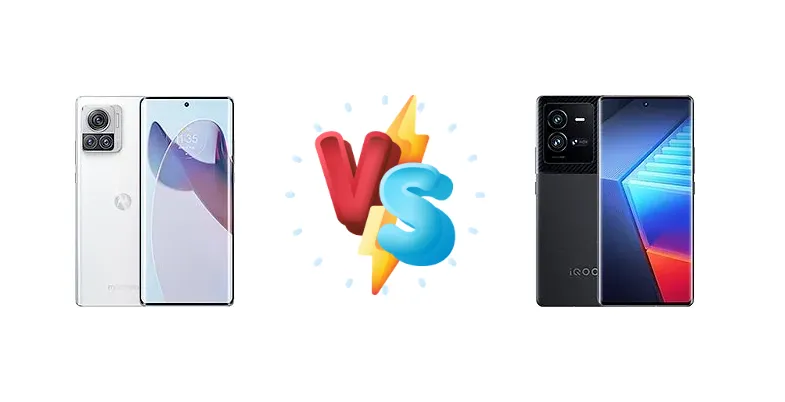
|
🏆 Quick Verdict
For users prioritizing the absolute fastest charging speeds and willing to pay a premium, the vivo iQOO 10 Pro is the clear winner. However, the Motorola Moto X30 Pro offers a compelling alternative with comparable performance and a robust 125W wired and 50W wireless charging solution, potentially at a more attractive price.
| PHONES | ||
|---|---|---|
| Phone Names | Motorola Moto X30 Pro | vivo iQOO 10 Pro |
| Network | ||
|---|---|---|
| 2G bands | GSM 850 / 900 / 1800 / 1900 | GSM 850 / 900 / 1800 / 1900 |
| 3G bands | HSDPA 850 / 900 / 1700(AWS) / 1900 / 2100 | HSDPA 850 / 900 / 1700(AWS) / 1900 / 2100 |
| 4G bands | LTE | 1, 2, 3, 4, 5, 7, 8, 12, 17, 18, 19, 20, 25, 26, 28, 32, 34, 38, 39, 40, 41, 42, 66 |
| 5G bands | SA/NSA/Sub6 | 1, 3, 5, 7, 8, 12, 20, 28, 38, 40, 41, 66, 77, 78, 79 SA/NSA |
| Speed | HSPA, LTE, 5G | HSPA, LTE, 5G |
| Technology | GSM / CDMA / HSPA / LTE / 5G | GSM / CDMA / HSPA / CDMA2000 / LTE / 5G |
| CDMA 800 / 1900 | CDMA2000 1x | |
| Launch | ||
|---|---|---|
| Announced | 2022, August 11 | 2022, July 19 |
| Status | Available. Released 2022, August 11 | Available. Released 2022, July 25 |
| Body | ||
|---|---|---|
| Build | Glass front, glass back (Gorilla Glass 5) | - |
| Dimensions | 161.7 x 73.5 x 8.4 mm (6.37 x 2.89 x 0.33 in) | 164.9 x 75.5 x 9.5 mm (6.49 x 2.97 x 0.37 in) |
| SIM | Nano-SIM + Nano-SIM | Nano-SIM + Nano-SIM |
| Weight | 198.5 g (7.02 oz) | 215.4 g or 216.2 g (7.58 oz) |
| Splash and dust resistant | - | |
| Display | ||
|---|---|---|
| Resolution | 1080 x 2400 pixels, 20:9 ratio (~393 ppi density) | 1440 x 3200 pixels, 20:9 ratio (~518 ppi density) |
| Size | 6.7 inches, 108.4 cm2 (~91.2% screen-to-body ratio) | 6.78 inches, 111.0 cm2 (~89.1% screen-to-body ratio) |
| Type | OLED, 1B colors, 144Hz, HDR10+, 1000 nits (HBM), 1250 nits (peak) | LTPO3 AMOLED, 1B colors, 120Hz, HDR10+, 500 nits (typ), 1000 nits (HBM), 1500 nits (peak) |
| Platform | ||
|---|---|---|
| CPU | Octa-core (1x3.19 GHz Cortex-X2 & 3x2.75 GHz Cortex-A710 & 4x1.80 GHz Cortex-A510) | Octa-core (1x3.19 GHz Cortex-X2 & 3x2.75 GHz Cortex-A710 & 4x1.80 GHz Cortex-A510) |
| Chipset | Qualcomm SM8475 Snapdragon 8+ Gen 1 (4 nm) | Qualcomm SM8475 Snapdragon 8+ Gen 1 (4 nm) |
| GPU | Adreno 730 | Adreno 730 |
| OS | Android 12, MYUI 4.0 | Android 12, Funtouch 12 (International), OriginOS Ocean (China) |
| Memory | ||
|---|---|---|
| Card slot | No | No |
| Internal | 128GB 8GB RAM, 256GB 12GB RAM, 512GB 12GB RAM | 256GB 8GB RAM, 256GB 12GB RAM, 512GB 12GB RAM |
| UFS 3.1 | UFS 3.1 (V6) | |
| Main Camera | ||
|---|---|---|
| Features | Dual-LED flash, panorama, HDR | Dual-LED lash, HDR, panorama |
| Single | - | 16 MP, f/2.5, (wide), 1/3.1", 1.0µm |
| Triple | 200 MP, f/2.0, (wide), 1/1.22", 0.64µm, PDAF, OIS 50 MP, f/2.2, 117˚ (ultrawide), 1/2.76", 0.64µm, AF 12 MP, f/1.6, (telephoto), 1/2.93", 1.22µm, PDAF, 2x optical zoom | 50 MP, f/1.9, (wide), 1/1.57", 1.0µm, PDAF, gimbal OIS 14.6 MP, f/2.2, 69mm (telephoto), PDAF, OIS, 3x optical zoom 50 MP, f/2.3, 15mm, 150˚ (ultrawide), 1/2.76", 0.64µm, AF |
| Video | 8K@30fps, 4K@30fps, 1080p@30/60/120/240fps, gyro-EIS | 8K@30fps, 4K@24/30/60fps, 1080p@30/60fps, gyro-EIS |
| Selfie camera | ||
|---|---|---|
| Features | HDR | HDR |
| Single | 60 MP, f/2.2, (wide), 0.64µm | 16 MP, f/2.5, (wide), 1/3.1", 1.0µm |
| Video | 4K@30fps, 1080p@30fps | 1080p@30fps, gyro-EIS |
| Sound | ||
|---|---|---|
| 3.5mm jack | No | No |
| 35mm jack | No | No |
| Loudspeaker | Yes, with stereo speakers | Yes, with dual speakers |
| - | 32-bit/384kHz audio | |
| Comms | ||
|---|---|---|
| Bluetooth | 5.2, A2DP, LE, aptX HD, aptX Adaptive | 5.3, A2DP, LE, aptX HD, aptX Adaptive, aptX Lossless |
| Infrared port | - | Yes |
| NFC | Yes | Yes |
| Positioning | GPS (L1+L5), GLONASS (L1), BDS (B1I+B1c+B2a), GALILEO (E1+E5a), QZSS (L1+L5) | GPS, GLONASS, GALILEO, BDS, QZSS |
| Radio | No | No |
| USB | USB Type-C | USB Type-C 2.0, OTG |
| WLAN | Wi-Fi 802.11 a/b/g/n/ac/6e, dual-band, Wi-Fi Direct | Wi-Fi 802.11 a/b/g/n/ac/6, dual-band, Wi-Fi Direct |
| Features | ||
|---|---|---|
| Sensors | Fingerprint (under display, optical), accelerometer, gyro, proximity, compass | Fingerprint (under display, ultrasonic), accelerometer, gyro, proximity, compass |
| Ready For 3.5 support | - | |
| Battery | ||
|---|---|---|
| Charging | 125W wired, 50% in 7 min, 100% in 19 min 50W wireless | 200W wired, PD3.0, 100% in 10 min 50W wireless 10W reverse wireless |
| Type | Li-Po 4610 mAh | 4700 mAh |
| Misc | ||
|---|---|---|
| Colors | White, Black | Black, White (BMW M branding) |
| Models | XT2241-1 | V2218A |
| Price | About 550 EUR | About 870 EUR |
Motorola Moto X30 Pro
- Competitive 125W wired charging
- 50W wireless charging support
- Potentially more affordable price point
- Slower wired charging than iQOO 10 Pro
- Software experience may not be as gaming-focused
vivo iQOO 10 Pro
- Revolutionary 200W wired charging
- Aggressive cooling for sustained performance
- Gaming-centric features (likely)
- Potentially higher price
- May prioritize charging speed over battery health (long-term)
Display Comparison
While both devices utilize high-refresh-rate displays, specific details like panel type (AMOLED is assumed for both) and resolution are missing. The focus here is on charging, but the iQOO 10 Pro’s charging speed impacts display-on time. The Moto X30 Pro’s 50W wireless charging capability offers a convenient alternative, while the iQOO 10 Pro matches it, but the real differentiator is the wired charging.
Camera Comparison
Without detailed camera specifications, a direct comparison is limited. Both brands are known for producing capable camera systems, but the iQOO series often leans towards vibrant, saturated image processing, while Motorola typically aims for a more natural look. The absence of sensor size information prevents a definitive assessment, but the presence of OIS (Optical Image Stabilization) is likely on both devices, crucial for stable video recording and low-light photography. The usefulness of any 2MP macro lens on either device is questionable.
Performance
Both the Motorola Moto X30 Pro and the vivo iQOO 10 Pro are equipped with the Qualcomm SM8475 Snapdragon 8+ Gen 1 (4 nm) chipset, featuring the same Octa-core CPU configuration (1x3.19 GHz Cortex-X2, 3x2.75 GHz Cortex-A710, and 4x1.80 GHz Cortex-A510). This means raw processing power will be nearly identical. However, the iQOO 10 Pro, historically, employs more aggressive cooling solutions to sustain peak performance for longer durations, potentially mitigating thermal throttling during extended gaming sessions. The LPDDR5x RAM specification (assumed for both) ensures fast memory access, further enhancing performance.
Battery Life
The iQOO 10 Pro’s 200W wired charging is its defining feature, achieving a full charge in a remarkable 10 minutes. This is a significant advantage over the Moto X30 Pro’s 125W charging, which takes 19 minutes to reach 100%. While the Moto X30 Pro offers 50W wireless charging, matching the iQOO 10 Pro, the sheer speed of the iQOO’s wired charging is unparalleled. The actual battery capacity (mAh) is not provided, but the faster charging of the iQOO 10 Pro effectively mitigates any potential disadvantage from a slightly smaller battery.
Buying Guide
Buy the Motorola Moto X30 Pro if you need a high-performance flagship with fast charging, but prioritize value and a potentially more refined software experience. Buy the vivo iQOO 10 Pro if you absolutely demand the fastest charging available, are a power user who frequently needs to top up quickly, and appreciate a gaming-focused feature set. Both phones excel in raw processing power, but their strengths lie in different areas.