
Motorola Moto X30 Pro vs. Edge X30: A Detailed Comparison
| Phones Images | |||||
|---|---|---|---|---|---|
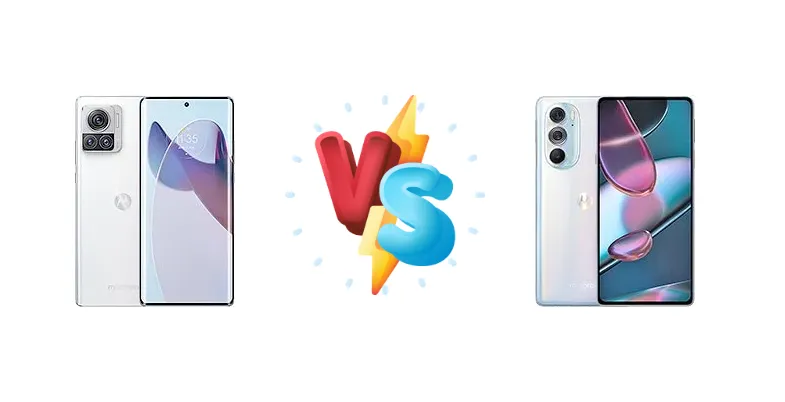
|
🏆 Quick Verdict
The Moto X30 Pro takes the crown with its significantly faster charging, superior chipset (Snapdragon 8+ Gen 1), and potentially improved camera capabilities. However, the Edge X30 remains a strong contender, offering a compelling package at a potentially lower price point.
| PHONES | ||
|---|---|---|
| Phone Names | Motorola Moto X30 Pro | Motorola Edge X30 |
| Network | ||
|---|---|---|
| 2G bands | GSM 850 / 900 / 1800 / 1900 | GSM 850 / 900 / 1800 / 1900 |
| 3G bands | HSDPA 850 / 900 / 1700(AWS) / 1900 / 2100 | HSDPA 850 / 900 / 1800 / 1900 / 2100 |
| 4G bands | LTE | 1, 2, 3, 4, 5, 7, 8, 12, 17, 34, 38, 39, 40, 41 |
| 5G bands | SA/NSA/Sub6 | 1, 3, 5, 7, 8, 20, 28, 38, 41, 78 SA/NSA/Sub6 |
| Speed | HSPA, LTE, 5G | HSPA, LTE, 5G |
| Technology | GSM / CDMA / HSPA / LTE / 5G | GSM / HSPA / LTE / 5G |
| CDMA 800 / 1900 | - | |
| Launch | ||
|---|---|---|
| Announced | 2022, August 11 | 2021, December 09 |
| Status | Available. Released 2022, August 11 | Available. Released 2021, December 15 |
| Body | ||
|---|---|---|
| Build | Glass front, glass back (Gorilla Glass 5) | Glass front, glass back (Gorilla Glass 5) |
| Dimensions | 161.7 x 73.5 x 8.4 mm (6.37 x 2.89 x 0.33 in) | 163.6 x 75.6 x 8.5 mm (6.44 x 2.98 x 0.33 in) |
| SIM | Nano-SIM + Nano-SIM | Nano-SIM + Nano-SIM |
| Weight | 198.5 g (7.02 oz) | 194 g (6.84 oz) |
| Splash and dust resistant | Water-repellent design | |
| Display | ||
|---|---|---|
| Resolution | 1080 x 2400 pixels, 20:9 ratio (~393 ppi density) | 1080 x 2400 pixels, 20:9 ratio (~393 ppi density) |
| Size | 6.7 inches, 108.4 cm2 (~91.2% screen-to-body ratio) | 6.7 inches, 108.4 cm2 (~87.6% screen-to-body ratio) |
| Type | OLED, 1B colors, 144Hz, HDR10+, 1000 nits (HBM), 1250 nits (peak) | OLED, 1B colors, 144Hz, HDR10+, 500 nits (typ), 700 nits (HBM) |
| Platform | ||
|---|---|---|
| CPU | Octa-core (1x3.19 GHz Cortex-X2 & 3x2.75 GHz Cortex-A710 & 4x1.80 GHz Cortex-A510) | Octa-core (1x3.00 GHz Cortex-X2 & 3x2.50 GHz Cortex-A710 & 4x1.80 GHz Cortex-A510) |
| Chipset | Qualcomm SM8475 Snapdragon 8+ Gen 1 (4 nm) | Qualcomm SM8450 Snapdragon 8 Gen 1 (4 nm) |
| GPU | Adreno 730 | Adreno 730 |
| OS | Android 12, MYUI 4.0 | Android 12, MYUI 3.0 |
| Memory | ||
|---|---|---|
| Card slot | No | No |
| Internal | 128GB 8GB RAM, 256GB 12GB RAM, 512GB 12GB RAM | 128GB 8GB RAM, 256GB 8GB RAM, 256GB 12GB RAM |
| UFS 3.1 | UFS 3.1 | |
| Main Camera | ||
|---|---|---|
| Features | Dual-LED flash, panorama, HDR | Dual-LED flash, panorama, HDR |
| Triple | 200 MP, f/2.0, (wide), 1/1.22", 0.64µm, PDAF, OIS 50 MP, f/2.2, 117˚ (ultrawide), 1/2.76", 0.64µm, AF 12 MP, f/1.6, (telephoto), 1/2.93", 1.22µm, PDAF, 2x optical zoom | 50 MP, f/1.9, (wide), 1/1.55", 1.0µm, dual pixel PDAF, OIS 50 MP, f/2.2, 114˚ (ultrawide), 1/2.76", 0.64µm Auxiliary lens |
| Video | 8K@30fps, 4K@30fps, 1080p@30/60/120/240fps, gyro-EIS | 4K@30fps, 1080p@30/60/120/240fps, 720p@960fps, 10-bit HDR10+, gyro-EIS |
| Selfie camera | ||
|---|---|---|
| Features | HDR | HDR |
| Single | 60 MP, f/2.2, (wide), 0.64µm | 60 MP, f/2.2, (wide), 1/2.8", 0.61µm or 60 MP, f/2.2, (wide), 1/2.8", 0.61µm, under display |
| Video | 4K@30fps, 1080p@30fps | 4K@30fps, 1080p@30/120fps |
| Sound | ||
|---|---|---|
| 3.5mm jack | No | No |
| 35mm jack | No | No |
| Loudspeaker | Yes, with stereo speakers | Yes, with stereo speakers |
| Comms | ||
|---|---|---|
| Bluetooth | 5.2, A2DP, LE, aptX HD, aptX Adaptive | 5.2, A2DP, LE, aptX HD, aptX Adaptive |
| NFC | Yes | Yes |
| Positioning | GPS (L1+L5), GLONASS (L1), BDS (B1I+B1c+B2a), GALILEO (E1+E5a), QZSS (L1+L5) | GPS (L1+L5), GLONASS, BDS, GALILEO |
| Radio | No | No |
| USB | USB Type-C | USB Type-C |
| WLAN | Wi-Fi 802.11 a/b/g/n/ac/6e, dual-band, Wi-Fi Direct | Wi-Fi 802.11 a/b/g/n/ac/6e, dual-band, Wi-Fi Direct |
| Features | ||
|---|---|---|
| Sensors | Fingerprint (under display, optical), accelerometer, gyro, proximity, compass | Fingerprint (side-mounted), accelerometer, gyro, proximity, compass |
| Ready For 3.5 support | Ready For support | |
| Battery | ||
|---|---|---|
| Charging | 125W wired, 50% in 7 min, 100% in 19 min 50W wireless | 68W wired, 100% in 35 min |
| Type | Li-Po 4610 mAh | Market-dependent versions:· Li-Po 5000 mAh (regular version)· Li-Po 4800 mAh (under screen camera version) |
| Misc | ||
|---|---|---|
| Colors | White, Black | White, Black |
| Models | XT2241-1 | XT2201-2, XT2201-6 |
| Price | About 550 EUR | About 420 EUR |
Motorola Moto X30 Pro
- Significantly faster charging (125W wired, 50W wireless)
- More powerful Snapdragon 8+ Gen 1 chipset
- Potentially better camera performance
- Premium build quality
- Likely higher price
- May be slightly larger/heavier
Motorola Edge X30
- Excellent performance with Snapdragon 8 Gen 1
- Smooth 144Hz OLED display
- Competitive price
- Sleek design
- Slower charging (68W wired)
- Less powerful chipset compared to X30 Pro
- Potentially slightly inferior camera
Display Comparison
Both phones feature a 6.7-inch OLED display with a 144Hz refresh rate, offering vibrant colors and smooth scrolling. The X30 Pro might have slightly better peak brightness, but the difference is likely minimal in everyday use. Resolution is likely FHD+ on both.
Camera Comparison
The X30 Pro boasts a 60MP main camera, likely with improved image processing and low-light performance compared to the Edge X30's 50MP main camera. Both phones likely feature ultrawide and macro lenses, but the X30 Pro's image quality is expected to be superior. The X30 Pro also likely has a better front-facing camera.
Performance
The X30 Pro's Snapdragon 8+ Gen 1 chipset is a noticeable upgrade over the Edge X30's Snapdragon 8 Gen 1. Expect smoother multitasking, faster app loading times, and better performance in demanding games. The X30 Pro's chip is more efficient, potentially leading to slightly better battery life despite the faster charging.
Battery Life
The X30 Pro's 125W wired charging is a game-changer, allowing for incredibly fast top-ups. The 50W wireless charging is also a significant advantage. The Edge X30's 68W wired charging is still respectable, but considerably slower. Battery capacity is likely similar (around 4600-5000 mAh) on both devices.
Buying Guide
The Moto X30 Pro is ideal for power users who demand the absolute best performance, lightning-fast charging, and a top-tier camera experience. The Edge X30 is a great choice for those seeking a high-end Android phone with excellent performance and a smooth display, without breaking the bank.