
Motorola Moto X30 Pro vs Edge 30 Fusion: A Detailed Comparison
| Phones Images | |||||
|---|---|---|---|---|---|
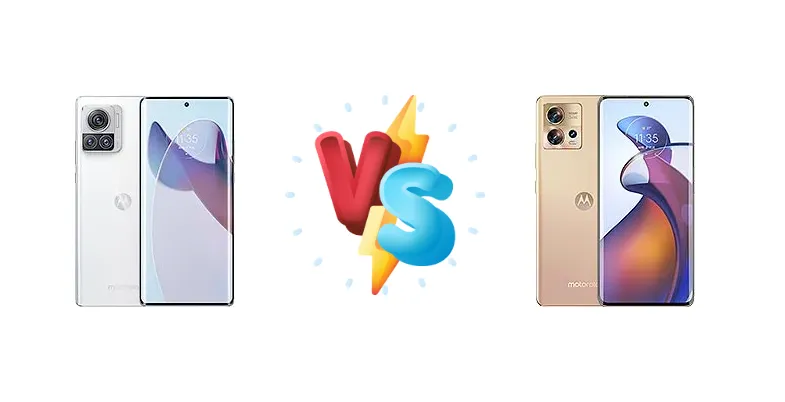
|
🏆 Quick Verdict
The Moto X30 Pro takes the performance crown with its Snapdragon 8+ Gen 1, offering significantly faster speeds. However, the Edge 30 Fusion shines with its exceptional battery life and bright display. If raw power is your priority, the X30 Pro wins; for longevity and visual appeal, the Fusion is the better choice.
| PHONES | ||
|---|---|---|
| Phone Names | Motorola Moto X30 Pro | Motorola Edge 30 Fusion |
| Network | ||
|---|---|---|
| 2G bands | GSM 850 / 900 / 1800 / 1900 | GSM 850 / 900 / 1800 / 1900 |
| 3G bands | HSDPA 850 / 900 / 1700(AWS) / 1900 / 2100 | HSDPA 850 / 900 / 1700(AWS) / 1900 / 2100 - International |
| 4G bands | LTE | 1, 2, 3, 4, 5, 7, 8, 12, 13, 17, 18, 19, 20, 25, 26, 28, 32, 38, 39, 40, 41, 42, 43, 66 - International |
| 5G bands | SA/NSA/Sub6 | 1, 3, 5, 7, 8, 20, 28, 38, 40, 41, 66, 77, 78 SA/NSA - International |
| Speed | HSPA, LTE, 5G | HSPA, LTE, 5G |
| Technology | GSM / CDMA / HSPA / LTE / 5G | GSM / CDMA / HSPA / CDMA2000 / LTE / 5G |
| CDMA 800 / 1900 | 1, 2, 3, 5, 7, 8, 20, 28, 38, 41, 77, 78 SA/NSA - PRC | |
| Launch | ||
|---|---|---|
| Announced | 2022, August 11 | 2022, September 08 |
| Status | Available. Released 2022, August 11 | Available. Released 2022, September 08 |
| Body | ||
|---|---|---|
| Build | Glass front, glass back (Gorilla Glass 5) | Glass front (Gorilla Glass 5), glass back (Gorilla Glass 5), aluminum frame |
| Dimensions | 161.7 x 73.5 x 8.4 mm (6.37 x 2.89 x 0.33 in) | 158.5 x 72 x 7.5 mm or 7.7 mm |
| SIM | Nano-SIM + Nano-SIM | · Nano-SIM· Nano-SIM + Nano-SIM |
| Weight | 198.5 g (7.02 oz) | 168 g / 175 g (5.93 oz) |
| Splash and dust resistant | Splash and dust resistant | |
| Display | ||
|---|---|---|
| Protection | - | Corning Gorilla Glass 5 |
| Resolution | 1080 x 2400 pixels, 20:9 ratio (~393 ppi density) | 1080 x 2400 pixels, 20:9 ratio (~402 ppi density) |
| Size | 6.7 inches, 108.4 cm2 (~91.2% screen-to-body ratio) | 6.55 inches, 103.6 cm2 (~90.8% screen-to-body ratio) |
| Type | OLED, 1B colors, 144Hz, HDR10+, 1000 nits (HBM), 1250 nits (peak) | P-OLED, 1B colors, 144Hz, HDR10+, 1100 nits (peak) |
| Platform | ||
|---|---|---|
| CPU | Octa-core (1x3.19 GHz Cortex-X2 & 3x2.75 GHz Cortex-A710 & 4x1.80 GHz Cortex-A510) | Octa-core (1x2.99 GHz Cortex-X1 & 3x2.42 GHz Cortex-A78 & 4x1.80 GHz Cortex-A55) |
| Chipset | Qualcomm SM8475 Snapdragon 8+ Gen 1 (4 nm) | Qualcomm SM8350 Snapdragon 888+ 5G (5 nm) |
| GPU | Adreno 730 | Adreno 660 |
| OS | Android 12, MYUI 4.0 | Android 12, upgradable to Android 14 |
| Memory | ||
|---|---|---|
| Card slot | No | No |
| Internal | 128GB 8GB RAM, 256GB 12GB RAM, 512GB 12GB RAM | 128GB 8GB RAM, 256GB 6GB RAM, 256GB 8GB RAM, 256GB 12GB RAM, 512GB 12GB RAM |
| UFS 3.1 | UFS 3.1 | |
| Main Camera | ||
|---|---|---|
| Features | Dual-LED flash, panorama, HDR | LED flash, panorama, HDR |
| Triple | 200 MP, f/2.0, (wide), 1/1.22", 0.64µm, PDAF, OIS 50 MP, f/2.2, 117˚ (ultrawide), 1/2.76", 0.64µm, AF 12 MP, f/1.6, (telephoto), 1/2.93", 1.22µm, PDAF, 2x optical zoom | 50 MP, f/1.8, (wide), 1/1.55", 1.0µm, multi-directional PDAF, OIS 13 MP, f/2.2, 120˚ (ultrawide), 1.12µm, AF Auxiliary lens |
| Video | 8K@30fps, 4K@30fps, 1080p@30/60/120/240fps, gyro-EIS | 8K@30fps, 4K@30fps, 1080p@30/60/120fps, 720p@960fps, gyro-EIS |
| Selfie camera | ||
|---|---|---|
| Features | HDR | HDR |
| Single | 60 MP, f/2.2, (wide), 0.64µm | 32 MP, f/2.5, (wide), 1/2.8", 0.8µm, AF |
| Video | 4K@30fps, 1080p@30fps | 4K@30fps, 1080p@30fps |
| Sound | ||
|---|---|---|
| 3.5mm jack | No | No |
| 35mm jack | No | No |
| Loudspeaker | Yes, with stereo speakers | Yes, with stereo speakers |
| Comms | ||
|---|---|---|
| Bluetooth | 5.2, A2DP, LE, aptX HD, aptX Adaptive | 5.2, A2DP, LE, aptX HD, aptX Adaptive |
| NFC | Yes | Yes |
| Positioning | GPS (L1+L5), GLONASS (L1), BDS (B1I+B1c+B2a), GALILEO (E1+E5a), QZSS (L1+L5) | GPS (L1+L5), GLONASS, BDS (B1I+B1c), GALILEO |
| Radio | No | No |
| USB | USB Type-C | USB Type-C 3.1, OTG |
| WLAN | Wi-Fi 802.11 a/b/g/n/ac/6e, dual-band, Wi-Fi Direct | Wi-Fi 802.11 a/b/g/n/ac/6e, tri-band, Wi-Fi Direct |
| Features | ||
|---|---|---|
| Sensors | Fingerprint (under display, optical), accelerometer, gyro, proximity, compass | Fingerprint (under display, optical), accelerometer, gyro, proximity, compass |
| Ready For 3.5 support | Ready For 3.5 support | |
| Battery | ||
|---|---|---|
| Charging | 125W wired, 50% in 7 min, 100% in 19 min 50W wireless | 68W wired, 50% in 10 min |
| Type | Li-Po 4610 mAh | Li-Po 4400 mAh |
| Misc | ||
|---|---|---|
| Colors | White, Black | Neptune Blue, Cosmic Grey, Solar Gold, Aurora White, Viva Magenta |
| Models | XT2241-1 | XT2243-1 |
| Price | About 550 EUR | About 150 EUR |
| Tests | ||
|---|---|---|
| Battery life | - | Endurance rating 101h |
| Camera | - | Photo / Video |
| Display | - | Contrast ratio: Infinite (nominal) |
| Loudspeaker | - | -24.6 LUFS (Very good) |
| Performance | - | AnTuTu: 827929 (v9) GeekBench: 3458 (v5.1) GFXBench: 62fps (ES 3.1 onscreen) |
Motorola Moto X30 Pro
- Blazing-fast Snapdragon 8+ Gen 1
- Incredibly fast 125W charging
- Versatile camera system
- Premium build quality
- Battery life not as impressive as Fusion
- Potentially higher price
Motorola Edge 30 Fusion
- Exceptional battery life (101h endurance rating)
- Bright and vibrant display
- Sleek and lightweight design
- Competitive price
- Less powerful processor than X30 Pro
- Camera may not be as detailed in all conditions
Display Comparison
The Edge 30 Fusion's 946 nits peak brightness and infinite contrast ratio provide a visually stunning experience, especially for outdoor use. The X30 Pro's display is also excellent, but doesn't quite reach the Fusion's brightness levels. Both offer smooth 144Hz refresh rates.
Camera Comparison
Both phones offer capable camera systems, but the X30 Pro generally produces more detailed images, especially in challenging lighting conditions. The Edge 30 Fusion's camera is still very good, offering pleasing colors and reliable performance. The X30 Pro often has a more versatile camera setup with a higher resolution main sensor and potentially more advanced features.
Performance
Here, the X30 Pro dominates. The Snapdragon 8+ Gen 1 is a significant upgrade over the Edge 30 Fusion's Snapdragon 888+. Expect noticeably faster app loading, smoother multitasking, and superior gaming performance on the X30 Pro.
Battery Life
The Edge 30 Fusion's endurance rating of 101h is truly impressive, suggesting exceptional battery life. The X30 Pro's 125W charging is incredibly fast, but its overall battery life is likely to be less than the Fusion's.
Buying Guide
The Motorola Moto X30 Pro is ideal for gamers, power users, and those who demand the latest and greatest performance. The Motorola Edge 30 Fusion is perfect for users who prioritize long battery life, a stunning display for media consumption, and a more budget-friendly price point.