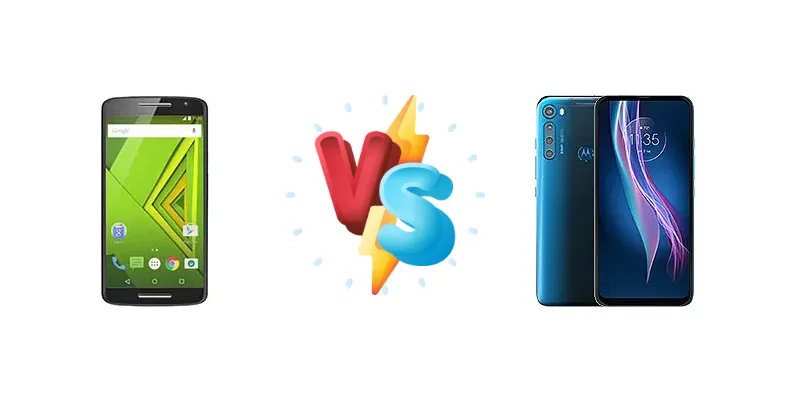
Motorola has a history of delivering solid mid-range phones. The Moto X Play, released in 2015, was a contender, while the One Fusion+ arrived later aiming to elevate the experience. But which one holds up better today? Let's dive into a comprehensive comparison.
🏆 Quick Verdict
The Motorola One Fusion+ is the clear winner. Its significantly improved battery life, brighter display, and more modern chipset provide a noticeably better user experience than the aging Moto X Play. While the X Play had its strengths, the Fusion+ offers a more compelling package.
| Network |
|---|
| 2G bands | GSM 850 / 900 / 1800 / 1900 | GSM 850 / 900 / 1800 / 1900 |
| 3G bands | HSDPA 850 / 900 / 1800 / 1900 / 2100 - XT1562 | HSDPA 800 / 850 / 900 / 1900 / 2100 International |
| 4G bands | 1, 3, 5, 7, 8, 19, 20, 28, 38, 41 - XT1562 | 1, 2, 3, 5, 7, 8, 19, 20, 38, 40, 41 - Europe, India |
| Speed | HSPA, LTE | HSPA 42.2/5.76 Mbps, LTE Cat4 150/50 Mbps |
| Technology | GSM / HSPA / LTE | GSM / HSPA / LTE |
| | 1, 3, 5, 7, 8, 19, 20, 28, 38, 40, 41 - India | 1, 2, 3, 5, 7, 8, 19, 20, 28, 38, 40, 41 - APEM |
| Launch |
|---|
| Announced | 2015, July. Released 2015, August | 2020, June 08. Released 2020, June 08 |
| Status | Discontinued | Discontinued |
| Body |
|---|
| Build | - | Glass front, plastic back, plastic frame |
| Dimensions | 148 x 75 x 10.9 mm (5.83 x 2.95 x 0.43 in) | 162.9 x 76.4 x 9.6 mm (6.41 x 3.01 x 0.38 in) |
| SIM | Nano-SIM | · Nano-SIM· Nano-SIM + Nano-SIM |
| Weight | 169 g (5.96 oz) | 210 g (7.41 oz) |
| | Splash and dust resistant | Water-repellent coating |
| Display |
|---|
| Protection | Corning Gorilla Glass 3 | - |
| Resolution | 1080 x 1920 pixels, 16:9 ratio (~403 ppi density) | 1080 x 2340 pixels, 19.5:9 ratio (~396 ppi density) |
| Size | 5.5 inches, 82.6 cm2 (~74.4% screen-to-body ratio) | 6.5 inches, 103.7 cm2 (~83.3% screen-to-body ratio) |
| Type | IPS LCD | IPS LCD, HDR10 |
| Platform |
|---|
| CPU | Octa-core (4x1.7 GHz Cortex-A53 & 4x1.0 GHz Cortex-A53) | Octa-core (2x2.2 GHz Kryo 470 Gold & 6x1.8 GHz Kryo 470 Silver) |
| Chipset | Qualcomm MSM8939 Snapdragon 615 (28 nm) | Qualcomm SDM730 Snapdragon 730 (8 nm) - EuropeQualcomm SDM730 Snapdragon 730G (8 nm) - India |
| GPU | Adreno 405 | Adreno 618 |
| OS | Android 5.1.1 (Lollipop), upgradable to 7.1.1 (Nougat) | Android 10 |
| Memory |
|---|
| Card slot | microSDXC (dedicated slot) | microSDXC (uses shared SIM slot) |
| Internal | 16GB 2GB RAM, 32GB 2GB RAM | 128GB 4GB RAM, 128GB 6GB RAM |
| | eMMC 4.5 | UFS 2.1 |
| Main Camera |
|---|
| Features | Dual-LED dual-tone flash, panorama | LED flash, panorama, HDR |
| Quad | - | 64 MP, f/1.8, (wide), 1/1.72", 0.8µm, PDAF
8 MP, f/2.2, 118˚ (ultrawide), 1/4.0", 1.12µm
5 MP (macro)
Auxiliary lens |
| Single | 21 MP, f/2.0, 1/2.4", 1.1µm, PDAF | - |
| Video | 1080p@30fps | 4K@30fps, 1080p@30/60fps |
| Selfie camera |
|---|
| Single | 5 MP, f/2.2 | Motorized pop-up 16 MP, f/2.0, (wide), 1/3.06", 1.0µm |
| Video | - | 1080p@30fps |
| Sound |
|---|
| 3.5mm jack | Yes | Yes |
| 35mm jack | Yes | Yes |
| Loudspeaker | Yes | Yes |
| Comms |
|---|
| Bluetooth | 4.0, A2DP, LE, aptX | 5.0, A2DP, LE |
| NFC | Yes | No |
| Positioning | GPS | GPS, GLONASS, GALILEO, BDS |
| Radio | FM radio | FM radio (market/region dependent) |
| USB | microUSB 2.0 | USB Type-C 2.0, OTG |
| WLAN | Wi-Fi 802.11 a/b/g/n, dual-band, hotspot | Wi-Fi 802.11 a/b/g/n/ac, dual-band, Wi-Fi Direct |
| Features |
|---|
| Sensors | Accelerometer, proximity | Fingerprint (rear-mounted), accelerometer, gyro, proximity |
| Battery |
|---|
| Charging | 15W wired | 15W wired |
| Type | Li-Ion 3630 mAh, non-removable | Li-Po 5000 mAh |
| Misc |
|---|
| Colors | Black, White | Moonlight White, Twilight Blue |
| Models | XT1562, XT1563, XT1564 | PAKF0002IN |
| Price | About 240 EUR | About 300 EUR |
| SAR | 0.56 W/kg (head) 0.80 W/kg (body) | 0.52 W/kg (head) 1.43 W/kg (body) |
| SAR EU | 0.49 W/kg (head) 0.68 W/kg (body) | - |
| Tests |
|---|
| Audio quality |
Noise -93.8dB / Crosstalk -95.2dB | - |
| Battery life |
Endurance rating 83h
|
Endurance rating 136h
|
| Camera |
Photo / Video |
Photo / Video |
| Display |
Contrast ratio: 1520:1 (nominal), 3.222 (sunlight) |
Contrast ratio: 1423:1 (nominal) |
| Loudspeaker |
Voice 69dB / Noise 66dB / Ring 75dB
|
-27.9 LUFS (Good)
|
| Performance |
Basemark OS II 2.0: 809Basemark X: 5032 |
AnTuTu: 267980 (v8)
GeekBench: 1705 (v5.1)
GFXBench: 14fps (ES 3.1 onscreen) |
Motorola Moto X Play
- Excellent battery life (for its time)
- Decent display contrast
- Relatively affordable (if found used)
- Outdated chipset
- Lower brightness display
- Slower performance
- Aging camera
Motorola One Fusion+
- Exceptional battery life
- Brighter and more modern display
- Faster performance thanks to Snapdragon 730/730G
- Improved camera capabilities
- Charging speed could be faster
- Design is somewhat generic
Display Comparison
The Motorola One Fusion+ boasts a brighter display with a measured peak brightness of 562 nits, significantly outperforming the Moto X Play. While both offer a respectable contrast ratio (1520:1 for the X Play, 1423:1 for the Fusion+), the Fusion+'s brightness makes it much more usable outdoors. The X Play's display, while adequate, feels dated in comparison.
Camera Comparison
While both phones offer 'Photo / Video' capabilities (specific details are lacking in the provided specs), the One Fusion+’s newer chipset and likely improved image processing algorithms should result in better image quality, especially in low light. The X Play's camera was decent for its time, but it struggles to compete with modern smartphone cameras.
Performance
The Snapdragon 730/730G in the One Fusion+ is a substantial upgrade over the Snapdragon 615 in the Moto X Play. The Fusion+ offers noticeably faster app loading times, smoother multitasking, and better overall responsiveness. The X Play can feel sluggish at times, especially with demanding apps.
Battery Life
This is where the One Fusion+ truly shines. With an endurance rating of 136 hours, it significantly surpasses the Moto X Play's 83 hours. The Fusion+ offers significantly longer battery life, easily lasting a full day or more on a single charge.
Buying Guide
Who should buy the Motorola Moto X Play? Primarily those seeking a very budget-friendly option and are willing to compromise on performance and features. Who should buy the Motorola One Fusion+? Anyone looking for a reliable mid-range phone with excellent battery life, a decent camera, and a smoother overall experience.
Frequently Asked Questions
❓ Is the Moto X Play still worth buying?
Only if you're on an extremely tight budget and understand its limitations. Otherwise, the One Fusion+ offers a much better experience for a similar price (if found used).
❓ What's the biggest difference between these two phones?
The biggest difference is performance and battery life. The One Fusion+ has a significantly faster processor and a much larger battery, resulting in a smoother and longer-lasting experience.