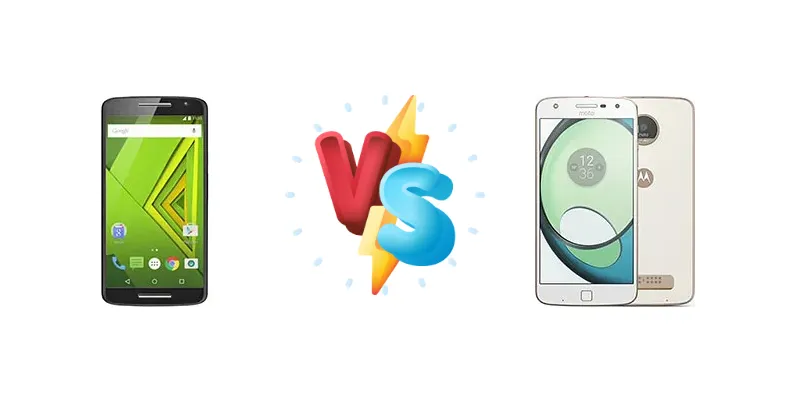
Motorola has a history of delivering solid mid-range phones, and the Moto X Play and Moto Z Play are prime examples. Both offer impressive features at competitive prices, but which one truly comes out on top? This comprehensive comparison will break down every aspect, helping you decide which phone is right for you.
🏆 Quick Verdict
The Moto Z Play edges out the Moto X Play thanks to its superior Snapdragon 625 chipset, slightly better display, and longer battery life. While the X Play boasts a respectable endurance rating, the Z Play's overall improvements make it the more compelling choice for most users.
| Network |
|---|
| 2G bands | GSM 850 / 900 / 1800 / 1900 | GSM 850 / 900 / 1800 / 1900 - SIM 1 & SIM 2 (dual-SIM model only) |
| 3G bands | HSDPA 850 / 900 / 1800 / 1900 / 2100 - XT1562 | HSDPA 850 / 900 / 1700(AWS) / 1900 / 2100 |
| 4G bands | 1, 3, 5, 7, 8, 19, 20, 28, 38, 41 - XT1562 | 1, 2, 3, 4, 5, 7, 8, 12, 17, 19, 20, 28, 38, 40 - USA |
| Speed | HSPA, LTE | HSPA, LTE |
| Technology | GSM / HSPA / LTE | GSM / CDMA / HSPA / LTE |
| | 1, 3, 5, 7, 8, 19, 20, 28, 38, 40, 41 - India | 1, 2, 3, 4, 5, 7, 8, 12, 17, 19, 20, 28 - Europe |
| Launch |
|---|
| Announced | 2015, July. Released 2015, August | 2016, August. Released 2016, September |
| Status | Discontinued | Discontinued |
| Body |
|---|
| Build | - | Glass front (Gorilla Glass 3), glass back, aluminum frame |
| Dimensions | 148 x 75 x 10.9 mm (5.83 x 2.95 x 0.43 in) | 156.4 x 76.4 x 7 mm (6.16 x 3.01 x 0.28 in) |
| SIM | Nano-SIM | · Nano-SIM· Nano-SIM + Nano-SIM |
| Weight | 169 g (5.96 oz) | 165 g (5.82 oz) |
| | Splash and dust resistant | Splash and dust resistant |
| Display |
|---|
| Protection | Corning Gorilla Glass 3 | Corning Gorilla Glass 3 |
| Resolution | 1080 x 1920 pixels, 16:9 ratio (~403 ppi density) | 1080 x 1920 pixels, 16:9 ratio (~403 ppi density) |
| Size | 5.5 inches, 82.6 cm2 (~74.4% screen-to-body ratio) | 5.5 inches, 82.6 cm2 (~69.1% screen-to-body ratio) |
| Type | IPS LCD | Super AMOLED |
| Platform |
|---|
| CPU | Octa-core (4x1.7 GHz Cortex-A53 & 4x1.0 GHz Cortex-A53) | Octa-core 2.0 GHz Cortex-A53 |
| Chipset | Qualcomm MSM8939 Snapdragon 615 (28 nm) | Qualcomm MSM8953 Snapdragon 625 (14 nm) |
| GPU | Adreno 405 | Adreno 506 |
| OS | Android 5.1.1 (Lollipop), upgradable to 7.1.1 (Nougat) | Android 6.0.1 (Marshmallow), upgradable to Android 8.0 (Oreo) |
| Memory |
|---|
| Card slot | microSDXC (dedicated slot) | microSDXC (dedicated slot) |
| Internal | 16GB 2GB RAM, 32GB 2GB RAM | 32GB 3GB RAM |
| | eMMC 4.5 | eMMC 5.1 |
| Main Camera |
|---|
| Features | Dual-LED dual-tone flash, panorama | Laser AF, Dual-LED dual-tone flash, panorama |
| Single | 21 MP, f/2.0, 1/2.4", 1.1µm, PDAF | 16 MP, f/2.0, 1.3µm, PDAF |
| Video | 1080p@30fps | 4K@30fps, 1080p@30fps, 720p@120fps |
| Selfie camera |
|---|
| Features | - | LED flash |
| Single | 5 MP, f/2.2 | 5 MP, f/2.2, 1/4.0", 1.4µm |
| Video | - | 1080p@30fps |
| Sound |
|---|
| 3.5mm jack | Yes | Yes |
| 35mm jack | Yes | Yes |
| Loudspeaker | Yes | Yes |
| Comms |
|---|
| Bluetooth | 4.0, A2DP, LE, aptX | 4.0, A2DP, LE, aptX |
| NFC | Yes | Yes |
| Positioning | GPS | GPS, GLONASS |
| Radio | FM radio | No |
| USB | microUSB 2.0 | USB Type-C, magnetic connector |
| WLAN | Wi-Fi 802.11 a/b/g/n, dual-band, hotspot | Wi-Fi 802.11 a/b/g/n, Wi-Fi Direct |
| Features |
|---|
| Sensors | Accelerometer, proximity | Fingerprint (front-mounted), accelerometer, gyro, proximity, compass |
| | - | Moto Mods snap-on accessories |
| Battery |
|---|
| Charging | 15W wired | 15W wired |
| Type | Li-Ion 3630 mAh, non-removable | Li-Ion 3510 mAh, non-removable |
| Misc |
|---|
| Colors | Black, White | Black/Silver/Black Slate, White/Fine Gold/Sugar White |
| Models | XT1562, XT1563, XT1564 | XT1635-02, XT1635-01, XT1635-03 |
| Price | About 240 EUR | About 220 EUR |
| SAR | 0.56 W/kg (head) 0.80 W/kg (body) | 1.45 W/kg (head) 1.15 W/kg (body) |
| SAR EU | 0.49 W/kg (head) 0.68 W/kg (body) | 0.40 W/kg (head) 1.40 W/kg (body) |
| Tests |
|---|
| Audio quality |
Noise -93.8dB / Crosstalk -95.2dB |
Noise-93.0dB / Crosstalk -93.8dB |
| Battery life |
Endurance rating 83h
|
Endurance rating 100h
|
| Camera |
Photo / Video |
Photo / Video |
| Display |
Contrast ratio: 1520:1 (nominal), 3.222 (sunlight) |
Contrast ratio: Infinite (nominal), 3.526 (sunlight) |
| Loudspeaker |
Voice 69dB / Noise 66dB / Ring 75dB
| - |
| Performance |
Basemark OS II 2.0: 809Basemark X: 5032 |
GFXBench: 3.7fps (ES 3.1 onscreen) |
Motorola Moto X Play
- Excellent battery life
- Large display
- Affordable price
- Older chipset
- Potentially slower performance
- Camera details unclear
Motorola Moto Z Play
- Improved performance (Snapdragon 625)
- Slightly better display
- Longer battery life
- Moto Mods compatibility
- Potentially higher price
- Camera details unclear
Display Comparison
Both phones feature vibrant displays, but the Moto Z Play's 'Infinite' contrast ratio (likely a marketing term, but suggests improved blacks) and slightly higher sunlight readability (3.526 vs 3.222) give it a slight edge. The X Play's 1520:1 contrast is still very good, however.
Camera Comparison
While both phones offer 'Photo / Video' capabilities, detailed camera specs are missing. Generally, the Z Play's newer chipset and potentially improved image processing algorithms likely result in slightly better image quality, especially in low light. However, without specific sensor details, a definitive judgment is difficult.
Performance
The Moto Z Play's Snapdragon 625 (14nm) is significantly more efficient than the Moto X Play's Snapdragon 615 (28nm). This translates to smoother performance, better multitasking, and improved power efficiency. The Z Play's 2.0 GHz CPU also offers a performance boost over the X Play's slightly slower CPU configuration.
Battery Life
The Moto Z Play takes a clear victory in battery life, boasting an endurance rating of 100 hours compared to the Moto X Play's 83 hours. This difference is noticeable in real-world usage, providing longer screen-on time and fewer charging cycles.
Buying Guide
The Moto X Play is a good option for budget-conscious users who prioritize long battery life and a large display. The Moto Z Play is ideal for those seeking a more modern processor, slightly improved display visibility, and the modular Moto Mods ecosystem.
Frequently Asked Questions
❓ Is the Moto Z Play worth the extra cost over the Moto X Play?
Generally, yes. The Z Play's improved performance and battery life justify the price difference, especially if you value a smoother user experience and longer usage times.
❓ Can I use Moto Mods with the Moto X Play?
No, the Moto Mods ecosystem is exclusive to the Moto Z series of phones.