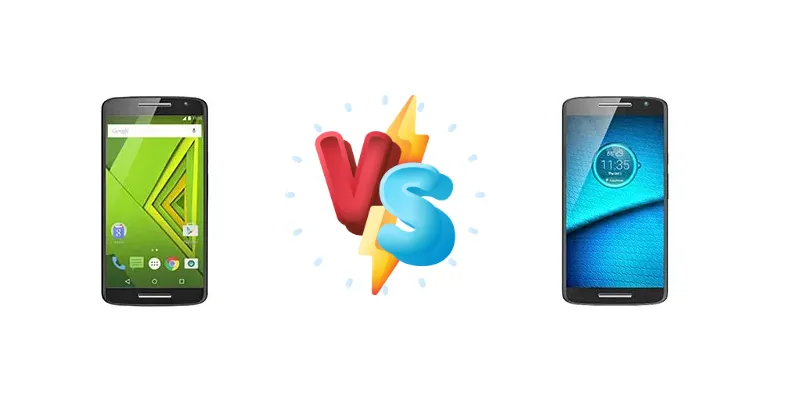
Motorola's legacy of reliable smartphones continues with the Moto X Play and Droid Maxx 2. Both offered compelling features at their time, but cater to slightly different needs. This comparison dives deep into their strengths and weaknesses to help you decide which one was the better choice.
🏆 Quick Verdict
The Moto X Play takes the crown thanks to its significantly better battery life and superior sunlight display performance. While both share the same chipset, the X Play's endurance and screen visibility make it the more practical and enjoyable daily driver, despite the Maxx 2's slightly more robust build.
| Network |
|---|
| 2G bands | GSM 850 / 900 / 1800 / 1900 | GSM 850 / 900 / 1800 / 1900 |
| 3G bands | HSDPA 850 / 900 / 1800 / 1900 / 2100 - XT1562 | HSDPA 850 / 900 / 1900 / 2100 |
| 4G bands | 1, 3, 5, 7, 8, 19, 20, 28, 38, 41 - XT1562 | 2, 3, 4, 5, 7, 13, 20 |
| EDGE | - | No |
| GPRS | - | No |
| Speed | HSPA, LTE | HSPA, LTE Cat4 150/50 Mbps, EV-DO Rev.A 3.1 Mbps |
| Technology | GSM / HSPA / LTE | GSM / CDMA / HSPA / EVDO / LTE |
| | 1, 3, 5, 7, 8, 19, 20, 28, 38, 40, 41 - India | CDMA2000 1xEV-DO |
| Launch |
|---|
| Announced | 2015, July. Released 2015, August | 2015, October. Released 2015, October |
| Status | Discontinued | Discontinued |
| Body |
|---|
| Dimensions | 148 x 75 x 10.9 mm (5.83 x 2.95 x 0.43 in) | 148 x 75 x 10.9 mm (5.83 x 2.95 x 0.43 in) |
| SIM | Nano-SIM | Nano-SIM |
| Weight | 169 g (5.96 oz) | 169 g (5.96 oz) |
| | Splash and dust resistant | Splash and dust resistant |
| Display |
|---|
| Protection | Corning Gorilla Glass 3 | Corning Gorilla Glass 3 |
| Resolution | 1080 x 1920 pixels, 16:9 ratio (~403 ppi density) | 1080 x 1920 pixels, 16:9 ratio (~403 ppi density) |
| Size | 5.5 inches, 82.6 cm2 (~74.4% screen-to-body ratio) | 5.5 inches, 82.6 cm2 (~74.4% screen-to-body ratio) |
| Type | IPS LCD | IPS LCD |
| Platform |
|---|
| CPU | Octa-core (4x1.7 GHz Cortex-A53 & 4x1.0 GHz Cortex-A53) | Octa-core (4x1.7 GHz Cortex-A53 & 4x1.0 GHz Cortex-A53) |
| Chipset | Qualcomm MSM8939 Snapdragon 615 (28 nm) | Qualcomm MSM8939 Snapdragon 615 (28 nm) |
| GPU | Adreno 405 | Adreno 405 |
| OS | Android 5.1.1 (Lollipop), upgradable to 7.1.1 (Nougat) | Android 5.1.1 (Lollipop), upgradable to 7.0 (Nougat) |
| Memory |
|---|
| Card slot | microSDXC (dedicated slot) | microSDXC (dedicated slot) |
| Internal | 16GB 2GB RAM, 32GB 2GB RAM | 16GB 2GB RAM |
| | eMMC 4.5 | eMMC 4.5 |
| Main Camera |
|---|
| Features | Dual-LED dual-tone flash, panorama | Dual-LED dual-tone flash, panorama |
| Single | 21 MP, f/2.0, 1/2.4", 1.1µm, PDAF | 21 MP, f/2.0, PDAF |
| Video | 1080p@30fps | 1080p@30fps |
| Selfie camera |
|---|
| Single | 5 MP, f/2.2 | 5 MP, f/2.0 |
| Sound |
|---|
| 3.5mm jack | Yes | Yes |
| 35mm jack | Yes | Yes |
| Loudspeaker | Yes | Yes |
| Comms |
|---|
| Bluetooth | 4.0, A2DP, LE, aptX | 4.0, A2DP, LE, aptX |
| NFC | Yes | Yes |
| Positioning | GPS | GPS |
| Radio | FM radio | FM radio |
| USB | microUSB 2.0 | microUSB 2.0 |
| WLAN | Wi-Fi 802.11 a/b/g/n, dual-band, hotspot | Wi-Fi 802.11 a/b/g/n, dual-band, hotspot |
| Features |
|---|
| Sensors | Accelerometer, proximity | Yes |
| Battery |
|---|
| Charging | 15W wired | 15W wired |
| Stand-by | - | Up to 576 h (3G) |
| Talk time | - | Up to 48 h (3G) |
| Type | Li-Ion 3630 mAh, non-removable | Li-Ion 3630 mAh, non-removable |
| Misc |
|---|
| Colors | Black, White | Deep Sea Blue, White |
| Models | XT1562, XT1563, XT1564 | XT1565B, XT1565 |
| Price | About 240 EUR | About 300 EUR |
| SAR | 0.56 W/kg (head) 0.80 W/kg (body) | 1.14 W/kg (head) 1.38 W/kg (body) |
| SAR EU | 0.49 W/kg (head) 0.68 W/kg (body) | - |
| Tests |
|---|
| Audio quality |
Noise -93.8dB / Crosstalk -95.2dB |
Noise -82.7dB / Crosstalk -82.9dB |
| Battery life |
Endurance rating 83h
| Endurance rating 56h |
| Camera |
Photo / Video | - |
| Display |
Contrast ratio: 1520:1 (nominal), 3.222 (sunlight) |
Contrast ratio: 1256:1 (nominal) / 911:1 (docking station) |
| Loudspeaker |
Voice 69dB / Noise 66dB / Ring 75dB
|
Voice 57dB / Noise 66dB / Ring 77dB |
| Performance |
Basemark OS II 2.0: 809Basemark X: 5032 | - |
Motorola Moto X Play
- Exceptional battery life (83h)
- Excellent sunlight display visibility
- Slightly better software optimization
- Good value for money at launch
- Camera performance is average
- Design is somewhat generic
- Plastic build may feel less premium
Motorola Droid Maxx 2
- Slightly more rugged build (potentially)
- Decent performance for everyday tasks
- Good call quality (Droid branding often implies this)
- Significantly shorter battery life (56h)
- Weaker display, especially in sunlight
- Lower contrast ratio
Display Comparison
The Moto X Play boasts a significantly better display, particularly in direct sunlight. Its contrast ratio of 1520:1 (nominal) and impressive 3.222 rating under sunlight conditions far surpass the Droid Maxx 2's 1256:1 (nominal) and 911:1 (docking station). While both use similar LCD panels, the X Play's calibration and brightness are noticeably superior.
Camera Comparison
Camera performance is a mixed bag. While both offer decent photo and video capabilities for their time, neither excels. The Moto X Play's camera likely benefits from slightly better software processing. Detailed camera specs are missing, so a direct comparison is difficult, but expect similar results in most scenarios.
Performance
Both devices share the same Qualcomm Snapdragon 615 chipset and octa-core CPU. Performance will be largely comparable for everyday tasks like browsing, social media, and light gaming. However, the Moto X Play's slightly more efficient software optimization might provide a marginal edge in sustained performance.
Battery Life
This is where the Moto X Play truly shines. Its endurance rating of 83 hours dwarfs the Droid Maxx 2's 56 hours. This difference translates to significantly longer usage between charges, making the X Play a clear winner for battery-conscious users.
Buying Guide
The Motorola Moto X Play is ideal for users prioritizing long battery life and excellent outdoor visibility. The Droid Maxx 2 might appeal to those seeking a slightly more rugged device, though it compromises on battery performance. Consider your usage patterns and environment when making your decision.
Frequently Asked Questions
❓ Which phone is better for gaming?
Both phones offer similar gaming performance due to the same chipset. However, the Moto X Play's better battery life will allow for longer gaming sessions.
❓ Is the Droid Maxx 2 more durable than the Moto X Play?
The Droid Maxx 2 likely has a slightly more robust build, but both phones primarily use plastic construction. Neither is exceptionally rugged.