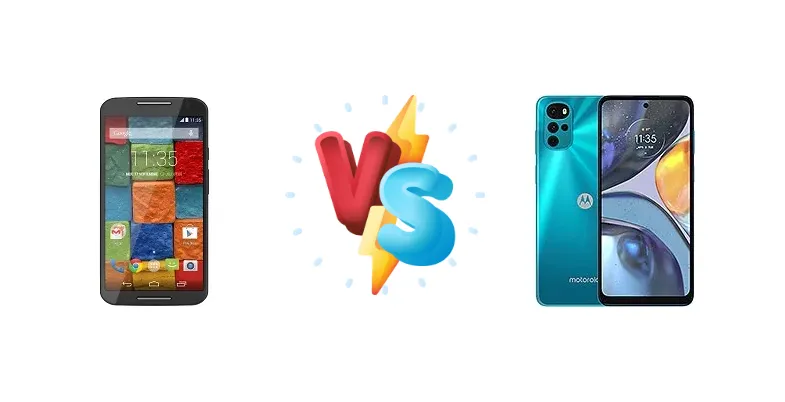
The Motorola Moto X (2nd Gen) was a flagship contender in its time, known for its design and performance. Now, the Moto G22 offers a more budget-friendly option. But which phone is the better choice in today's market? Let's dive into a detailed comparison.
🏆 Quick Verdict
The Moto X (2nd Gen) boasts a significantly more powerful processor and a potentially better camera, but its age is a factor. The Moto G22 offers modern features, a newer chipset, and a more competitive price point. For most users, the G22 provides better value.
| Network |
|---|
| 2G bands | GSM 850 / 900 / 1800 / 1900 - all versions | GSM 850 / 900 / 1800 / 1900 |
| 3G bands | HSDPA 850 / 900 / 1900 / 2100 - EU, AT&T, Verizon | HSDPA 850 / 900 / 1900 / 2100 |
| 4G bands | 2, 3, 4, 5, 7, 17 - XT1097 AT&T, XT1095 T-Mobile | 1, 3, 5, 7, 8, 20, 38, 40, 41 |
| Speed | HSPA 42.2/5.76 Mbps, LTE Cat4 150/50 Mbps | HSPA 42.2/5.76 Mbps, LTE Cat4 150/50 Mbps |
| Technology | GSM / CDMA / HSPA / LTE | GSM / HSPA / LTE |
| | 1, 3, 7, 20 - India | - |
| Launch |
|---|
| Announced | 2014, September. Released 2014, September | 2022, March 04 |
| Status | Discontinued | Available. Released 2022, March 04 |
| Body |
|---|
| Build | - | Glass front, plastic frame, plastic back |
| Dimensions | 140.8 x 72.4 x 10 mm (5.54 x 2.85 x 0.39 in) | 164 x 75 x 8.5 mm (6.46 x 2.95 x 0.33 in) |
| SIM | Nano-SIM | · Nano-SIM· Nano-SIM + Nano-SIM |
| Weight | 144 g (5.08 oz) | 185 g (6.53 oz) |
| | Water resistant | Water-repellent design |
| Display |
|---|
| Protection | Corning Gorilla Glass 3 | - |
| Resolution | 1080 x 1920 pixels, 16:9 ratio (~424 ppi density) | 720 x 1600 pixels, 20:9 ratio (~268 ppi density) |
| Size | 5.2 inches, 74.5 cm2 (~73.1% screen-to-body ratio) | 6.5 inches, 103.5 cm2 (~84.2% screen-to-body ratio) |
| Type | AMOLED | IPS LCD, 90Hz |
| Platform |
|---|
| CPU | Quad-core 2.5 GHz Krait 400 | Octa-core (4x2.3 GHz Cortex-A53 & 4x1.8 GHz Cortex-A53) |
| Chipset | Qualcomm MSM8974AC Snapdragon 801 (28 nm) | Mediatek MT6765V/CB Helio G37 (12 nm) |
| GPU | Adreno 330 | PowerVR GE8320 |
| OS | Android 4.4.4 (KitKat), upgradable to 6.0 (Marshmallow) | Android 12 |
| Memory |
|---|
| Card slot | No | microSDXC (dedicated slot) |
| Internal | 16GB 2GB RAM, 32GB 2GB RAM, 64GB 2GB RAM (AT&T, T-Mobile) | 64GB 4GB RAM, 128GB 4GB RAM |
| | eMMC 5.0 | - |
| Main Camera |
|---|
| Features | Dual-LED flash, panorama, HDR | LED flash, HDR, panorama |
| Quad | - | 50 MP, f/1.8, (wide), 0.64µm, PDAF
8 MP, f/2.2, 118˚ (ultrawide), 1/4.0", 1.12µm
2 MP (macro)
Auxiliary lens |
| Single | 13 MP, f/2.2, 29mm (standard), 1/3.1", 1.13µm, AF | - |
| Video | 4K@30fps, 1080p@30fps, HDR | 1080p@30fps |
| Selfie camera |
|---|
| Features | - | HDR |
| Single | 2 MP, f/2.2 | 16 MP, f/2.5, (wide), 1.0µm |
| Video | 1080p@30fps | 1080p@30fps |
| Sound |
|---|
| 3.5mm jack | Yes | Yes |
| 35mm jack | Yes | Yes |
| Loudspeaker | Yes | Yes |
| Comms |
|---|
| Bluetooth | 4.0, A2DP, EDR, LE, aptX | 5.0, A2DP, LE |
| NFC | Yes | Yes (market/region dependent) |
| Positioning | GPS, GLONASS | GPS, GLONASS, GALILEO |
| Radio | No | Unspecified |
| USB | microUSB 2.0, OTG | USB Type-C 2.0 |
| WLAN | Wi-Fi 802.11 a/b/g/n/ac, dual-band, DLNA, hotspot | Wi-Fi 802.11 a/b/g/n/ac, dual-band, Wi-Fi Direct |
| Features |
|---|
| Sensors | Accelerometer, gyro, proximity, compass, barometer, temperature | Fingerprint (side-mounted), accelerometer, gyro, proximity, compass |
| Battery |
|---|
| Charging | 15W wired, QC2 | 20W wired (India)
15W wired (Global) |
| Type | Li-Ion 2300 mAh, non-removable | Li-Po 5000 mAh |
| Misc |
|---|
| Colors | Black, White | Pearl White, Iceberg Blue, Cosmic Black, Mint Green |
| Models | XT1097, XT1096, XT1095, XT1092, XT1085, XT1093 | XT2231-1, XT2231-2, XT2231-5 |
| Price | About 320 EUR | About 120 EUR |
| SAR | 1.46 W/kg (head) 1.27 W/kg (body) | - |
| SAR EU | 0.49 W/kg (head) 0.69 W/kg (body) | - |
| Tests |
|---|
| Audio quality |
Noise -93.5dB / Crosstalk -93.8dB | - |
| Battery life |
Endurance rating 48h
| - |
| Camera |
Photo / Video | - |
| Loudspeaker |
Voice 66dB / Noise 66dB / Ring 72dB
| - |
| Performance |
Basemark OS II 2.0: 1176Basemark X: 11855 | - |
Motorola Moto X (2nd Gen)
- Powerful Snapdragon 801 processor
- AMOLED display
- Sleek design (for its time)
- Good camera (for its time)
- Outdated software support
- Older battery technology
- Difficult to find new
- Potential for battery degradation
Motorola Moto G22
- Modern design
- Affordable price
- Decent camera with 50MP sensor
- Longer software support (potentially)
- Less powerful processor
- IPS LCD display (not as vibrant as AMOLED)
- Charging speed could be faster
Display Comparison
The Moto X (2nd Gen) featured a 5.2-inch AMOLED display with a 1080p resolution, offering vibrant colors and deep blacks. The Moto G22 has a 6.5-inch IPS LCD display with a 1080p resolution. While the G22's screen is larger, the Moto X's AMOLED technology provides a superior viewing experience in terms of color accuracy and contrast.
Camera Comparison
The Moto X (2nd Gen) had a 13MP camera with advanced features like Quick Focus. While details are scarce on its exact capabilities now, it was generally considered a good camera for its time. The Moto G22 features a 50MP main camera, promising higher resolution images. Image quality will depend on software processing, but the G22 likely has an edge in low-light conditions due to newer sensor technology.
Performance
Here's where the Moto X (2nd Gen) shines. Its Snapdragon 801 chipset and 2.5 GHz Krait 400 CPU were flagship-level at the time, offering significantly faster performance than the Moto G22's Helio G37. The G22's octa-core processor is adequate for everyday tasks, but struggles with demanding games or multitasking.
Battery Life
Both phones claim impressive battery life. The Moto X (2nd Gen) was rated for 48 hours of endurance. The Moto G22, while not explicitly stated, typically offers all-day battery life with moderate usage. The G22's more efficient 12nm chipset may give it a slight advantage in real-world usage.
Buying Guide
Who should buy the Motorola Moto X (2nd Gen)? Enthusiasts seeking a vintage flagship experience or those who can find it at a very low price. Who should buy the Motorola Moto G22? Budget-conscious buyers looking for a reliable smartphone with decent performance and a modern design.
Frequently Asked Questions
❓ Is the Moto X (2nd Gen) still worth buying?
Only if you can find it at a very low price and are willing to accept its age and limited software support. Otherwise, the Moto G22 offers a better overall experience.
❓ Which phone has better software support?
The Moto G22 is likely to receive longer software updates and security patches compared to the Moto X (2nd Gen).