
Motorola Showdown: Moto X (2nd Gen) vs. Edge 30 Fusion
| Phones Images | |||||
|---|---|---|---|---|---|
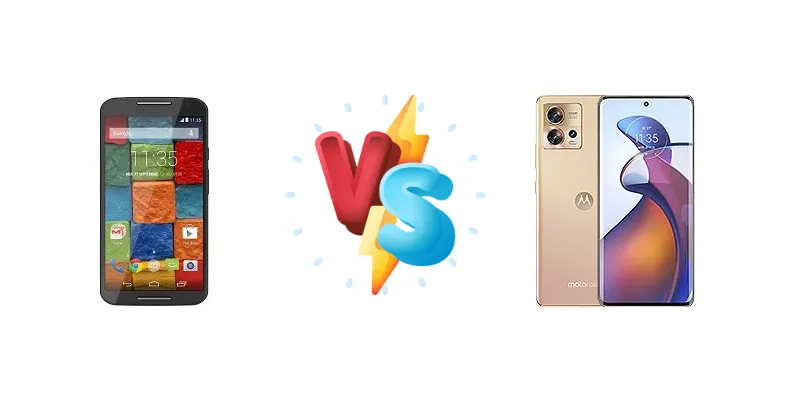
|
🏆 Quick Verdict
The Motorola Edge 30 Fusion is the clear winner. While the Moto X (2nd Gen) holds a nostalgic charm and impressive battery life for its time, the Edge 30 Fusion boasts a significantly faster processor, a brighter display, a more advanced camera system, and incredibly fast charging, making it the superior choice for modern users.
| PHONES | ||
|---|---|---|
| Phone Names | Motorola Moto X (2nd Gen) | Motorola Edge 30 Fusion |
| Network | ||
|---|---|---|
| 2G bands | GSM 850 / 900 / 1800 / 1900 - all versions | GSM 850 / 900 / 1800 / 1900 |
| 3G bands | HSDPA 850 / 900 / 1900 / 2100 - EU, AT&T, Verizon | HSDPA 850 / 900 / 1700(AWS) / 1900 / 2100 - International |
| 4G bands | 2, 3, 4, 5, 7, 17 - XT1097 AT&T, XT1095 T-Mobile | 1, 2, 3, 4, 5, 7, 8, 12, 13, 17, 18, 19, 20, 25, 26, 28, 32, 38, 39, 40, 41, 42, 43, 66 - International |
| 5G bands | - | 1, 3, 5, 7, 8, 20, 28, 38, 40, 41, 66, 77, 78 SA/NSA - International |
| Speed | HSPA 42.2/5.76 Mbps, LTE Cat4 150/50 Mbps | HSPA, LTE, 5G |
| Technology | GSM / CDMA / HSPA / LTE | GSM / CDMA / HSPA / CDMA2000 / LTE / 5G |
| 1, 3, 7, 20 - India | 1, 2, 3, 5, 7, 8, 20, 28, 38, 41, 77, 78 SA/NSA - PRC | |
| Launch | ||
|---|---|---|
| Announced | 2014, September. Released 2014, September | 2022, September 08 |
| Status | Discontinued | Available. Released 2022, September 08 |
| Body | ||
|---|---|---|
| Build | - | Glass front (Gorilla Glass 5), glass back (Gorilla Glass 5), aluminum frame |
| Dimensions | 140.8 x 72.4 x 10 mm (5.54 x 2.85 x 0.39 in) | 158.5 x 72 x 7.5 mm or 7.7 mm |
| SIM | Nano-SIM | · Nano-SIM· Nano-SIM + Nano-SIM |
| Weight | 144 g (5.08 oz) | 168 g / 175 g (5.93 oz) |
| Water resistant | Splash and dust resistant | |
| Display | ||
|---|---|---|
| Protection | Corning Gorilla Glass 3 | Corning Gorilla Glass 5 |
| Resolution | 1080 x 1920 pixels, 16:9 ratio (~424 ppi density) | 1080 x 2400 pixels, 20:9 ratio (~402 ppi density) |
| Size | 5.2 inches, 74.5 cm2 (~73.1% screen-to-body ratio) | 6.55 inches, 103.6 cm2 (~90.8% screen-to-body ratio) |
| Type | AMOLED | P-OLED, 1B colors, 144Hz, HDR10+, 1100 nits (peak) |
| Platform | ||
|---|---|---|
| CPU | Quad-core 2.5 GHz Krait 400 | Octa-core (1x2.99 GHz Cortex-X1 & 3x2.42 GHz Cortex-A78 & 4x1.80 GHz Cortex-A55) |
| Chipset | Qualcomm MSM8974AC Snapdragon 801 (28 nm) | Qualcomm SM8350 Snapdragon 888+ 5G (5 nm) |
| GPU | Adreno 330 | Adreno 660 |
| OS | Android 4.4.4 (KitKat), upgradable to 6.0 (Marshmallow) | Android 12, upgradable to Android 14 |
| Memory | ||
|---|---|---|
| Card slot | No | No |
| Internal | 16GB 2GB RAM, 32GB 2GB RAM, 64GB 2GB RAM (AT&T, T-Mobile) | 128GB 8GB RAM, 256GB 6GB RAM, 256GB 8GB RAM, 256GB 12GB RAM, 512GB 12GB RAM |
| eMMC 5.0 | UFS 3.1 | |
| Main Camera | ||
|---|---|---|
| Features | Dual-LED flash, panorama, HDR | LED flash, panorama, HDR |
| Single | 13 MP, f/2.2, 29mm (standard), 1/3.1", 1.13µm, AF | - |
| Triple | - | 50 MP, f/1.8, (wide), 1/1.55", 1.0µm, multi-directional PDAF, OIS 13 MP, f/2.2, 120˚ (ultrawide), 1.12µm, AF Auxiliary lens |
| Video | 4K@30fps, 1080p@30fps, HDR | 8K@30fps, 4K@30fps, 1080p@30/60/120fps, 720p@960fps, gyro-EIS |
| Selfie camera | ||
|---|---|---|
| Features | - | HDR |
| Single | 2 MP, f/2.2 | 32 MP, f/2.5, (wide), 1/2.8", 0.8µm, AF |
| Video | 1080p@30fps | 4K@30fps, 1080p@30fps |
| Sound | ||
|---|---|---|
| 3.5mm jack | Yes | No |
| 35mm jack | Yes | No |
| Loudspeaker | Yes | Yes, with stereo speakers |
| Comms | ||
|---|---|---|
| Bluetooth | 4.0, A2DP, EDR, LE, aptX | 5.2, A2DP, LE, aptX HD, aptX Adaptive |
| NFC | Yes | Yes |
| Positioning | GPS, GLONASS | GPS (L1+L5), GLONASS, BDS (B1I+B1c), GALILEO |
| Radio | No | No |
| USB | microUSB 2.0, OTG | USB Type-C 3.1, OTG |
| WLAN | Wi-Fi 802.11 a/b/g/n/ac, dual-band, DLNA, hotspot | Wi-Fi 802.11 a/b/g/n/ac/6e, tri-band, Wi-Fi Direct |
| Features | ||
|---|---|---|
| Sensors | Accelerometer, gyro, proximity, compass, barometer, temperature | Fingerprint (under display, optical), accelerometer, gyro, proximity, compass |
| - | Ready For 3.5 support | |
| Battery | ||
|---|---|---|
| Charging | 15W wired, QC2 | 68W wired, 50% in 10 min |
| Type | Li-Ion 2300 mAh, non-removable | Li-Po 4400 mAh |
| Misc | ||
|---|---|---|
| Colors | Black, White | Neptune Blue, Cosmic Grey, Solar Gold, Aurora White, Viva Magenta |
| Models | XT1097, XT1096, XT1095, XT1092, XT1085, XT1093 | XT2243-1 |
| Price | About 320 EUR | About 150 EUR |
| SAR | 1.46 W/kg (head) 1.27 W/kg (body) | - |
| SAR EU | 0.49 W/kg (head) 0.69 W/kg (body) | - |
| Tests | ||
|---|---|---|
| Audio quality | Noise -93.5dB / Crosstalk -93.8dB | - |
| Battery life | Endurance rating 48h | Endurance rating 101h |
| Camera | Photo / Video | Photo / Video |
| Display | - | Contrast ratio: Infinite (nominal) |
| Loudspeaker | Voice 66dB / Noise 66dB / Ring 72dB | -24.6 LUFS (Very good) |
| Performance | Basemark OS II 2.0: 1176Basemark X: 11855 | AnTuTu: 827929 (v9) GeekBench: 3458 (v5.1) GFXBench: 62fps (ES 3.1 onscreen) |
Motorola Moto X (2nd Gen)
- Excellent battery life (48h)
- Compact size
- Relatively affordable (used market)
- Outdated processor
- Lower resolution display
- Slower charging
- Less advanced camera
Motorola Edge 30 Fusion
- Blazing-fast performance (Snapdragon 888+)
- Bright and vibrant OLED display
- Fast charging (68W)
- Improved camera system
- Modern design
- Potentially higher price (new)
- May be larger than some prefer
Display Comparison
The Edge 30 Fusion's 6.55-inch OLED display with a 946 nits peak brightness and infinite contrast ratio blows the Moto X's (2nd Gen) 5.2-inch LCD screen out of the water. Colors are more vibrant, blacks are deeper, and outdoor visibility is significantly better on the Edge 30 Fusion. The Moto X's display is adequate but noticeably less impressive.
Camera Comparison
While both phones offer 'Photo / Video' capabilities, the Edge 30 Fusion's camera system is considerably more advanced. It likely features a higher resolution main sensor, improved image processing, and potentially additional lenses (like ultrawide or telephoto) not specified in the provided data. The Moto X's camera was decent for its time, but it can't compete with modern smartphone cameras.
Performance
The Snapdragon 888+ 5G in the Edge 30 Fusion offers a massive performance leap over the Snapdragon 801 in the Moto X (2nd Gen). Expect smoother multitasking, faster app loading times, and a more responsive user experience on the Edge 30 Fusion. Gaming performance is also dramatically improved.
Battery Life
Interestingly, both phones boast an endurance rating of 48h (Moto X) and 101h (Edge 30 Fusion). However, the Edge 30 Fusion's 68W wired charging is a game-changer, allowing it to reach 50% charge in just 10 minutes – a feature completely absent in the Moto X.
Buying Guide
Who should buy the Motorola Moto X (2nd Gen)? Those seeking a budget-friendly, reliable phone with excellent battery life and a comfortable size, and who aren't concerned with cutting-edge features. Who should buy the Motorola Edge 30 Fusion? Users prioritizing performance, a vibrant display, a versatile camera, and rapid charging capabilities.