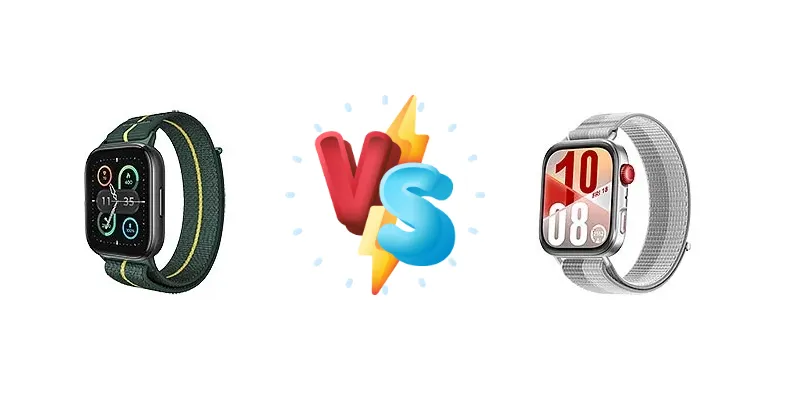
The sub-$100 fitness tracker market is fiercely competitive. Both the Motorola Moto Watch Fit and the Huawei Watch Fit 4 aim to deliver essential health and activity tracking features without breaking the bank. However, they approach this goal with different philosophies, making a direct comparison crucial for budget-conscious consumers.
🏆 Quick Verdict
For most users, the Huawei Watch Fit 4 emerges as the better choice. Its 5W wireless charging offers convenience, and while detailed specs are limited for the Moto Watch Fit, Huawei’s established fitness tracking ecosystem and potential for more robust software updates give it an edge.
| Network |
|---|
| 2G bands | N/A | N/A |
| 3G bands | - | N/A |
| 4G bands | - | N/A |
| EDGE | No | No |
| GPRS | No | No |
| Speed | - | No |
| Technology | No cellular connectivity | No cellular connectivity |
| Launch |
|---|
| Announced | 2025, April 24 | 2025, May 15 |
| Status | Available. Released 2025, May | Available. Released 2025, May 26 |
| Body |
|---|
| Build | Glass front (Gorilla Glass 3), aluminum frame, plastic back | Glass front, aluminum alloy frame, plastic back |
| Dimensions | 44.5 x 38 x 9.5 mm (1.75 x 1.50 x 0.37 in) | 43 x 38 x 9.5 mm (1.69 x 1.50 x 0.37 in) |
| SIM | No | No |
| Weight | 25 g (0.88 oz) | 27 g (0.95 oz) |
| Display |
|---|
| Protection | Corning Gorilla Glass 3 | - |
| Resolution | 348 x 442 pixels* (~296 ppi density) | 480 x 408 pixels (~347 ppi density) |
| Size | 1.9 inches | 1.82 inches |
| Type | OLED, 1000 nits (peak) | AMOLED, 2000 nits (peak) |
| Memory |
|---|
| Call records | - | No |
| Card slot | No | No |
| Internal | Unspecified storage | Unspecified |
| Phonebook | - | No |
| Sound |
|---|
| 35mm jack | No | No |
| Loudspeaker | No | Yes |
| Comms |
|---|
| Bluetooth | 5.3, A2DP, LE | 5.2, LE |
| NFC | No | Yes (gray model only) |
| Positioning | GPS | GPS (L1+L5), GALILEO (E1+E5a), QZSS (L1+L5), BDS (B1l+B1C), GLONASS |
| Radio | No | No |
| USB | No | No |
| WLAN | No | No |
| Features |
|---|
| Games | - | No |
| Java | - | No |
| Messaging | - | Email, IM |
| Sensors | Accelerometer, gyro, heart rate, PPG | Accelerometer, gyro, heart rate, SpO2, compass, barometer |
| Battery |
|---|
| Charging | - | 5W wireless |
| Type | - | Li-Ion 400 mAh |
| Misc |
|---|
| Colors | Trekking Green | Black, Silver |
| Models | - | SYA-B19 |
| Price | About 80 EUR | € 109.00 / $ 140.75 |
Motorola Moto Watch Fit
- Potentially simpler user interface
- May be more affordable (depending on sales)
- Lightweight design (assumed)
- Lack of detailed specifications
- Unknown chipset performance
- Proprietary charging likely less convenient
Huawei Watch Fit 4
- 5W Wireless Charging for convenience
- Established Huawei fitness tracking ecosystem
- Likely more robust software support
- Potential privacy concerns (Huawei)
- May be slightly more expensive
- Software can be complex for some users
Display Comparison
Given the lack of specific display information for the Moto Watch Fit, we can only speculate. Huawei’s Watch Fit 4 likely features an AMOLED display, common in this price range, offering vibrant colors and good outdoor visibility. The size is likely around 1.64 inches, typical for fitness trackers. The Moto Watch Fit’s display quality is unknown, but a lower-resolution panel or LCD technology would be a significant disadvantage. Bezels are a key consideration; smaller bezels on the Fit 4 would translate to a more immersive viewing experience.
Camera Comparison
Neither device is expected to feature a camera, focusing instead on core fitness tracking functionality. This is a sensible omission for devices in this price bracket, prioritizing battery life and form factor.
Performance
The Motorola Moto Watch Fit’s chipset remains undisclosed. Huawei typically utilizes proprietary Kirin or similar low-power processors in its wearables. The performance difference will likely be minimal for basic fitness tracking, but the Huawei Watch Fit 4 may handle more complex features or third-party apps more smoothly. RAM capacity is also unknown for the Moto Watch Fit, potentially limiting multitasking capabilities compared to the Fit 4.
Battery Life
The Huawei Watch Fit 4’s 5W wireless charging is a significant advantage, offering a convenient charging experience. While the battery capacity of both devices is unknown, the efficiency of the charging method and software optimization will be crucial. Wireless charging, while slower than wired, reduces wear and tear on the charging port and offers a cleaner aesthetic. The Moto Watch Fit likely relies on a proprietary wired charging solution, which may be less convenient.
Buying Guide
Buy the Motorola Moto Watch Fit if you prioritize a potentially simpler, more streamlined experience and are comfortable with limited information regarding its internal components. Buy the Huawei Watch Fit 4 if you value the convenience of wireless charging, a potentially more feature-rich software experience, and the backing of a larger, established brand in the wearable space.
Frequently Asked Questions
❓ Does the Huawei Watch Fit 4's wireless charging significantly impact charging speed compared to a wired connection?
While 5W wireless charging is slower than many fast-wired solutions, it's sufficient for overnight charging and offers a significant convenience factor. The slower charging speed is a trade-off for the ease of simply placing the watch on a charging pad.
❓ Given the limited information on the Motorola Moto Watch Fit, is it a risky purchase?
It is a higher-risk purchase due to the lack of transparency regarding its specifications. Consumers are essentially buying into the Motorola brand without knowing the exact components powering the device. This makes it difficult to assess its long-term performance and software support.
❓ How accurate are the fitness tracking features on the Huawei Watch Fit 4 compared to more expensive smartwatches?
Huawei's fitness tracking algorithms are generally considered accurate for basic metrics like step counting, heart rate monitoring, and sleep tracking. However, more expensive smartwatches often offer more advanced sensors and algorithms for greater precision, particularly during high-intensity workouts.