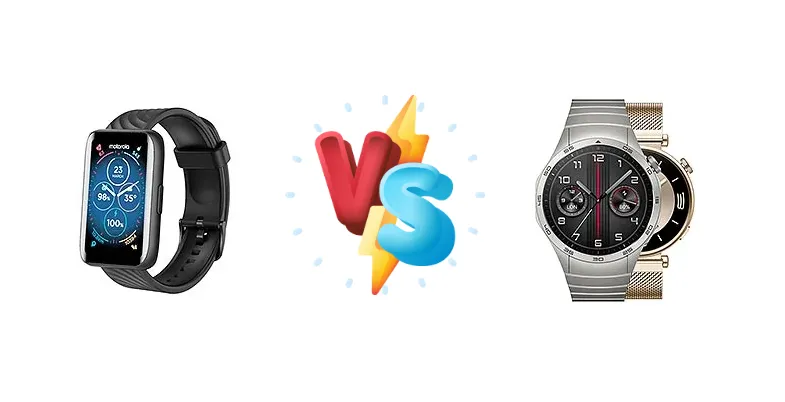
The Motorola Moto Watch 40 and Huawei Watch GT 4 represent distinct approaches to the smartwatch experience. While both aim to provide comprehensive health and fitness tracking, a key differentiator lies in their charging methodologies: the Moto Watch 40 utilizes a wired connection for rapid replenishment, while the Huawei Watch GT 4 embraces the convenience of wireless charging. This comparison dissects these differences and their implications for the user.
🏆 Quick Verdict
For users prioritizing speed and minimal downtime, the Motorola Moto Watch 40’s 25-minute full charge is a clear advantage. However, the Huawei Watch GT 4’s wireless charging offers a more convenient, albeit slower, experience, making it ideal for those who value ease of use over absolute charging speed.
| Network |
|---|
| 2G bands | No | N/A |
| 3G bands | - | N/A |
| 4G bands | - | N/A |
| EDGE | No | No |
| GPRS | No | No |
| Speed | - | No |
| Technology | No cellular connectivity | No cellular connectivity |
| Launch |
|---|
| Announced | 2024, February 07 | 2023, September 14 |
| Status | Available. Released 2024, February 07 | Available. Released 2023, October 02 |
| Body |
|---|
| Build | Zinc alloy case, plastic back | Glass front, plastic back, stainless steel frame |
| Dimensions | 45.9 x 30.8 x 10.2 mm (1.81 x 1.21 x 0.40 in) | 46 x 46 x 10.9 mm (1.81 x 1.81 x 0.43 in) |
| SIM | No | No |
| Weight | 26 g (0.92 oz) | 37 g (41mm) / 48 g (46mm) (1.31 oz) |
| Display |
|---|
| Resolution | 240 x 280 pixels (~235 ppi density) | 466 x 466 pixels (~326 ppi density) |
| Size | 1.57 inches | 1.43 inches |
| Type | IPS LCD | AMOLED |
| Platform |
|---|
| OS | Moto Watch OS | HarmonyOS 4.0 |
| Memory |
|---|
| Card slot | No | No |
| Internal | - | Unspecified |
| Sound |
|---|
| 35mm jack | No | No |
| Loudspeaker | No | Yes |
| Comms |
|---|
| Bluetooth | 5.0, A2DP, LE | 5.2, A2DP, LE |
| NFC | No | Yes |
| Positioning | No | GPS (L1+L5), GLONASS, BDS, GALILEO, QZSS |
| Radio | No | No |
| USB | No | No |
| WLAN | No | No |
| Features |
|---|
| Sensors | Accelerometer, heart rate, SpO2 | Accelerometer, gyro, heart rate, barometer, compass, SpO2, thermometer (body temperature) |
| Battery |
|---|
| Charging | Wired, 100% in 25 min | Wireless |
| Type | 240 mAh | Li-Ion 524 mAh |
| Misc |
|---|
| Colors | Phantom Black, Black Rose Gold | Black, Steel, Silver, Gold |
| Models | - | ARA-B19, PNX-B19 |
| Price | About 60 EUR | About 270 EUR |
Motorola Moto Watch 40
- Extremely fast 25-minute full charge.
- Wired charging is generally more efficient, potentially reducing energy waste.
- Simpler cable connection (potentially more durable).
- Requires a dedicated charging cable.
- Wired charging can be less convenient than wireless.
Huawei Watch GT 4
- Convenient wireless charging – no cables needed.
- Clutter-free charging setup.
- Potentially compatible with existing Qi wireless chargers.
- Slower charging speeds compared to wired.
- Wireless charging can be less efficient, generating more heat.
Display Comparison
Information regarding display specifications is unavailable. However, given the market positioning of both devices, we can infer that both likely employ AMOLED panels for vibrant visuals. The absence of LTPO specification suggests neither prioritizes variable refresh rates for power saving, a common trade-off in this price segment.
Camera Comparison
Neither device is known for camera capabilities, and no camera specifications were provided. Smartwatches primarily rely on smartphone connectivity for photography, making camera hardware less critical.
Performance
Performance data is unavailable. However, Motorola typically focuses on efficient chipsets for extended battery life, while Huawei often prioritizes a balance between performance and power efficiency. The lack of information prevents a detailed comparison of processing power or RAM speed.
Battery Life
The core distinction lies in charging. The Motorola Moto Watch 40 achieves a full charge in just 25 minutes via a wired connection. This rapid charging is ideal for users who frequently forget to charge their devices or need a quick boost before a workout. Conversely, the Huawei Watch GT 4 utilizes wireless charging, offering a more convenient, cable-free experience. While the exact charging time isn't specified, wireless charging inherently takes longer than wired, trading speed for ease of use. The impact of this difference is significant: the Moto Watch 40 minimizes downtime, while the GT 4 prioritizes convenience.
Buying Guide
Buy the Motorola Moto Watch 40 if you need a smartwatch that can quickly return to a 100% charge, minimizing interruptions to your day, and you don't mind the need for a proprietary cable. Buy the Huawei Watch GT 4 if you prefer the convenience of wireless charging, even if it takes longer, and value a clutter-free charging setup. The GT 4 caters to users who prioritize simplicity and don't require the fastest possible recharge times.
Frequently Asked Questions
❓ Does the wireless charging of the Huawei Watch GT 4 work with any Qi-compatible charger, or is it proprietary?
While Huawei doesn't explicitly state Qi compatibility, their previous models have supported the standard. It's highly probable the GT 4 will also work with most Qi-enabled wireless chargers, offering flexibility beyond Huawei's own charging accessories. However, optimal charging speeds may be achieved with a Huawei-certified charger.
❓ Is the 25-minute charge time of the Moto Watch 40 consistent, or does it vary depending on the charger used?
The 25-minute full charge time is likely based on using a charger that supports the appropriate power delivery standard (likely USB-PD). Using a slower charger will extend the charging time. Motorola likely includes a suitable charger in the box, but using a third-party charger may yield different results.
❓ Will the wireless charging of the Huawei Watch GT 4 significantly impact battery health over the long term due to heat generation?
Wireless charging inherently generates more heat than wired charging, which *could* contribute to slightly faster battery degradation over several years. However, modern smartwatches incorporate thermal management systems to mitigate this effect. The impact is likely minimal for most users, and the convenience of wireless charging may outweigh this potential concern.