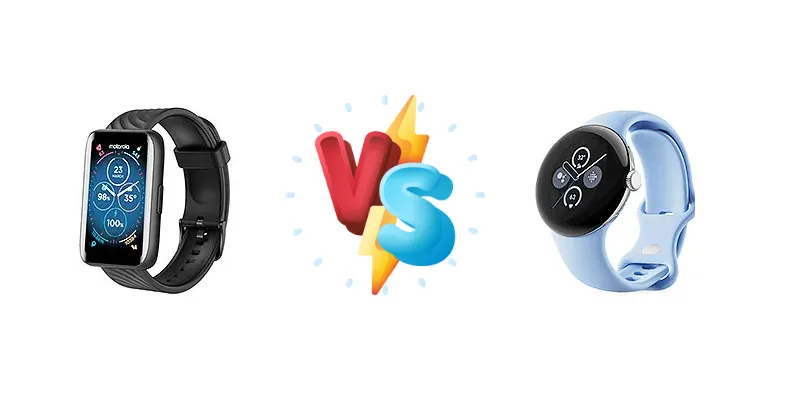
The Wear OS smartwatch landscape is heating up. The Motorola Moto Watch 40 aims to disrupt with a focus on rapid charging, while the Google Pixel Watch 2 leverages Qualcomm's 5100 platform for a smoother, more integrated experience. This comparison dissects the key differences to help you choose the right smartwatch for your needs.
🏆 Quick Verdict
For most users, the Google Pixel Watch 2 is the superior choice. While the Moto Watch 40 boasts impressively fast 25-minute charging, the Pixel Watch 2’s Qualcomm 5100 chipset provides a more responsive and feature-rich Wear OS experience, justifying the price difference.
| Network |
|---|
| 2G bands | No | GSM 850 / 900 / 1800 / 1900 |
| 3G bands | - | HSDPA 850 / 900 / 1700(AWS) / 1900 / 2100 |
| 4G bands | - | LTE |
| EDGE | No | - |
| GPRS | No | - |
| Speed | - | HSPA, LTE |
| Technology | No cellular connectivity | GSM / HSPA / LTE |
| Launch |
|---|
| Announced | 2024, February 07 | 2023, October 04 |
| Status | Available. Released 2024, February 07 | Available. Released 2023, October 12 |
| Body |
|---|
| Build | Zinc alloy case, plastic back | Glass front (Gorilla Glass 5), aluminum frame |
| Dimensions | 45.9 x 30.8 x 10.2 mm (1.81 x 1.21 x 0.40 in) | 41 x 41 x 12.3 mm (1.61 x 1.61 x 0.48 in) |
| SIM | No | eSIM |
| Weight | 26 g (0.92 oz) | 31 g (1.09 oz) |
| Display |
|---|
| Protection | - | Corning Gorilla Glass 5 |
| Resolution | 240 x 280 pixels (~235 ppi density) | 450 x 450 pixels (~320 ppi density) |
| Size | 1.57 inches | 1.2 inches |
| Type | IPS LCD | AMOLED, 1000 nits (peak) |
| Platform |
|---|
| Chipset | - | Qualcomm 5100 |
| OS | Moto Watch OS | Android Wear OS 4 |
| Memory |
|---|
| Card slot | No | No |
| Internal | - | 32GB 2GB RAM |
| Sound |
|---|
| 35mm jack | No | No |
| Loudspeaker | No | Yes |
| Comms |
|---|
| Bluetooth | 5.0, A2DP, LE | 5.0, A2DP, LE |
| NFC | No | Yes |
| Positioning | No | GPS, GLONASS, GALILEO, BDS, QZSS |
| Radio | No | No |
| USB | No | No |
| WLAN | No | Wi-Fi 802.11 b/g/n |
| Features |
|---|
| Sensors | Accelerometer, heart rate, SpO2 | Accelerometer, gyro, heart rate, altimeter, compass, SpO2, thermometer (skin temperature), skin conductance |
| Battery |
|---|
| Charging | Wired, 100% in 25 min | Wired, 80% in 45 min |
| Type | 240 mAh | Li-Ion 306 mAh |
| Misc |
|---|
| Colors | Phantom Black, Black Rose Gold | Polished Silver, Matte Black, Champagne Gold |
| Models | - | G4TSL, GC3G8, GD2WG |
| Price | About 60 EUR | About 160 EUR |
Motorola Moto Watch 40
- Extremely fast 25-minute charging
- Likely more affordable price point
- Potentially longer battery life due to simpler feature set
- Less powerful chipset compared to the Pixel Watch 2
- Potentially less refined software experience
- Unknown display quality
Google Pixel Watch 2
- Qualcomm 5100 chipset for superior performance
- Optimized Wear OS experience with Google integration
- Likely higher quality display
- Slower charging time (45 minutes to 80%)
- Higher price point
- Potentially higher power consumption
Display Comparison
Display specifications are absent from the provided data, but given the market positioning, we can infer differences. The Pixel Watch 2 likely features an AMOLED display with potentially LTPO technology for variable refresh rates, maximizing battery efficiency. Motorola typically focuses on value, so the Moto Watch 40 may utilize a standard AMOLED panel. Color accuracy and peak brightness are likely superior on the Pixel Watch 2, benefiting from Google’s display calibration expertise.
Camera Comparison
Neither device is explicitly marketed for camera functionality, and details are absent. Smartwatches generally have limited camera capabilities, and this comparison is unlikely to be influenced by camera specs.
Performance
The core differentiator lies in the chipset. The Google Pixel Watch 2’s Qualcomm 5100 offers a significant performance advantage over the unspecified chipset in the Moto Watch 40. The 5100, built on a power-efficient node, translates to snappier app launches, smoother animations, and more responsive health tracking. While the Moto Watch 40 may handle basic notifications and fitness tracking adequately, the Pixel Watch 2 is better equipped for demanding tasks and future software updates.
Battery Life
The Moto Watch 40’s 25-minute full charge time is a standout feature. This is significantly faster than the Pixel Watch 2’s 45 minutes to 80%. However, charging speed isn’t everything. The Pixel Watch 2’s Qualcomm 5100 chipset is more power-efficient, potentially offsetting the slower charging with longer real-world battery life. The actual battery capacity (mAh) of both devices is unknown, but the faster charging of the Moto Watch 40 is a clear advantage for users prioritizing convenience.
Buying Guide
Buy the Motorola Moto Watch 40 if you prioritize minimizing downtime and need a smartwatch that can fully charge in under half an hour. This is ideal for users who frequently forget to charge overnight or require quick top-ups between activities. Buy the Google Pixel Watch 2 if you value a polished software experience, enhanced performance for apps and health tracking, and the benefits of Qualcomm’s optimized chipset, even if it means a longer charging time.
Frequently Asked Questions
❓ Does the Qualcomm 5100 chipset in the Pixel Watch 2 noticeably improve app performance compared to the Moto Watch 40?
Yes, the Qualcomm 5100 is a significant upgrade. It provides a smoother and more responsive experience when launching apps, navigating the Wear OS interface, and utilizing features like Google Assistant. The Moto Watch 40, with its unspecified chipset, will likely exhibit more lag and slower response times.
❓ If I frequently travel and need a quick charge, is the Moto Watch 40's 25-minute charging time a game-changer?
Absolutely. The Moto Watch 40’s 25-minute full charge is a major advantage for travelers or anyone who often finds themselves needing to quickly top up their smartwatch. The Pixel Watch 2’s 45 minutes to 80% charge is considerably slower, requiring more planning and downtime.
❓ How does the power efficiency of the Qualcomm 5100 impact the Pixel Watch 2's overall battery life?
The Qualcomm 5100 is built on a power-efficient architecture. While the exact battery life depends on usage patterns, the 5100’s efficiency helps the Pixel Watch 2 potentially offset the slower charging time with longer real-world battery endurance compared to the Moto Watch 40.