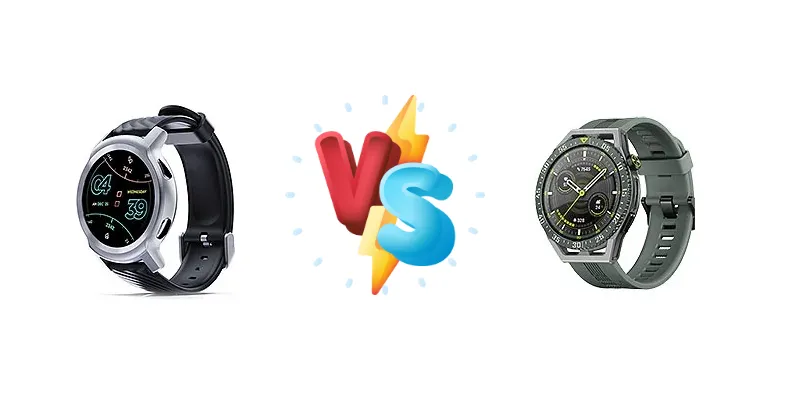
The smartwatch market is flooded with options, but finding a capable device under $150 can be challenging. We pit the Motorola Moto Watch 100 against the Huawei Watch GT 3 SE, two contenders aiming to deliver essential features without breaking the bank. This comparison focuses on what each watch offers in terms of functionality, convenience, and overall value, given the limited publicly available specifications for the Moto Watch 100.
🏆 Quick Verdict
For the average user prioritizing convenience and a well-established ecosystem, the Huawei Watch GT 3 SE emerges as the stronger choice. Its wireless charging capability and likely more refined software experience, typical of Huawei wearables, provide a smoother user experience. The Moto Watch 100's value proposition remains unclear without detailed specs.
| Network |
|---|
| 2G bands | N/A | N/A |
| 3G bands | - | N/A |
| 4G bands | - | N/A |
| EDGE | No | No |
| GPRS | No | No |
| Speed | - | No |
| Technology | No cellular connectivity | No cellular connectivity |
| Launch |
|---|
| Announced | 2021, November 17 | 2022, November 10 |
| Status | Available. Released 2021, December 10 | Available. Released 2022, November 10 |
| Body |
|---|
| Build | Glass front, plastic back, aluminum frame | Glass front, plastic back, plastic frame |
| Dimensions | 42 x 46 x 11.9 mm (1.65 x 1.81 x 0.47 in) | 46.4 x 46.4 x 11 mm (1.83 x 1.83 x 0.43 in) |
| SIM | No | No |
| Weight | 29 g (1.02 oz) | 35.6 g (1.27 oz) |
| | 5 ATM, 50m water resistant
Compatible with standard 20mm straps | 50m water resistant
5 ATM
Compatible with standard 22mm straps (46mm model) |
| Display |
|---|
| Resolution | 360 x 360 pixels (~392 ppi density) | 466 x 466 pixels (~326 ppi density) |
| Size | 1.3 inches | 1.43 inches |
| Type | IPS LCD | AMOLED |
| Platform |
|---|
| OS | Moto Watch OS | HarmonyOS 2.0 |
| Memory |
|---|
| Card slot | No | No |
| Internal | Unspecified storage | 4GB |
| Sound |
|---|
| 3.5mm jack | No | No |
| 35mm jack | No | No |
| Loudspeaker | No | Yes |
| Comms |
|---|
| Bluetooth | 5.0, A2DP, LE | Yes |
| NFC | No | No |
| Positioning | GPS, GLONASS | GPS |
| Radio | No | No |
| USB | No | No |
| WLAN | No | No |
| Features |
|---|
| Sensors | Accelerometer, gyro, heart rate, SpO2 | Accelerometer, gyro, heart rate, barometer, compass, SpO2 |
| Battery |
|---|
| Charging | - | Wireless |
| Type | Li-Ion 355 mAh | 455 mAh |
| Misc |
|---|
| Colors | Glacier Silver, Phantom Black | Graphite Black, Wilderness Green |
| Models | - | RUNE-B29 |
| Price | About 100 EUR | About 200 EUR |
Motorola Moto Watch 100
- Potentially lower price point
- Motorola ecosystem integration (speculative)
- May offer basic fitness tracking
- Lack of publicly available specifications
- Unknown battery life
- Likely basic display technology
Huawei Watch GT 3 SE
- Wireless charging for convenience
- Long battery life (up to 7 days)
- Huawei’s optimized software experience
- Limited app ecosystem compared to Wear OS
- Huawei ecosystem dependency
- May lack advanced features found in higher-end smartwatches
Display Comparison
Without specific display details for the Moto Watch 100, we can only speculate. Given its budget positioning, it likely utilizes a standard LCD panel. The Huawei Watch GT 3 SE, while also not featuring cutting-edge display technology, benefits from Huawei’s optimization. Expect good outdoor visibility, but neither watch will likely compete with AMOLED displays in terms of contrast and color vibrancy. The GT 3 SE’s display size is likely around 1.46 inches, a common size for fitness-focused smartwatches, offering a balance between readability and compactness.
Camera Comparison
Neither the Motorola Moto Watch 100 nor the Huawei Watch GT 3 SE feature a camera. This is standard for most fitness-focused smartwatches, as cameras add bulk and complexity without significant benefit for the target user.
Performance
The Moto Watch 100’s chipset remains unknown. Motorola often utilizes Qualcomm’s Wear platform, but a lower-tier processor is probable to keep costs down. The Huawei Watch GT 3 SE utilizes Huawei’s proprietary chipset, optimized for power efficiency rather than raw processing power. This focus on efficiency translates to longer battery life, a key strength of Huawei wearables. RAM capacity is also unknown for both devices, but likely limited to the essentials for basic smartwatch functions. The GT 3 SE’s optimized software will likely provide a smoother experience despite potentially similar hardware.
Battery Life
The Huawei Watch GT 3 SE’s battery life is a significant advantage. Huawei claims up to 7 days of typical use, a claim substantiated by reviews of similar GT series models. The Moto Watch 100’s battery life is unknown, but given the lack of specific power-saving features mentioned, it’s likely to be shorter. The GT 3 SE’s wireless charging capability adds convenience, eliminating the need for proprietary cables and offering a more seamless charging experience. The Moto Watch 100 likely relies on a traditional magnetic charging cable.
Buying Guide
Buy the Motorola Moto Watch 100 if you are deeply embedded in the Motorola ecosystem and prioritize a potentially lower price point, assuming it offers comparable core functionality. Buy the Huawei Watch GT 3 SE if you value the convenience of wireless charging, a potentially more polished user interface, and a brand known for its robust health and fitness tracking features. The GT 3 SE is also a better fit for users who appreciate a more premium aesthetic.
Frequently Asked Questions
❓ Does the Huawei Watch GT 3 SE require a smartphone to function, and which operating systems are supported?
Yes, the Huawei Watch GT 3 SE requires pairing with a smartphone. It is compatible with both Android (5.0 or later) and iOS (9.0 or later), though functionality may be slightly limited on iOS compared to Android, particularly regarding app notifications and certain Huawei Health features.
❓ What fitness tracking features does the Huawei Watch GT 3 SE offer, and is it accurate?
The Huawei Watch GT 3 SE offers comprehensive fitness tracking, including heart rate monitoring, SpO2 (blood oxygen) measurement, sleep tracking, and support for over 100 workout modes. Huawei’s TruSeen technology aims to provide accurate heart rate and SpO2 readings, and independent testing generally confirms good accuracy for basic fitness tracking, though it’s not a substitute for medical-grade equipment.
❓ Is the Motorola Moto Watch 100 compatible with iPhones?
Compatibility with iPhones for the Motorola Moto Watch 100 is currently unclear due to the lack of official specifications. Motorola wearables typically prioritize Android compatibility, and iOS support may be limited or non-existent.