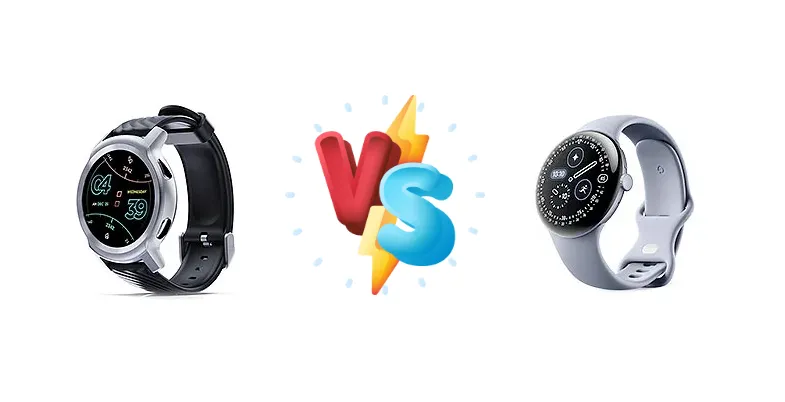
The smartwatch market is increasingly competitive, with options ranging from budget-friendly trackers to premium, feature-rich devices. We're pitting the Motorola Moto Watch 100 against the Google Pixel Watch 4 to determine which offers the best balance of performance, features, and value. While the Moto Watch 100's specifications are currently limited in available data, we can assess its position based on Motorola's historical approach to the smartwatch segment and contrast it with the Pixel Watch 4's clearly defined hardware.
🏆 Quick Verdict
For the average user prioritizing performance and a seamless Wear OS experience, the Google Pixel Watch 4 is the clear winner. Its Snapdragon W5 Gen 2 chipset delivers a substantial upgrade over what we anticipate from the Moto Watch 100, despite potentially impacting battery life. However, the Moto Watch 100 may appeal to budget-conscious buyers seeking a basic Wear OS experience.
| Network |
|---|
| 2G bands | N/A | GSM 850 / 900 / 1800 / 1900 |
| 3G bands | - | HSDPA 850 / 900 / 1700(AWS) / 1900 / 2100 |
| 4G bands | - | LTE |
| EDGE | No | - |
| GPRS | No | - |
| Speed | - | HSPA, LTE |
| Technology | No cellular connectivity | GSM / HSPA / LTE |
| Launch |
|---|
| Announced | 2021, November 17 | 2025, August 20 |
| Status | Available. Released 2021, December 10 | Available. Released 2025, October 09 |
| Body |
|---|
| Build | Glass front, plastic back, aluminum frame | Glass front (Gorilla Glass 5), aluminum frame |
| Dimensions | 42 x 46 x 11.9 mm (1.65 x 1.81 x 0.47 in) | 45 x 45 x 12.3 mm (1.77 x 1.77 x 0.48 in) |
| SIM | No | eSIM |
| Weight | 29 g (1.02 oz) | 31 g or 37 g (1.09 oz) |
| | 5 ATM, 50m water resistant
Compatible with standard 20mm straps | - |
| Display |
|---|
| Protection | - | Corning Gorilla Glass 5 |
| Resolution | 360 x 360 pixels (~392 ppi density) | 456 x 456 pixels (~320 ppi density) |
| Size | 1.3 inches | 1.4 inches |
| Type | IPS LCD | LTPO AMOLED, 3000 nits (peak) |
| Platform |
|---|
| CPU | - | Quad-core (4x1.7 GHz Cortex-A53) |
| Chipset | - | Qualcomm Snapdragon W5 Gen 2 (4 nm) |
| GPU | - | Adreno A702 |
| OS | Moto Watch OS | Android Wear OS 6 |
| Memory |
|---|
| Card slot | No | No |
| Internal | Unspecified storage | 32GB 2GB RAM |
| Sound |
|---|
| 3.5mm jack | No | - |
| 35mm jack | No | No |
| Loudspeaker | No | Yes |
| Comms |
|---|
| Bluetooth | 5.0, A2DP, LE | 6.0, A2DP |
| NFC | No | Yes |
| Positioning | GPS, GLONASS | GPS (L1+L5), GLONASS, GALILEO (E1+E5a) |
| Radio | No | No |
| USB | No | No |
| WLAN | No | Wi-Fi 802.11 a/b/g/n/ac/6, dual-band |
| Features |
|---|
| Sensors | Accelerometer, gyro, heart rate, SpO2 | Accelerometer, gyro, heart rate, altimeter, compass, SpO2, thermometer (skin temperature), skin conductance |
| Battery |
|---|
| Charging | - | Wired, 50% in 15 min, 80% in 30 min, 100% in 60 min - 45mm model
Wired, 50% in 15 min, 80% in 25 min, 100% in 45 min - 41mm model |
| Type | Li-Ion 355 mAh | Li-Ion 455 mAh |
| Misc |
|---|
| Colors | Glacier Silver, Phantom Black | Matte Black, Polished Silver, Champagne Gold, Satin Moonstone |
| Price | About 100 EUR | € 353.94 |
Motorola Moto Watch 100
- Potentially more affordable price point
- Likely longer battery life due to less powerful processor (speculative)
- Simple and straightforward Wear OS experience
- Significantly slower performance
- Outdated chipset
- Limited feature set compared to Pixel Watch 4
Google Pixel Watch 4
- Powerful Snapdragon W5 Gen 2 chipset
- Fast charging capabilities
- Smooth and responsive Wear OS experience
- Higher price tag
- Potentially shorter battery life due to power-hungry processor
- May require more frequent charging
Display Comparison
Without specific display details for the Moto Watch 100, we can assume it utilizes a standard LCD or OLED panel common in its price bracket. The Google Pixel Watch 4, while not specified in terms of nits, benefits from the efficiency of its chipset to potentially drive a brighter, more vibrant display. The Pixel Watch 4's display technology is likely to be OLED, offering superior contrast and viewing angles. The 41mm model's faster charging suggests a potentially smaller battery, which could necessitate more aggressive power management of the display.
Camera Comparison
Neither device is primarily marketed for its camera capabilities. As such, detailed camera specs are unavailable for either. Smartwatches generally feature limited camera functionality, primarily for quick scans or video calls. Any camera on the Moto Watch 100 is likely to be a basic resolution, while the Pixel Watch 4 may offer slightly improved image quality due to its more advanced image signal processor (ISP) integrated within the Snapdragon W5 Gen 2.
Performance
The Google Pixel Watch 4's Qualcomm Snapdragon W5 Gen 2 (4nm) chipset is the defining performance advantage. This 4nm process node is significantly more efficient than older manufacturing processes, translating to improved performance per watt. The quad-core, 1.7 GHz Cortex-A53 CPU configuration provides ample processing power for Wear OS and its applications. The Moto Watch 100, lacking detailed specs, likely employs a less powerful chipset, potentially a MediaTek or older Qualcomm platform, resulting in slower app loading times and less fluid animations. The Snapdragon W5 Gen 2's integrated GPU will also provide a smoother experience for graphics-intensive tasks.
Battery Life
The Google Pixel Watch 4 offers impressive charging speeds: 50% in 15 minutes, 80% in 30/25 minutes (depending on 45mm/41mm model), and 100% in 60/45 minutes. This rapid charging is a significant convenience factor. The Moto Watch 100's battery performance is harder to predict without specific capacity details. However, given its likely less efficient chipset, it may require longer charging times to achieve a comparable level of battery life. The Pixel Watch 4's power efficiency, stemming from the 4nm Snapdragon W5 Gen 2, could offset the potential impact of a smaller battery capacity (relative to a hypothetical larger battery in the Moto Watch 100).
Buying Guide
Buy the Motorola Moto Watch 100 if you need a simple, affordable Wear OS smartwatch and aren't demanding of cutting-edge performance. It's likely geared towards users who prioritize basic notifications, fitness tracking, and a lower price point. Buy the Google Pixel Watch 4 if you prefer a premium experience with a powerful processor, faster charging, and a more refined software experience, and are willing to pay a premium for it. This watch is for users who want a smartwatch that can handle demanding apps and provide a smooth, responsive interface.
Frequently Asked Questions
❓ Is the Snapdragon W5 Gen 2 in the Pixel Watch 4 prone to overheating during intensive tasks?
While the Snapdragon W5 Gen 2 is a powerful chipset, its 4nm process node and optimized thermal design in the Pixel Watch 4 mitigate overheating concerns. Users should experience smooth performance even during demanding applications, though prolonged use of GPS and high-intensity apps may result in some warmth.
❓ How does the charging speed of the Pixel Watch 4 compare to other Wear OS smartwatches?
The Pixel Watch 4's charging speed (50% in 15 minutes) is notably faster than many other Wear OS smartwatches on the market. This rapid charging is a significant advantage for users who want to quickly top up their battery before heading out.
❓ Given the limited specs of the Moto Watch 100, is it a worthwhile upgrade from an older, basic fitness tracker?
If you're upgrading from a basic fitness tracker and primarily want notifications and basic activity tracking, the Moto Watch 100 could be a worthwhile step up, especially if budget is a major concern. However, if you're looking for a more feature-rich and powerful smartwatch experience, the Pixel Watch 4 is a more substantial upgrade.