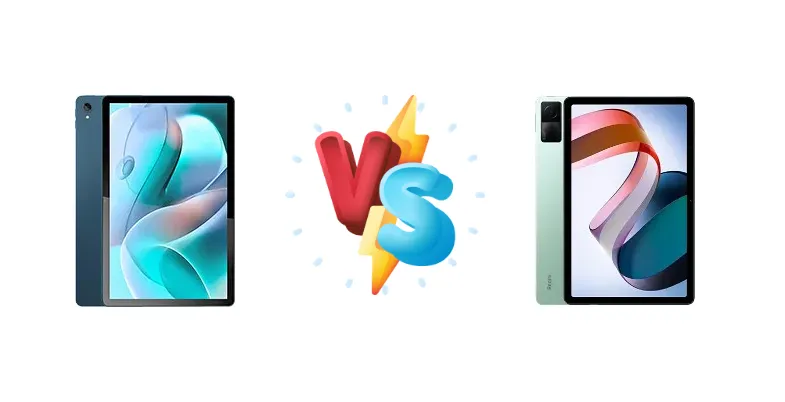
The budget tablet market is heating up! Both the Motorola Moto Tab G70 and the Xiaomi Redmi Pad offer compelling features at attractive prices. But which one deserves your money? We're diving deep into a head-to-head comparison to help you decide.
🏆 Quick Verdict
The Redmi Pad edges out the Moto Tab G70 thanks to its slightly more efficient chipset and brighter display. While the G70 boasts a powerful GPU, the Redmi Pad's overall package offers a more polished and enjoyable user experience, especially for media consumption.
| Network |
|---|
| 2G bands | GSM 850 / 900 / 1800 / 1900 | N/A |
| 3G bands | HSDPA 850 / 900 / 1900 / 2100 | N/A |
| 4G bands | 1, 2, 4, 7, 8, 20, 28, 38, 40, 41 | N/A |
| EDGE | - | N/A |
| GPRS | - | N/A |
| Speed | HSPA 42.2/5.76 Mbps, LTE Cat4 150/50 Mbps - cellular model only | - |
| Technology | GSM / HSPA / LTE | No cellular connectivity |
| Launch |
|---|
| Announced | 2022, January 12 | 2022, October 04 |
| Status | Available. Released 2022, January 13 | Available. Released 2022, October 05 |
| Body |
|---|
| Build | Glass front, aluminum back, aluminum frame | Glass front, aluminum frame |
| Dimensions | 258.4 x 163 x 7.5 mm (10.17 x 6.42 x 0.30 in) | 250.5 x 158.1 x 7.1 mm (9.86 x 6.22 x 0.28 in) |
| SIM | Nano-SIM (cellular model only) | No |
| Weight | 500 g (1.10 lb) | 465 g (1.03 lb) |
| | Water repellent design | - |
| Display |
|---|
| Resolution | 1200 x 2000 pixels, 5:3 ratio (~212 ppi density) | 1200 x 2000 pixels, 5:3 ratio (~220 ppi density) |
| Size | 11.0 inches, 344.4 cm2 (~81.8% screen-to-body ratio) | 10.61 inches, 320.4 cm2 (~80.9% screen-to-body ratio) |
| Type | IPS LCD, 400 nits (typ) | IPS LCD, 1B colors, 90Hz, 400 nits (typ) |
| Platform |
|---|
| CPU | Octa-core (2x2.05 GHz Cortex-A76 & 6x2.0 GHz Cortex-A55) | Octa-core (2x2.2 GHz Cortex-A76 & 6x2.0 GHz Cortex-A55) |
| Chipset | Mediatek MT6785 Helio G90T (12 nm) | Mediatek Helio G99 (6 nm) |
| GPU | Mali-G76 MC4 | Mali-G57 MC2 |
| OS | Android 11 | Android 12, upgradable to Android 13, MIUI 14 |
| Memory |
|---|
| Card slot | microSDXC (dedicated slot) | microSDXC |
| Internal | 64GB 4GB RAM, 128GB 6GB RAM | 64GB 3GB RAM, 128GB 4GB RAM, 128GB 6GB RAM |
| | eMMC 5.1 | UFS 2.2 |
| Main Camera |
|---|
| Features | LED flash | - |
| Single | 13 MP, f/2.2, 26mm (wide), AF | 8 MP, f/2.0, (wide), AF |
| Video | 1080p@30fps | 1080p@30fps |
| Selfie camera |
|---|
| Single | 8 MP, f/2.0, 26mm (wide) | 8 MP, f/2.3, 105° (ultrawide) |
| Video | 1080p@30fps | 1080p@30fps |
| Sound |
|---|
| 3.5mm jack | Yes | No |
| 35mm jack | Yes | No |
| Loudspeaker | Yes, with stereo speakers (4 speakers) | Yes, with stereo speakers (4 speakers) |
| | - | 24-bit/192kHz audio |
| Comms |
|---|
| Bluetooth | 5.2, A2DP, LE | 5.2, A2DP, LE |
| NFC | No | No |
| Positioning | GPS, GLONASS - cellular model only | No |
| Radio | No | No |
| USB | USB Type-C 2.0, OTG | USB Type-C, OTG |
| WLAN | Wi-Fi 802.11 a/b/g/n/ac, dual-band, Wi-Fi Direct | Wi-Fi 802.11 a/b/g/n/ac, dual-band, Wi-Fi Direct |
| Features |
|---|
| Sensors | Accelerometer, gyro, proximity | Accelerometer |
| Battery |
|---|
| Charging | 20W wired | 18W wired |
| Type | Li-Po 7700 mAh | Li-Po 8000 mAh |
| Misc |
|---|
| Colors | Modernist Teal, Blue | Graphite Gray, Moonlight Silver, Mint Green |
| Models | - | 22081283G |
| Price | About 380 EUR | About 250 EUR |
| SAR EU | - | 0.36 W/kg (body) |
| Tests |
|---|
| Display | - |
Contrast ratio: 1529:1 (nominal) |
| Loudspeaker | - |
-23.9 LUFS (Very good)
|
| Performance | - |
AnTuTu: 319077 (v9)
GeekBench: 1852 (v5.1)
GFXBench: 13fps (ES 3.1 onscreen) |
Motorola Moto Tab G70
- Strong GPU for gaming
- Decent display
- Expandable storage (microSD)
- Clean Android experience
- Less bright display
- Slightly less efficient chipset
- Charging speed could be faster
Xiaomi Redmi Pad
- Brighter and more vibrant display
- More efficient chipset
- Slightly better battery life
- Good value for money
- GPU not as powerful as G70
- No headphone jack
- Software can be a bit cluttered
Display Comparison
Both tablets feature a 10.1-inch display, but the Redmi Pad's 402 nits brightness gives it a noticeable advantage in brighter environments. While both have a 1529:1 contrast ratio, the Redmi Pad's display feels more vibrant and visually appealing. The Moto Tab G70's display is adequate but lacks the same punch.
Camera Comparison
Neither tablet excels in the camera department. The Moto Tab G70 has an 8MP front and rear camera, while the Redmi Pad has a 8MP front and a 13MP rear camera. Image quality is acceptable for video calls but not impressive for photography. The Redmi Pad's rear camera offers slightly better detail.
Performance
The Moto Tab G70's Helio G90T has a slight edge in raw GPU power, making it potentially better for demanding games. However, the Redmi Pad's newer and more efficient Helio G99 chipset provides smoother overall performance and better power efficiency. Day-to-day tasks feel snappier on the Redmi Pad.
Battery Life
Both tablets offer a large 7,701 mAh battery. However, the Redmi Pad's more efficient chipset allows it to deliver slightly longer battery life. Expect around 10-12 hours of mixed usage on both devices.
Buying Guide
The Motorola Moto Tab G70 is ideal for gamers on a budget who prioritize raw graphical power. The Xiaomi Redmi Pad is a better choice for general users, students, and those who value a vibrant display and smoother everyday performance.
Frequently Asked Questions
❓ Which tablet is better for gaming?
The Motorola Moto Tab G70 has a slightly more powerful GPU, making it a better choice for demanding games. However, the Redmi Pad can still handle most games well.
❓ Does the Redmi Pad have a headphone jack?
No, the Xiaomi Redmi Pad does not have a headphone jack.
❓ What is the storage capacity of each tablet?
Both tablets are available in various storage configurations, typically starting at 32GB and going up to 128GB. The Moto Tab G70 offers expandable storage via microSD card.
❓ Which tablet has a better software experience?
The Moto Tab G70 offers a cleaner, more stock Android experience. The Redmi Pad's MIUI software can be a bit more cluttered, but it offers a wider range of features.