
Motorola Moto S50 vs vivo X100 Ultra: Which Android Flagship Reigns Supreme?
| Phones Images | |||||
|---|---|---|---|---|---|
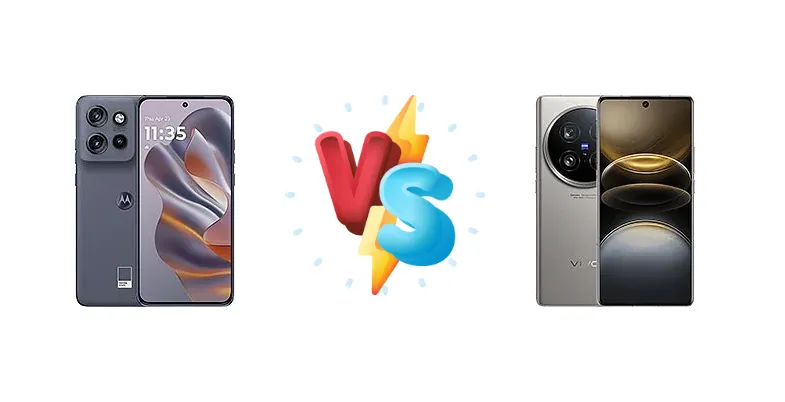
|
🏆 Quick Verdict
For the average user prioritizing raw performance and a top-tier display, the vivo X100 Ultra is the clear winner. Its Snapdragon 8 Gen 3 chipset and significantly brighter display justify the higher price. However, the Moto S50 offers a solid experience at a more accessible price point.
| PHONES | ||
|---|---|---|
| Phone Names | Motorola Moto S50 | vivo X100 Ultra |
| Network | ||
|---|---|---|
| 2G bands | GSM 850 / 900 / 1800 / 1900 | GSM 850 / 900 / 1800 / 1900 |
| 3G bands | HSDPA 850 / 900 / 2100 | HSDPA 800 / 850 / 900 / 1700(AWS) / 1900 / 2100 |
| 4G bands | LTE | 1, 2, 3, 4, 5, 7, 8, 12, 17, 18, 19, 20, 25, 26, 28, 34, 38, 39, 40, 41, 42, 66 |
| 5G bands | SA/NSA/Sub6 | 1, 2, 3, 5, 7, 8, 12, 20, 25, 26, 28, 38, 40, 41, 66, 77, 78, 79 SA/NSA |
| Speed | HSPA, LTE, 5G | HSPA, LTE, 5G |
| Technology | GSM / CDMA / HSPA / CDMA2000 / LTE / 5G | GSM / CDMA / HSPA / LTE / 5G |
| Launch | ||
|---|---|---|
| Announced | 2024, September 05 | 2024, May 13 |
| Status | Available. Released 2024, September 05 | Available. Released 2024, May 28 |
| Body | ||
|---|---|---|
| Build | Glass front (Gorilla Glass 3), plastic frame, plastic back or silicone polymer (eco leather) back | Glass front, glass back, aluminum frame |
| Dimensions | 154.1 x 71.2 x 8.1 mm (6.07 x 2.80 x 0.32 in) | 164.1 x 75.6 x 9.2 mm (6.46 x 2.98 x 0.36 in) |
| SIM | Nano-SIM + Nano-SIM | Nano-SIM + Nano-SIM |
| Weight | 170 g (6.00 oz) | 229 g (8.08 oz) |
| Display | ||
|---|---|---|
| Resolution | 1272 x 2670 pixels, 19:9 ratio (~460 ppi density) | 1440 x 3200 pixels, 20:9 ratio (~517 ppi density) |
| Size | 6.36 inches, 103.5 cm2 (~94.4% screen-to-body ratio) | 6.78 inches, 111.4 cm2 (~89.8% screen-to-body ratio) |
| Type | LTPO P-OLED, 1B colors, 120Hz, HDR10+, 3000 nits (peak) | LTPO AMOLED, 1B colors, 120Hz, Dolby Vision, HDR, 3000 nits (peak) |
| Platform | ||
|---|---|---|
| CPU | Octa-core (4x2.5 GHz Cortex-A78 & 4x2.0 GHz Cortex-A55) | Octa-core (1x3.3 GHz Cortex-X4 & 3x3.2 GHz Cortex-A720 & 2x3.0 GHz Cortex-A720 & 2x2.3 GHz Cortex-A520) |
| Chipset | Mediatek Dimensity 7300 (4 nm) | Qualcomm SM8650-AB Snapdragon 8 Gen 3 (4 nm) |
| GPU | Mali-G615 MC2 | Adreno 750 |
| OS | Android 14 | Android 14, upgradable to Android 15, OriginOS 5 |
| Memory | ||
|---|---|---|
| Card slot | No | No |
| Internal | 256GB 12GB RAM, 512GB 12GB RAM | 256GB 12GB RAM, 512GB 16GB RAM, 1TB 16GB RAM |
| Main Camera | ||
|---|---|---|
| Features | LED flash, HDR, panorama | Laser AF, color spectrum sensor, Zeiss optics, Zeiss T* lens coating, LED flash, panorama, HDR, 3D LUT import |
| Triple | 50 MP, f/1.9, (wide), 1/1.5", 1.0µm, multi-directional PDAF, OIS 10 MP, f/2.0, 73mm (telephoto), 1.0µm, PDAF, OIS, 3x optical zoom 13 MP, f/2.2, 13mm, 123˚ (ultrawide), 1.12µm, PDAF | 50 MP, f/1.8, 23mm (wide), 1/0.98", 1.6µm, dual pixel PDAF, gimbal OIS 200 MP, f/2.7, 85mm (periscope telephoto), 1/1.4", 0.56µm, multi-directional PDAF, OIS, 3.7x optical zoom, macro 3.4:1 50 MP, f/2.2, 14mm, 116˚ (ultrawide), 1/2.0", 0.8µm, AF |
| Video | 4K@30fps, 1080p@30/60/120/240fps, gyro-EIS | 8K@30fps, 4K@30/60/120fps, 1080p@30/60/120/240fps, gyro-EIS, Dolby Vision HDR |
| Selfie camera | ||
|---|---|---|
| Features | HDR | HDR |
| Single | 32 MP, f/2.4, (wide), 0.7µm | 50 MP, f/2.5, 24mm (wide), 1/2.76", 0.64µm, AF |
| Video | 4K@30fps, 1080p@30/60/120fps | 4K@30/60fps, 1080p@30/60fps |
| Sound | ||
|---|---|---|
| 35mm jack | No | No |
| Loudspeaker | Yes, with stereo speakers | Yes, with stereo speakers |
| Comms | ||
|---|---|---|
| Bluetooth | 5.3, A2DP, LE | 5.4, A2DP, LE, aptX HD, aptX Adaptive, aptX Lossless, LHDC |
| Infrared port | - | Yes |
| NFC | Yes | Yes |
| Positioning | GPS, GLONASS, GALILEO | GPS (L1+L5), BDS (B1I+B1c+B2a), GALILEO (E1+E5a), QZSS (L1+L5), GLONASS |
| Radio | No | No |
| USB | USB Type-C 2.0 | USB Type-C 3.2, OTG, DisplayPort |
| WLAN | Wi-Fi 802.11 a/b/g/n/ac/6e, tri-band | Wi-Fi 802.11 a/b/g/n/ac/6/7, dual-band |
| Features | ||
|---|---|---|
| Sensors | Fingerprint (under display, optical), accelerometer, gyro, proximity, compass | Fingerprint (under display, ultrasonic), accelerometer, gyro, proximity, compass |
| Battery | ||
|---|---|---|
| Charging | 68W wired, 50% in 13 min 15W wireless | 80W wired, PD, PPS, QC, UFCS 30W wireless Reverse wired Reverse wireless |
| Type | 4310 mAh | Si/C Li-Ion 5500 mAh |
| Misc | ||
|---|---|---|
| Colors | Nautical Blue, Latte, Poinciana | Titanium, White, Grey |
| Models | XT2309-5 | V2366GA, V2366HA |
| Price | About 280 EUR | About 980 EUR |
Motorola Moto S50
- More affordable price point
- Decent performance for everyday tasks
- Respectable 68W wired charging
- Significantly less powerful chipset
- Likely inferior display quality
- Limited camera capabilities compared to the X100 Ultra
vivo X100 Ultra
- Top-tier Snapdragon 8 Gen 3 performance
- Exceptionally bright and likely LTPO display
- Fast 80W wired and 30W wireless charging with reverse charging
- Higher price tag
- Potential for thermal throttling under sustained load (requires further testing)
- Larger size and weight
Display Comparison
The vivo X100 Ultra’s display immediately stands out with a measured peak brightness of 1801 nits, offering exceptional visibility even in direct sunlight. While the Moto S50’s display specs are not provided, it’s likely to be significantly dimmer. The X100 Ultra’s panel likely utilizes LTPO technology for adaptive refresh rates, conserving battery life while maintaining smooth visuals – a feature not confirmed for the Moto S50. The X100 Ultra’s superior brightness will be particularly beneficial for outdoor use and HDR content consumption.
Camera Comparison
Without detailed camera specifications for the Moto S50, a direct comparison is limited. However, the vivo X100 Ultra is expected to feature a more sophisticated camera system, likely including a larger main sensor and advanced image processing capabilities. The X100 Ultra’s image processing will likely prioritize detail and dynamic range, while the Moto S50 will likely focus on providing a balanced, all-around camera experience. The X100 Ultra’s superior processing power will also enable faster image capture and more advanced computational photography features.
Performance
The core difference lies in the chipsets: the Motorola Moto S50 utilizes the Mediatek Dimensity 7300 (4nm), while the vivo X100 Ultra is powered by the Qualcomm Snapdragon 8 Gen 3 (4nm). The Snapdragon 8 Gen 3’s CPU configuration – 1x3.3 GHz Cortex-X4, 3x3.2 GHz Cortex-A720, 2x3.0 GHz Cortex-A720, and 2x2.3 GHz Cortex-A520 – represents a significant architectural leap over the Moto S50’s 4x2.5 GHz Cortex-A78 & 4x2.0 GHz Cortex-A55. This translates to substantially faster processing speeds and improved graphics performance on the X100 Ultra, particularly in demanding applications and games. While both are 4nm chips, the Snapdragon 8 Gen 3 benefits from Qualcomm’s advanced manufacturing process and optimizations.
Battery Life
The vivo X100 Ultra boasts an impressive active use battery score of 12:55h, indicating excellent battery life. The Moto S50 offers 68W wired charging, reaching 50% in 13 minutes, and 15W wireless charging. The X100 Ultra counters with 80W wired charging (supporting PD, PPS, QC, UFCS) and 30W wireless charging, alongside reverse wired and wireless charging capabilities. While the Moto S50’s charging speed is respectable, the X100 Ultra’s faster wired and wireless charging, combined with its longer battery life, provides a more convenient and versatile charging experience.
Buying Guide
Buy the Motorola Moto S50 if you need a reliable daily driver with decent performance for everyday tasks and moderate gaming, and value affordability. Buy the vivo X100 Ultra if you demand the absolute best in processing power, a stunning display, and are willing to pay a premium for a flagship experience geared towards power users and content creators.