
Moto S50 vs. Samsung Galaxy S24 FE: A Deep Dive into Mid-Range Champions
| Phones Images | |||||
|---|---|---|---|---|---|
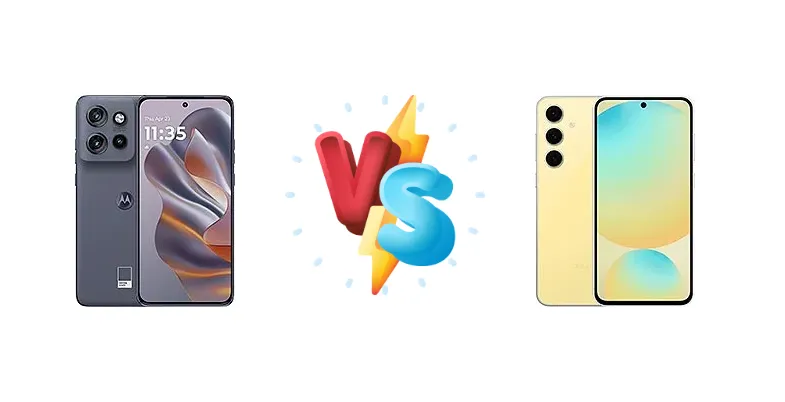
|
🏆 Quick Verdict
For the average user prioritizing longevity and a refined software experience, the Samsung Galaxy S24 FE emerges as the better choice. Its superior battery endurance, measured at 42 hours, and brighter display outweigh the Moto S50’s faster 68W charging. However, gamers on a budget may find the S50’s Dimensity 7300 a compelling alternative.
| PHONES | ||
|---|---|---|
| Phone Names | Motorola Moto S50 | Samsung Galaxy S24 FE |
| Network | ||
|---|---|---|
| 2G bands | GSM 850 / 900 / 1800 / 1900 | GSM 850 / 900 / 1800 / 1900 |
| 3G bands | HSDPA 850 / 900 / 2100 | HSDPA 850 / 900 / 1700(AWS) / 1900 / 2100 |
| 4G bands | LTE | 1, 2, 3, 4, 5, 7, 8, 12, 17, 18, 19, 20, 25, 26, 28, 32, 38, 40, 41, 66 - International |
| 5G bands | SA/NSA/Sub6 | 1, 2, 3, 5, 7, 8, 12, 20, 25, 26, 28, 38, 40, 41, 66, 75, 77, 78 SA/NSA/Sub6 - International |
| Speed | HSPA, LTE, 5G | HSPA, LTE, 5G |
| Technology | GSM / CDMA / HSPA / CDMA2000 / LTE / 5G | GSM / HSPA / LTE / 5G |
| Launch | ||
|---|---|---|
| Announced | 2024, September 05 | 2024, September 26 |
| Status | Available. Released 2024, September 05 | Available. Released 2024, October 03 |
| Body | ||
|---|---|---|
| Build | Glass front (Gorilla Glass 3), plastic frame, plastic back or silicone polymer (eco leather) back | Glass front (Gorilla Glass Victus+), glass back (Gorilla Glass Victus+), aluminum frame |
| Dimensions | 154.1 x 71.2 x 8.1 mm (6.07 x 2.80 x 0.32 in) | 162 x 77.3 x 8 mm (6.38 x 3.04 x 0.31 in) |
| SIM | Nano-SIM + Nano-SIM | · Nano-SIM· Nano-SIM + Nano-SIM· Nano-SIM + eSIM· eSIM + eSIM |
| Weight | 170 g (6.00 oz) | 213 g (7.51 oz) |
| Display | ||
|---|---|---|
| Protection | - | Corning Gorilla Glass Victus+, Mohs level 5 |
| Resolution | 1272 x 2670 pixels, 19:9 ratio (~460 ppi density) | 1080 x 2340 pixels, 19.5:9 ratio (~385 ppi density) |
| Size | 6.36 inches, 103.5 cm2 (~94.4% screen-to-body ratio) | 6.7 inches, 110.2 cm2 (~88.0% screen-to-body ratio) |
| Type | LTPO P-OLED, 1B colors, 120Hz, HDR10+, 3000 nits (peak) | Dynamic AMOLED 2X, 120Hz, HDR10+, 1900 nits (peak) |
| Platform | ||
|---|---|---|
| CPU | Octa-core (4x2.5 GHz Cortex-A78 & 4x2.0 GHz Cortex-A55) | 10-core (1x3.1 GHz + 2x2.9 GHz + 3x2.6 GHz + 4x1.95 GHz) |
| Chipset | Mediatek Dimensity 7300 (4 nm) | Exynos 2400e (4 nm) |
| GPU | Mali-G615 MC2 | Xclipse 940 |
| OS | Android 14 | Android 14, up to 7 major Android upgrades, One UI 8.0 |
| Memory | ||
|---|---|---|
| Card slot | No | No |
| Internal | 256GB 12GB RAM, 512GB 12GB RAM | 128GB 8GB RAM, 256GB 8GB RAM, 512GB 8GB RAM |
| Main Camera | ||
|---|---|---|
| Features | LED flash, HDR, panorama | LED flash, HDR, panorama |
| Triple | 50 MP, f/1.9, (wide), 1/1.5", 1.0µm, multi-directional PDAF, OIS 10 MP, f/2.0, 73mm (telephoto), 1.0µm, PDAF, OIS, 3x optical zoom 13 MP, f/2.2, 13mm, 123˚ (ultrawide), 1.12µm, PDAF | 50 MP, f/1.8, 24mm (wide), 1/1.57", 1.0µm, dual pixel PDAF, OIS 8 MP, f/2.4, 75mm (telephoto), 1/4.4", 1.0µm, PDAF, OIS, 3x optical zoom 12 MP, f/2.2, 13mm, 123˚ (ultrawide), 1/3.0", 1.12µm |
| Video | 4K@30fps, 1080p@30/60/120/240fps, gyro-EIS | 8K@30fps, 4K@30/60/120fps, 1080p@30/60/120/240fps |
| Selfie camera | ||
|---|---|---|
| Features | HDR | - |
| Single | 32 MP, f/2.4, (wide), 0.7µm | 10 MP, f/2.4, 26mm (wide), 1/3.0", 1.22µm |
| Video | 4K@30fps, 1080p@30/60/120fps | 4K@30/60fps, 1080p@30/60fps; gyro-EIS |
| Sound | ||
|---|---|---|
| 35mm jack | No | No |
| Loudspeaker | Yes, with stereo speakers | Yes, with stereo speakers |
| Comms | ||
|---|---|---|
| Bluetooth | 5.3, A2DP, LE | 5.3, A2DP, LE |
| NFC | Yes | Yes |
| Positioning | GPS, GLONASS, GALILEO | GPS, GLONASS, GALILEO, BDS |
| Radio | No | Unspecified |
| USB | USB Type-C 2.0 | USB Type-C 3.2, OTG |
| WLAN | Wi-Fi 802.11 a/b/g/n/ac/6e, tri-band | Wi-Fi 802.11 a/b/g/n/ac/6e, dual-band or tri-band (market/region dependent), Wi-Fi Direct |
| Features | ||
|---|---|---|
| Sensors | Fingerprint (under display, optical), accelerometer, gyro, proximity, compass | Fingerprint (under display, optical), accelerometer, gyro, compass |
| Battery | ||
|---|---|---|
| Charging | 68W wired, 50% in 13 min 15W wireless | 25W wired, PD, QC2, 50% in 30 min 15W wireless Reverse wireless |
| Type | 4310 mAh | 4700 mAh |
| Misc | ||
|---|---|---|
| Colors | Nautical Blue, Latte, Poinciana | Blue, Graphite, Gray, Mint, Yellow |
| Models | XT2309-5 | SM-S721B, SM-S721B/DS, SM-S721U1, SM-S721U, SM-S721W, SM-S7210, SM-S721N |
| Price | About 280 EUR | $ 249.74 / C$ 498.99 / £ 335.00 / € 387.00 / ₹ 34,180 |
| SAR | - | 0.94 W/kg (head) 0.71 W/kg (body) |
| SAR EU | - | 0.86 W/kg (head) 1.29 W/kg (body) |
| EU LABEL | ||
|---|---|---|
| Battery | - | 42:00h endurance, 2000 cycles |
| Energy | - | Class B |
| Free fall | - | Class A (270 falls) |
| Repairability | - | Class C |
Motorola Moto S50
- Faster 68W wired charging
- Potentially better gaming performance due to Dimensity 7300
- More affordable price point (likely)
- Unknown display quality and brightness
- Limited battery endurance information
- Uncertain long-term software support
Samsung Galaxy S24 FE
- Exceptional 42-hour battery life
- Bright and color-accurate display (1372 nits)
- Samsung’s software ecosystem and long-term support
- Slower 25W wired charging
- Exynos 2400e may throttle under heavy load
- Higher price compared to the Moto S50 (likely)
Display Comparison
The Samsung Galaxy S24 FE boasts a significantly brighter display, reaching a measured 1372 nits, making it far more usable in direct sunlight compared to the Moto S50 (brightness data unavailable). While the S50’s panel specifics are unknown, the S24 FE’s brightness advantage is substantial. The S24 FE likely employs a higher-quality panel with better color accuracy, benefiting content creators and media consumers. The absence of LTPO technology on either device suggests both will rely on adaptive refresh rates to conserve power, but the S24 FE’s superior brightness will be more noticeable in everyday use.
Camera Comparison
Without detailed camera specs for the Moto S50, a direct comparison is limited. However, Samsung typically excels in image processing, and the S24 FE likely benefits from this expertise. The S24 FE’s image processing will likely prioritize vibrant colors and detail enhancement, while the S50’s approach is unknown. The absence of information regarding OIS on the S50 is concerning, suggesting the S24 FE will offer superior stabilization for photos and videos. Ignoring the likely presence of low-resolution auxiliary cameras on both devices, the primary sensor quality and software processing will be the key differentiators.
Performance
The Exynos 2400e in the S24 FE, with its 10-core architecture and peak clock speed of 3.1 GHz, appears more powerful on paper than the Moto S50’s Dimensity 7300. However, the Dimensity 7300’s 4nm process node is comparable to the Exynos 2400e’s, suggesting similar efficiency. The S24 FE’s more complex CPU configuration may offer benefits in multi-threaded tasks, while the S50’s Cortex-A78 cores provide strong single-core performance. Real-world performance will depend on thermal management; the S24 FE’s larger chassis may provide better cooling, mitigating potential throttling under sustained load. The S50’s focus on gaming suggests optimizations for graphics performance.
Battery Life
The Samsung Galaxy S24 FE’s battery life is a clear advantage. Its 42-hour endurance rating and 11:48-hour active use score demonstrate superior efficiency. While the Moto S50 offers faster 68W wired charging (50% in 13 minutes), the S24 FE’s longer battery life reduces the need for frequent top-ups. The S24 FE’s 2000 charge cycles suggest a longer lifespan, while the S50’s 25W charging (50% in 30 minutes) is slower. Both devices support 15W wireless charging, and the S24 FE adds the convenience of reverse wireless charging.
Buying Guide
Buy the Motorola Moto S50 if you need a phone primarily for gaming and fast charging is a top priority. The Dimensity 7300 offers solid performance for the price, and the 68W charging gets you back up and running quickly. Buy the Samsung Galaxy S24 FE if you prefer a phone with exceptional battery life, a brighter and more color-accurate display, and the long-term software support and ecosystem benefits that Samsung provides.